
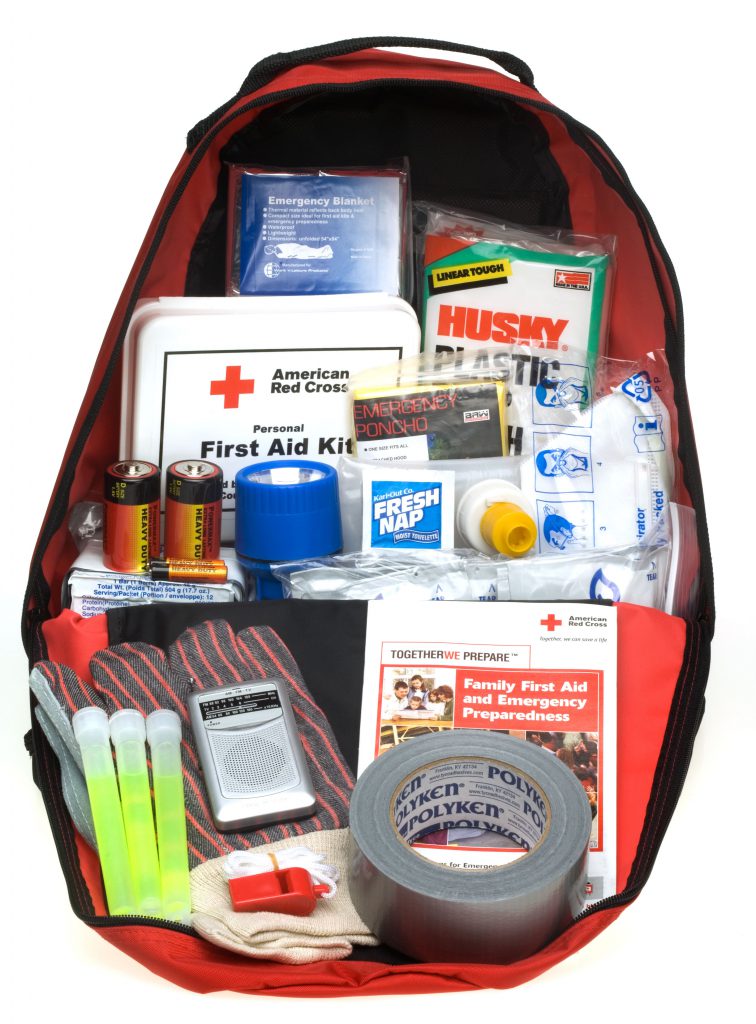
A bug-out bag as insurance against disaster
The COVID-19 pandemic made us realise how little it takes to shake our civilisation. We learnt that it will not always be possible to simply pop to the shop and buy whatever we need at that moment. Many of us started wondering back then: “what if a crisis like this, or a bigger one, happens again?”
[UPDATE] The outbreak of war in Ukraine got us wondering “what if…?”. What if war breaks out here? What if bombs start falling on my neighbourhood? What if we run out of food, water or electricity?
In 2025 the Polish government published its Safety Guide (Poradnik bezpieczeństwa) with a list of things to pack in an evacuation bag. In this article you will find that official list, my comments on the individual items, the things that are easy to forget (family, children, pets, a meeting plan) and, at the end, a checklist as a PDF that you can print and tick off as you pack.
Of course, there is no one-size-fits-all solution here; the idea is rather to improve your chances of survival. A so-called grab bag, also known as an evacuation bag, can help you with that. It is also called a bug-out bag or, for short, BOB.
You need to survive 72 hours
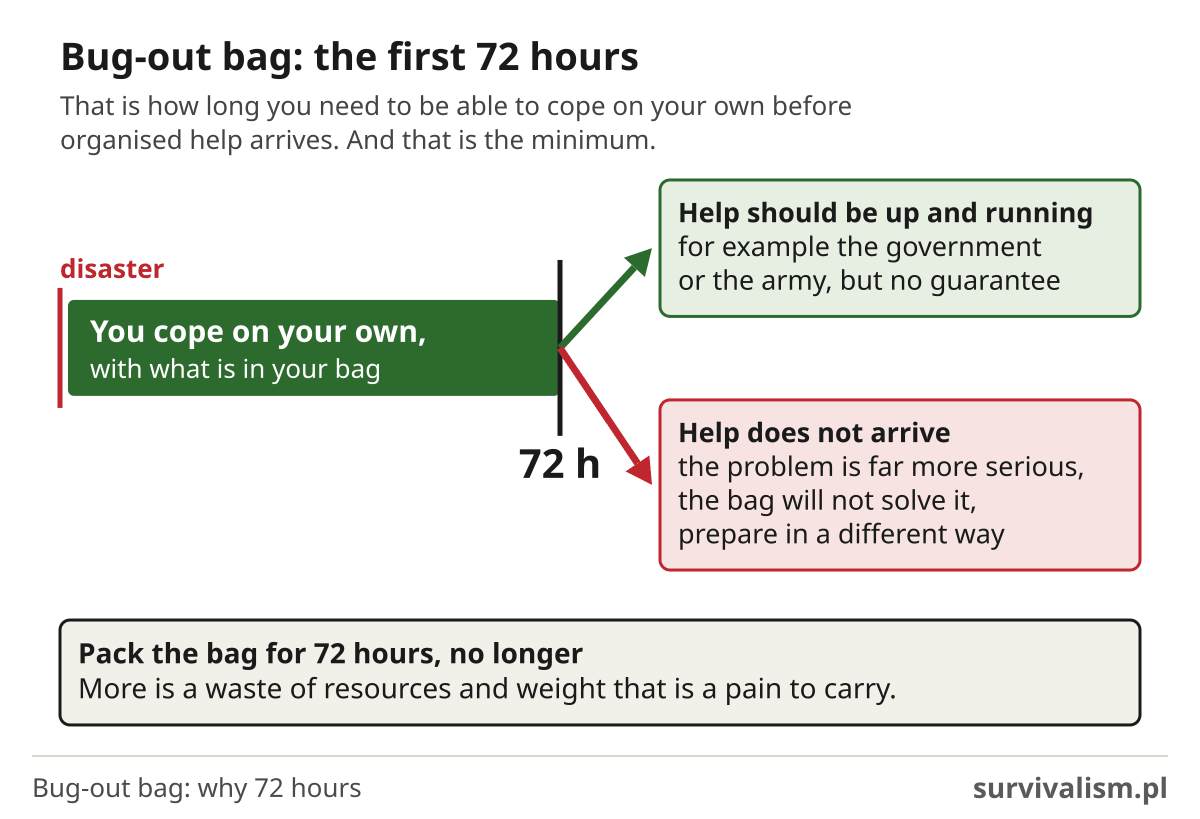
Your bug-out bag will hold the essentials that let you survive for at least 72 hours.
72 hours happens to be the period during which - after a sudden disaster - you need to be able to cope on your own before organised help arrives. And that is the minimum1. Once 72 hours have passed, organised help, for example from the government or the army, should be up and running, but there is no guarantee of that.
If help has not arrived by then, it means the problem is far more serious and not one we can solve even with the best-equipped backpack. For that scenario you need to prepare in a different way.
See also: I cover preparing for a longer crisis in a much more extensive article on blackouts. It has more detailed information on how to survive, as well as accounts from people who lived through a war in a besieged city. It will tell you what to do in the first hours, days and months after a war breaks out or the electricity supply is cut off.
That is why there is no point packing a bug-out bag with enough to last you longer than 72 hours. It would be a waste of resources, and an overloaded evacuation bag can also be a pain to carry. Unless, of course, you are planning to run off to the Bieszczady (remote mountains in south-eastern Poland, the classic place Poles dream of escaping to) and set up a winter camp there 😉
Where we live matters too, as Rob mentioned in his comment. If we live in the countryside near a forest, we will take different gear (probably with more emphasis on camping kit) than if we live in a big city.
You pointed out to me in the comments that the list could do with a few extra items. Thank you for those suggestions. When I updated the article in 2026, the list grew, among other things with items from the government’s Safety Guide, and at the end of the article you will find a printable checklist as a PDF.
Use your imagination, improvise
There is no single recipe for the perfectly equipped evacuation bag, but every one should contain at least a few basic items essential for survival, which I will try to list in the rest of this article.
The list below is my suggestion, not a closed list. It is only meant to point out a few obvious pieces of kit that, for one reason or another, I consider essential.
Even a bag with just a few of the most basic items listed here can decide whether you survive. You can (and, if need be, you should!) improvise - no penknife to hand? Take a kitchen knife. Survivalism is not just knowledge and equipment; above all, it is a state of mind. To survive, you have to think the right way (I write about how people who prepare for a crisis think in the article Who is a prepper).
What does the government’s Safety Guide say to pack?
Let’s start with the official list. The Safety Guide advises that every member of the household, even children, should have an evacuation bag, and lists the following for it:
- bottled water and water filters or purification tablets
- a first aid kit and personal medicines, toiletries and disinfectant
- documents, copies of them on a USB stick and cash in various denominations
- a torch and a battery-powered or wind-up radio, a charged phone and power bank, a charger, matching cables and spare batteries
- a penknife or multitool, a lighter, bin bags and printed maps
- high-energy, ready-to-eat food (energy bars, dried fruit, nuts)
- an important personal item, such as a photo or a family keepsake
- clothes suited to the season, rainwear, a sleeping bag, a sleeping mat and a foil blanket
- an alternative means of communication, such as walkie-talkies
It is a good foundation and there is no point reinventing it. My list below goes category by category, it is longer, and for each group I explain what to look out for. You will also find every item from the government list in the checklist at the end of the article.
The evacuation bag itself
The first item in our evacuation kit should, of course, be a suitable backpack. You can also use an ordinary shoulder bag for this, or even a suitcase. What matters is that you can carry it easily from place to place and that it is tough and won’t fall apart when given a good yank - which, unfortunately, does sometimes happen with cheap backpacks. It also has to be roomy enough to hold everything you plan to pack in it.
Also think about whether you care more about mobility - then choose a light, small backpack, which will hold fewer things - or whether you would like to be as well prepared as possible, in which case a large framed pack will be the better choice.
Think through every side of your choice carefully, too. With a big, heavy backpack you won’t be able to move quickly over longer distances, so in that case might it be worth preparing an alternative shelter somewhere nearby that you could reach fairly quickly?
Or, if you went for a small backpack with only the basics, wouldn’t it be a good idea to hide a larger stash of supplies somewhere - for example, buried on your allotment or at a spot in the woods that only you know?
How heavy can a bug-out bag be?
There is a simple rule of thumb: a packed backpack for a trip of several days should weigh no more than about 20% of your body weight, and a daypack about 10%2. If you weigh 75 kg, that is about 15 and 7.5 kg respectively.
Now work out the water alone: 9 litres for 72 hours is about 9 kg. That is why you won’t be able to carry your whole water supply anyway, and for every item you have to ask yourself whether it is worth its weight.
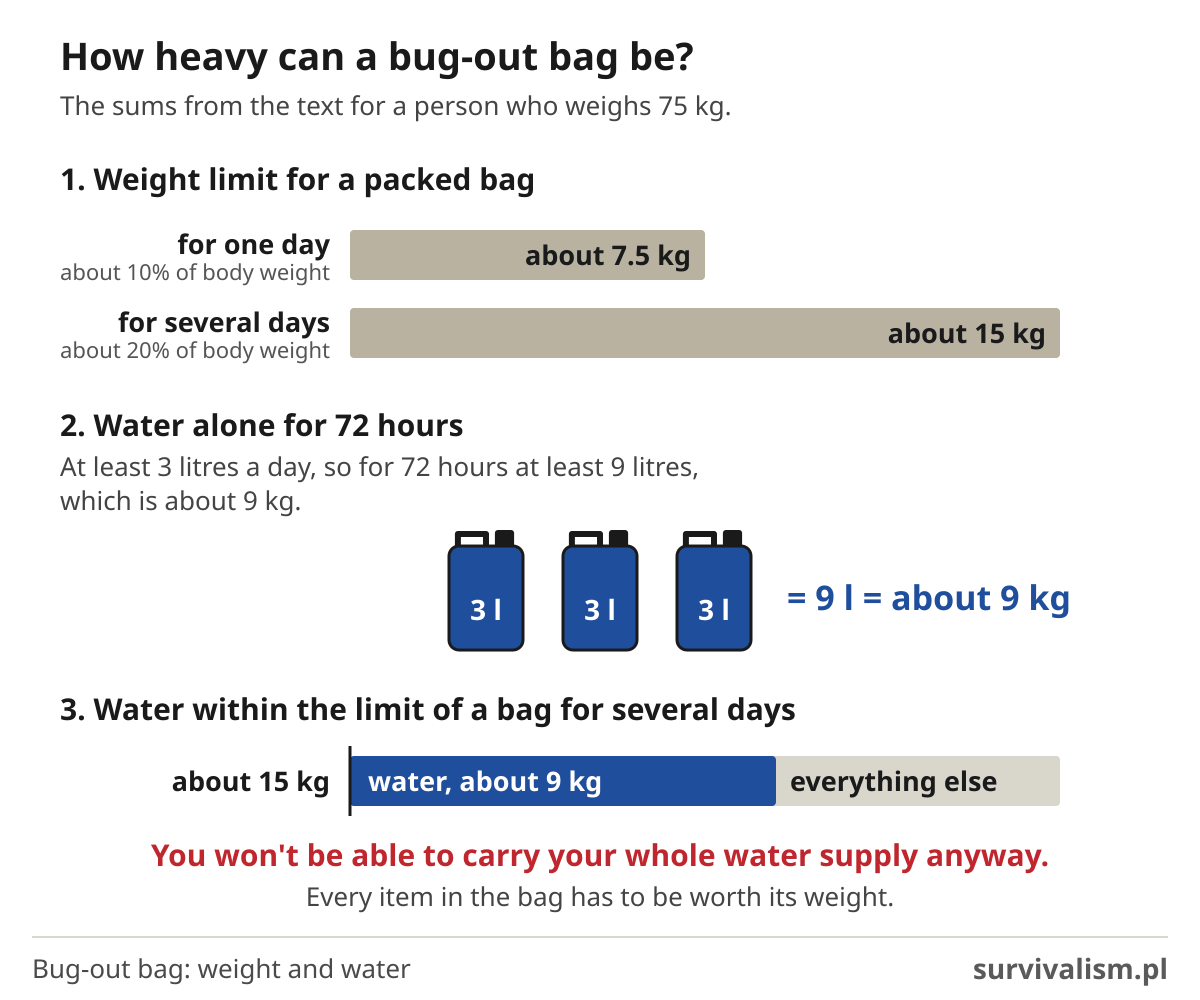
The simplest test: pack the bag completely, put it on and walk a few kilometres with it. You will soon find out what you don’t need 😉 And one more thing: the bag should stand there packed, not “to be packed”, because in an emergency there will be no time to gather things from the cupboards.
Medical supplies
Put together a first aid kit with the basics. Amazon store, affiliate link, opens in a new tab You can assemble it yourself or buy one ready-made. It should contain at least:
- bandages in various sizes or sterile gauze
- plasters, both individual ones and on a roll
- painkillers
- anti-diarrhoea medicine and oral rehydration salts (electrolyte sachets). Activated charcoal can also come in handy (the medicinal kind from a pharmacy, not barbecue charcoal), but don’t take it at the same time as other medicines, because it makes them less effective.
- antibiotic ointment. It can help you avoid infections with very serious consequences. In Poland you can buy it without a prescription (it is meant for minor cuts and grazes and used for a few days at most, as the leaflet says; a deep, puncture or dirty wound needs a doctor, and while you are at it, check that your tetanus jab is up to date).
- water purification tablets Amazon store, affiliate link, opens in a new tab
- any medicines you and your family take regularly, plus a note listing illnesses and allergies
- disposable gloves, an antiseptic for cleaning wounds and small scissors
- a tourniquet. It goes on above the wound, on the upper arm or thigh, when bleeding from a limb does not stop despite a pressure dressing, and you write down the time it was applied3. Learn how to do this in advance, ideally on a first aid course.
- a foil emergency blanket (NRC foil). Injured people lose heat faster, so the casualty needs to be covered.
Remember to check your first aid kit regularly and replace out-of-date medicines with new ones. Plasters and other dressings have a shelf life too, so it pays to go through the contents of your kit every so often.
Toiletries
Nobody needs convincing that keeping clean matters. It is especially important for your state of mind. So you mustn’t forget these basics:
- toothbrush and toothpaste
- soap (an ordinary bar of soap is the best option)
- toilet paper. You may not need it, but when you need it, you really need it 😉
- for women, sanitary pads/tampons will matter too
Here too, as with the rest of your kit, you need to strike a balance between weight and bulk on the one hand and usefulness on the other. While soap seems an essential item for keeping reasonably clean, an antiperspirant is not necessarily so.
Tools
Here the only limit is your imagination (and your strength to lug it all around), but let’s focus on the items that are most needed and essential, and that take up the least space for the most use. Pick one or more tools from the list below. Just remember that your survival backpack Amazon store, affiliate link, opens in a new tab has a limited capacity, and you can only carry so much.
- a penknife or multitool (more on multitools below the list)
- a large knife or a machete
- a small shovel or a folding entrenching tool
- pliers
- wire cutters
- a few metres of thin, flexible metal wire
- fishing line, ideally braided
- a screwdriver with interchangeable bits for different kinds of screws
There is also a whole range of multitools Amazon store, affiliate link, opens in a new tab on the market. Their big advantage is undoubtedly how compact they are. It means that one multi-purpose tool with a dozen or more functions fits in your trouser pocket.
Their weakness, especially at the cheaper end of the market, is that they are not very durable or tough. Admittedly, though, multi-purpose tools at slightly higher prices can offer decent quality and usefulness. A lot depends here on how deep your pockets are.
An important part of the kit in a bug-out bag will be a detailed map of the local area and a small-scale map of the country. It is also worth equipping our BOB with a compass Amazon store, affiliate link, opens in a new tab. And you really ought to know how to use it well in advance, because an emergency in which we need to navigate is not the best time to learn. That includes walking on a bearing: holding your direction step by step with the compass in your hand. A paper map also makes sense because GPS may not work1, and offline maps on your phone have to be downloaded beforehand. If you would like to learn more about this, have a look at the articles on maps and on the cardinal directions.
Clothes and other things to wear
Various items of clothing are an important part of an evacuation bag, especially warm, clean and dry underwear to change into.
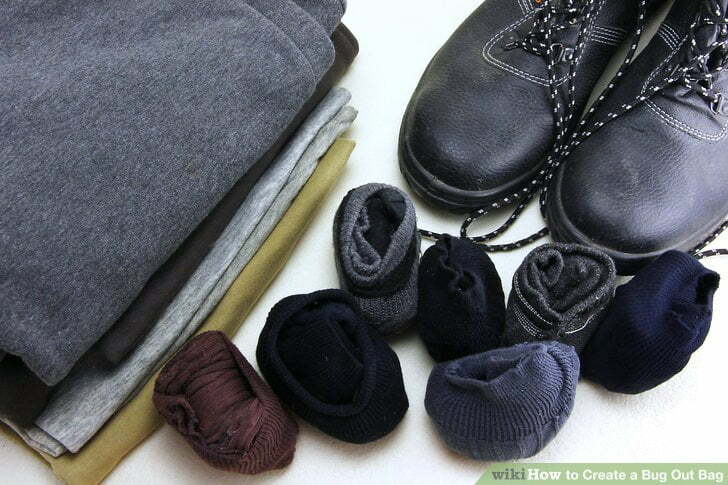
- socks
- light sports shoes
- T-shirts, thermal underwear
- briefs, boxers
- a blanket
- a hat
- gloves
- rainwear, such as a jacket or a poncho
There is a huge range of options to choose from here, but make sure you go for clothes that give you protection from cold and damp. I write about how to dress for freezing weather in the article Mountains in winter, or how not to freeze on the trail.
Water and food
A person can go a very long time without food, but only about three days without water (much less in the heat or during hard physical effort).
A full stomach and a well-hydrated body are vital for survival. As hunger and dehydration set in, our physical and mental performance will drop. So make sure your bug-out bag holds enough non-perishable food and water or - which in my opinion is the better solution - a decent water filter.
- water and a water filter. You will need at least 3 litres a day1. As simple maths tells you, 72 hours means at least 9 litres of water per person. That is why it is better to get a decent filter Amazon store, affiliate link, opens in a new tab that lets you drink water from a river or stream (a filter does not remove viruses or chemicals, though, so be careful). Water from an uncertain source is best boiled as well after filtering. Even so, take as much water as you can carry - in a city a filter is no use if there is nothing to filter.
- peanut butter, which keeps for a long time (unopened, usually from six months to two years; check the date on the jar) and is high in energy, which makes it the best option in an emergency.
- honey, which practically never goes off in a tightly sealed container. Archaeologists have found honey thousands of years old in Egyptian tombs that was still edible. Take it in a plastic bottle, not a glass jar, and remember that honey is not given to babies under one year old.
- sweet energy bars
- tinned meat or fish
- hard crackers
- sugar
- powdered milk
- dried fruit and nuts
Note that powdered milk has to be mixed with water, and hard crackers need washing down with something. So both need water, which is the heaviest load in your pack. That is why it is better to go for ready-to-eat food: energy bars, dried fruit, nuts. You can read about what else works as light food for the road in the article on food in the mountains.
With food, just as with medicines, you need to check your supplies regularly and replace anything nearing its use-by date with fresh stock.
Just bear in mind that the food you take with you shouldn’t really be planned, in quantity or quality, for a “MasterChef” cook-off and a smorgasbord. Its only job is to give you enough calories to survive 72 hours.
Camping gear
If you still have some room left in your backpack, you might also squeeze in some camping gear. This is a particularly good idea for those of us who live in the countryside or near mountains or forests. As events in Ukraine since 2022 have shown, cities are often deathtraps for civilians, so if a disaster drags on, get out of the city if you possibly can (but if the authorities announce an evacuation or tell you to shelter in place, follow the messages from the government’s RCB Alert texts, the RSO warning app or the radio, because fleeing at the wrong moment can be more dangerous than staying put).
Basic camping gear includes:
- a tent - choose a model that will comfortably fit you and your family but, at the same time, is not too big and heavy. I write about whether a tarp or a bivy might do instead of a tent in the article One-person tent, tarp or bivy?
- a sleeping bag - here too there are very light and compact options; just make sure your sleeping bag suits the weather. In summer a winter sleeping bag will be far too “hot”, while a thin summer one won’t keep you comfortably warm in winter. All things considered, the most versatile (and, sadly, expensive) option will be a warm down sleeping bag Amazon store, affiliate link, opens in a new tab.
- a sleeping mat. It is on the official list for good reason: when you sleep on the ground, you lose heat to the cold ground beneath you4, and a mat insulates you from it.
- a mini gas stove Amazon store, affiliate link, opens in a new tab that takes replaceable canisters. You can buy folding mini stoves that weigh just a few hundred grams or less
Choosing the right gear in this category is a hugely complex subject in itself, and I will try to cover it in a separate article in future.
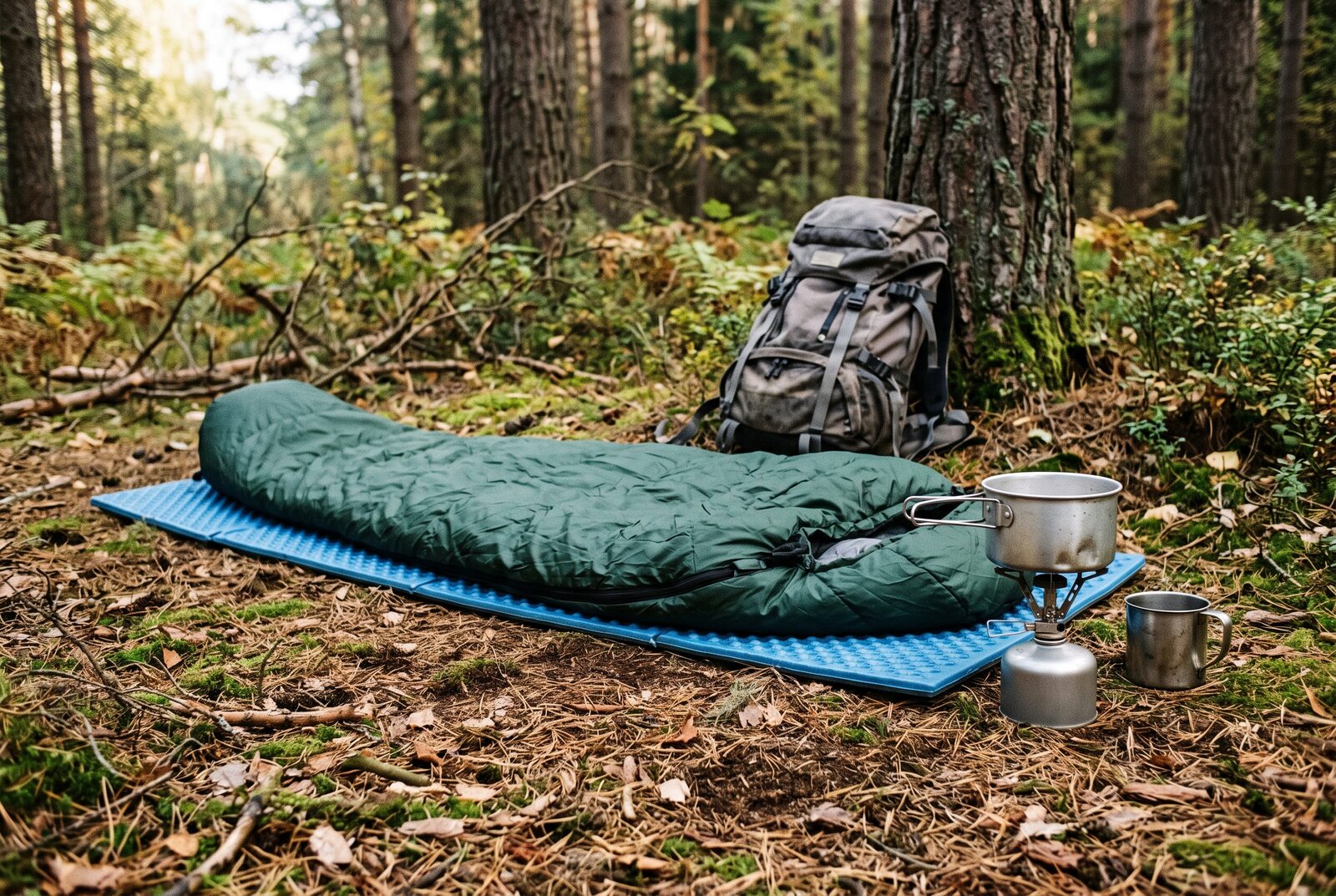
If you have never slept under the open sky, do a dress rehearsal before you have to. I write about how to prepare for it and where in Poland you can legally spend the night in the forest in the article A night in the woods, or how to have a great adventure.
Documents and other paperwork
You can also add copies of important documents, such as your passport, to your survival backpack, along with some cash in small notes or its equivalent, for example silver coins. To protect the documents from damage and getting wet, seal them in plastic bags.
Take your documents, copies of them on a USB stick and cash in various denominations1. And one more tip for an evacuation: don’t hand your documents over to people who offer you help or transport.
Phone, radio and communication
If you have an old mobile phone you no longer use, you can pack that too, together with a charged power bank, a charger and matching cables. Your phone can serve as an emergency means of communication, for example to call for help, assuming of course that the mobile network is still working.
Even without access to the mobile network, though, a smartphone can be a very handy survival tool. You can load it with various useful apps, guides, books, information and offline maps that will help you get your bearings in a crisis.
In Poland the emergency services warn of danger with sirens, on radio and television, in the Regional Warning System (RSO) app and with RCB Alerts, text messages from the Government Centre for Security sent to phones. Install the RSO app in advance, and if your phone dies, you still have a battery-powered or wind-up radio. That is why it is on my list.
When there is no signal, an alternative means of communication comes in handy: walkie-talkies (and, in the car, a CB radio as well)1. A pair of simple two-way radios will let your family talk over short distances without a mobile network.
And the simplest thing of all: write your loved ones’ phone numbers down on a piece of paper and put it in your bag. How many numbers can you dial from memory when your phone battery is dead?
Other useful things worth packing in a bug-out bag
Apart from the tools listed above, think about whether you will need anything from the list below. Once again, I stress that this is just a suggestion, from which everyone should pick whatever they consider essential.
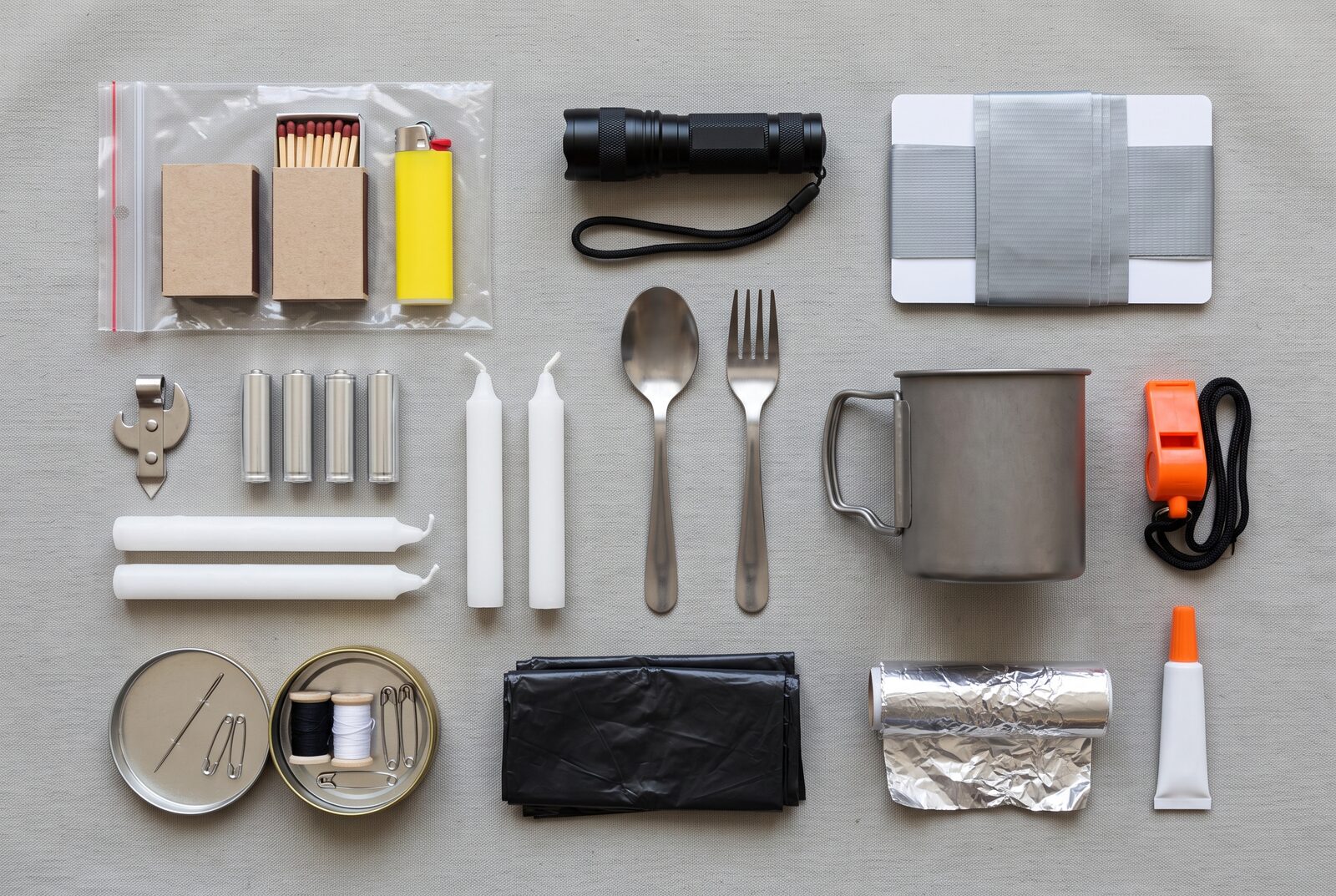
- a few boxes of matches and a lighter. Don’t forget to keep them in waterproof packaging, such as a plastic bag. You can read how to light a fire with them in the article How to light a campfire in almost any conditions.
- a small, portable radio Amazon store, affiliate link, opens in a new tab that runs on batteries Amazon store, affiliate link, opens in a new tab or a wind-up crank.
- a torch
- duct tape Amazon store, affiliate link, opens in a new tab (heavy-duty sticky tape). You can do an awful lot with this tape. It doesn’t take up much room and comes in handy in all sorts of situations. You can rewind duct tape onto something flat, for example an old credit card. That way it takes up far less space in your pack.
- a tin opener
- spare batteries Amazon store, affiliate link, opens in a new tab
- candles
- glue
- a spoon, teaspoon and fork
- a few metres of kitchen foil
- a mug
- a signal whistle
- a sewing kit
- a few strong bin bags. They will do as a poncho, a sit mat or a waterproof bag for your clothes.
- an important personal item, such as a photo of your loved ones or a family keepsake. It is on the government list, and it is not as silly as it sounds, because in a crisis your state of mind counts too.
Family and pets
Several of you raised the question of family in the comments. What do you do then? Well, I’m not sure there is much point packing your wife into the backpack. I also suspect that storing her that way for any length of time might cause a certain amount of inconvenience for both spouses 😉
Joking aside: every member of the household should have an evacuation bag, even children1. What does that mean in practice?
- A child carries a lighter bag suited to their age. Put a card in it with their full name, a parent’s or guardian’s phone number and medical information (illnesses, allergies, medicines). It is worth preparing ID cards like this for children and older people.
- If your child goes to school, write down the contact details of the person the school has designated to deal with collecting children in an emergency.
- Help an older person, someone who is ill or a person with a disability to pack their bag. Check that they have a supply of medicines and batteries for their assistive devices (hearing aid, glucose sensor).
- A pet needs its own “bag” too: food, drinking water and medicines for a few days, a lead, a collar or harness, a muzzle or carrier, plus its health records and proof of vaccinations. Put your contact details on its collar.
Where will you meet if you get separated?
The bag is not everything. Agree as a household where you will meet if you get separated and there is no way to get in touch: one place nearby and one outside your town. Write it down, together with the phone numbers, on a card in every bag. The Polish government’s „Plan na kryzys” (Crisis plan) has ready-made boxes to fill in. It is worth updating a plan like this regularly and practising it with your household.
If the authorities announce an evacuation, follow the instructions of the emergency services, and let your loved ones know that you are leaving, how and where to.
How should you store your evacuation bag?
Keep your bug-out bag somewhere easy to reach, but make sure small children and pets can’t get at it (this is mainly about the medicines and sharp tools; every member of the household, children included, should have their own, lighter bag1). Keep an eye on the use-by dates of medicines and food, too (and if you keep the bag in the car, check it more often, because heat and frost can spoil medicines, food and batteries faster). Where necessary, replace and top up anything that is about to expire.
You could also make up several bug-out bags and keep each one in a key location, for example in the boot of your car, at the office or in the garage.
Checklist
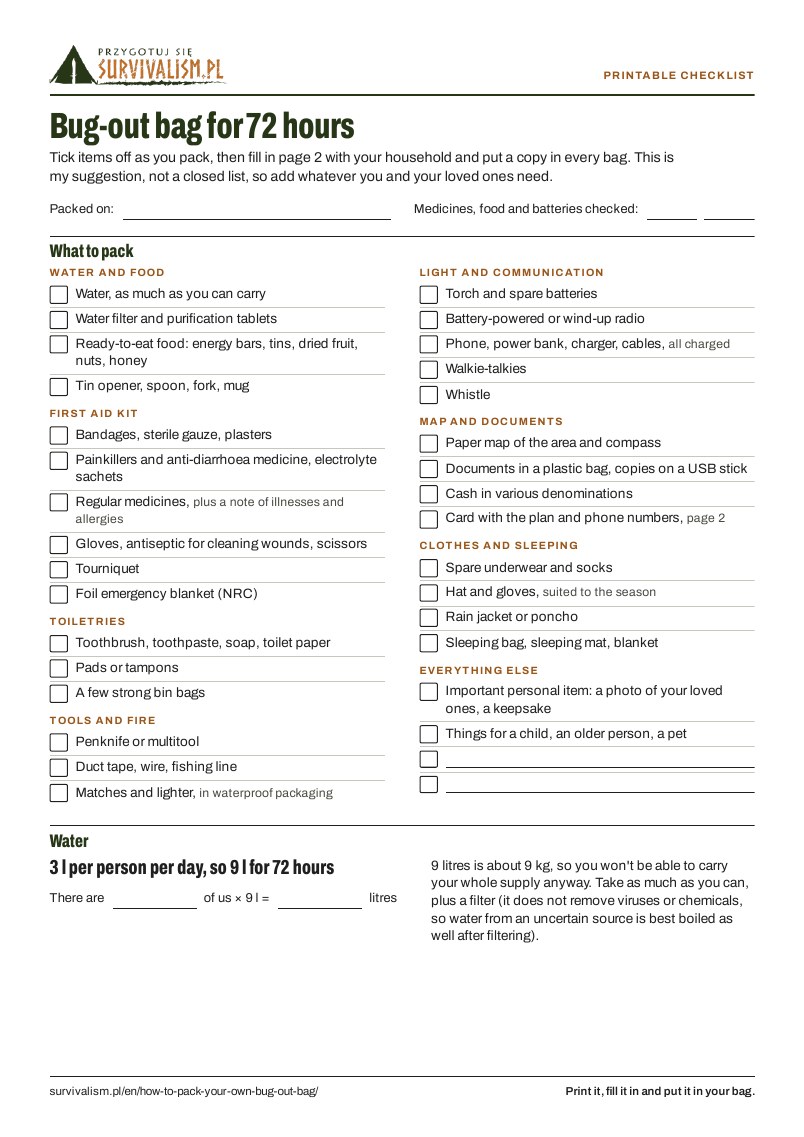
Finally, the checklist I promised. The easiest way is to download it as a PDF: two A4 pages, a list to tick off and a card for every bag with a meeting plan and emergency numbers. Print it, fill it in with your household and note the date you checked everything. It is worth going through your supplies at home every few months and checking the use-by dates1. Do the same with your bag.
| Item | Notes | Checked (date) |
|---|---|---|
| Backpack | tough, sized to what you can carry | |
| Water | as much as you can carry; you need at least 3 l per person per day | |
| Water filter and purification tablets | a filter does not remove viruses or chemicals | |
| Ready-to-eat food | bars, tins, dried fruit, nuts, honey; check the dates | |
| Tin opener, spoon, fork, mug | ||
| First aid kit | bandages, gauze, plasters, painkillers and anti-diarrhoea medicine, rehydration salts, ointment | |
| Regular medicines | plus a note of illnesses and allergies | |
| Gloves, antiseptic, scissors | ||
| Tourniquet | ||
| Foil emergency blanket (NRC) | ||
| Toiletries | toothbrush, toothpaste, soap, toilet paper, pads or tampons | |
| Bin bags | ||
| Penknife or multitool | ||
| Duct tape, wire, fishing line | ||
| Matches and lighter | in waterproof packaging | |
| Torch and spare batteries | ||
| Battery-powered or wind-up radio | ||
| Phone, power bank, charger, cables | charged | |
| Two-way radios (walkie-talkies) | ||
| Paper map and compass | ||
| Signal whistle | ||
| Documents, copies on a USB stick, cash | various denominations | |
| Card with phone numbers and the meeting place | ||
| Spare underwear and socks, hat, gloves | suited to the season | |
| Rainwear | ||
| Sleeping bag, sleeping mat, blanket | ||
| Important personal item | photo, keepsake | |
| Things for a child, a person you care for, a pet | see the section on family |
Anything else?
Is that everything? Hard to say. As I mentioned at the start, you cannot pack an evacuation bag that will work 100% in every circumstance. Besides, there would be no point building one, because it would have to weigh a ton 🙂
Or maybe you have other ideas about what to put in a bug-out bag?
Let me know in the comments.
Sources
- „Poradnik bezpieczeństwa” (Safety Guide), 2025, PDF version: coi.gov.pl (in Polish)
- REI, “How Much Should Your Pack Weigh”: rei.com
- „Poradnik bezpieczeństwa”, chapter „Pierwsza pomoc” (First aid): gov.pl (in Polish)
- REI, “Sleeping Pads”: rei.com
Leave a comment