
Water is one of the most important building blocks of our body
Water makes up as much as around 60% of an adult’s body weight, and in a newborn baby close to 80%1. Dehydration sets in when the body uses up more water than we give it. The most common causes of dehydration are physical exertion, illness, and high air temperature and/or humidity. In this article you will learn what the symptoms of dehydration are and how to prevent them, how much to drink in hot weather and on the trail, what to rehydrate with when you have diarrhoea, and how to tell dehydration from overheating.
Water deficit in the human body
Most people cope well with a relatively small deficit in total body water, around 3 - 4%, usually without much difficulty or any harmful effects on their health. At that point the symptoms of dehydration are not yet a threat to our health, but we may already feel some of its effects.
A drop in hydration of 5% to 8% can already cause tiredness and dizziness. Losing more than 10% of the body’s total water can lead to a decline in physical and mental condition, along with a very strong thirst. A deficit of 15% to 25% of the body’s water is usually fatal2.
These percentages refer to the total amount of water in the body, not to body weight. Since water makes up about 60% of body weight, losing 3 - 4% of that water comes to roughly 2% of body weight, which for someone weighing 80 kg is about 1.5 - 2 litres. Yet even a loss of that size, around 2% of body weight, already impairs concentration and physical performance, especially in hot weather3.
Symptoms of dehydration
The main symptoms of dehydration include2:
- feeling thirsty
- headaches
- general discomfort
- loss of appetite
- poor concentration
- passing less urine
- dark-coloured urine
- tiredness
- irritability
- a dry mouth
Some symptoms already point to severe dehydration or to shock. If you notice any of the following in someone, they need help immediately4:
- purple fingernails
- blue, grey, pale or blotchy lips, tongue or skin
- dry, cool skin
- fast, shallow breathing or breathlessness
- confusion
- unusual sleepiness and being hard to wake
- in extreme cases, seizures
In that case, call 112 straight away or go to A&E, but don’t drive there yourself.
In children and babies the symptoms of dehydration can be different from those in adults5:
- a dry mouth and tongue
- no tears when crying
- dry nappies for 3 hours or more
- sunken eyes and cheeks
- in babies, a sunken soft spot on the top of the head (fontanelle)
- drowsiness, lack of energy or irritability
Dehydration or overheating?
In summer on the trail, dehydration often goes hand in hand with overheating, and it is easy to mistake one for the other. Heat exhaustion shows up as tiredness, dizziness and a headache, feeling sick or being sick, heavy sweating and pale, clammy skin, cramps in the arms, legs or stomach, a raised body temperature, intense thirst and irritability6. If that happens, move somewhere cool, take off any clothing you don’t need, drink plenty of water or an electrolyte drink, and cool the skin by spraying it with water and fanning it. Things should improve within half an hour.
Heatstroke is already life-threatening: a very high body temperature, hot skin that stops sweating, fast breathing and a fast pulse, confusion, seizures or loss of consciousness. Treat overheating that hasn’t eased after 30 minutes the same way. Call for help, and until it arrives keep cooling the casualty: wrap them in a wet towel or T-shirt, fan them and wipe their skin with cold water. If they are unconscious, put them in the recovery position.
How long can a person survive without water?
It all depends on the circumstances and on the individual. It is fairly obvious that someone doing strenuous physical activity loses more water than someone who spends most of their time asleep. Air temperature and humidity also make a huge difference.
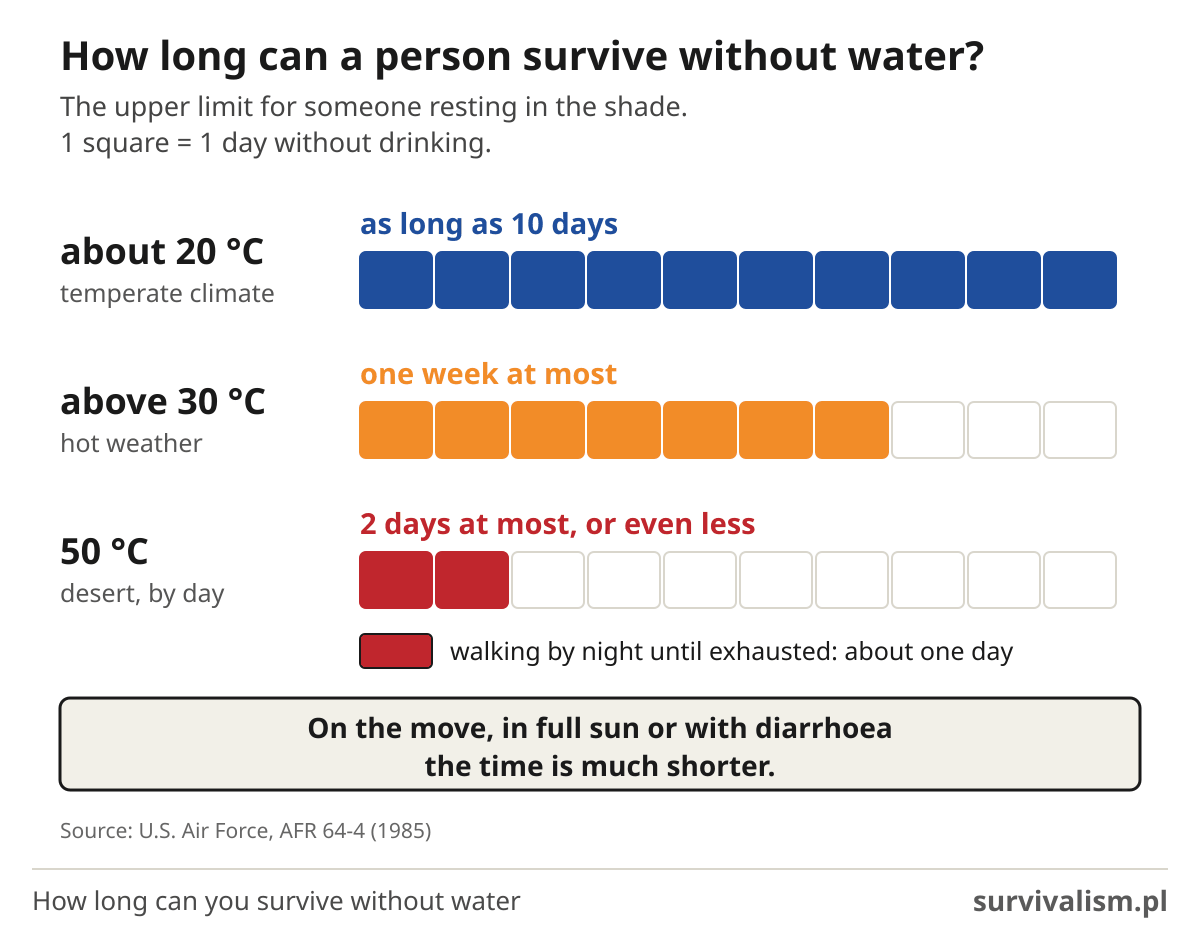
In a temperate climate, at around 20 degrees Celsius, you can last as long as 10 days without water. Above 30 degrees, however, that drops to one week at most. And in the desert, with daytime temperatures reaching 50 degrees Celsius, you are down to 2 days at most, or even less (treat these figures as the upper limit for someone resting in the shade - on the move, in full sun or with diarrhoea the time is much shorter; anyone who walks by night in that kind of heat until they are exhausted has about one day left)7.
In a crisis or an extreme situation, staying properly hydrated is absolutely key. You should keep a supply of drinking water, stored the right way. Allow at least 3 litres per person per day, for a minimum of 3 days8. That is more than the daily requirement I write about below, and that’s a good thing, because the supply also has to last in hot weather, during physical effort and for cooking. I describe how to prepare it at home in my article on blackouts in Poland, and how much water to take with you in my guide to the bug-out bag.
For one reason or another we may end up without such a supply. Then all that is left is getting water “wherever we can”. When water is short, ration your sweat, not your water: during the hottest part of the day cut down on effort and stay in the shade, and instead of rationing your water, sip it regularly9.
Boiling is the simplest way to purify water in almost any circumstances, and anyone can do it. Water often contains bacteria, parasites and other harmful things that need to be eliminated. For this you can get yourself a filter straw, the so-called life straw, which you can buy fairly cheaply, for example on Amazon (a filter like this removes bacteria and parasites, but not viruses or chemicals, so be careful). We can also build a simple filter ourselves from materials found almost anywhere, but that is a topic for a separate article.
In my own experience, most people drink less water than they actually need. Bear Grylls says that by the time you feel thirsty you are already dehydrated, so you should drink earlier, well in advance, so that you never get to the point of feeling thirsty (there is something in this, because thirst kicks in when we are already about 1 - 2% short of water11. So in hot weather and when you are sweating a lot, drink regularly, in small amounts. For exertion lasting many hours, however, sports doctors recommend drinking to thirst12, because forcing down large amounts of plain water beyond your thirst risks a dangerous drop in the level of sodium in your blood).
A hydration test
A very simple way to check how well hydrated you are is the skin test (it is only a rough guide, though, and unreliable in older people, whose skin loses its elasticity regardless of hydration - the amount and colour of your urine is a more reliable indicator, more on that below)13. To do it, pinch the skin on the back of your hand and hold it for a moment. When you let go, the skin should immediately smooth out and go back to where it was, without any creasing. If we are dehydrated, our skin will be less elastic and will keep its pinched shape for a while (a second or two).
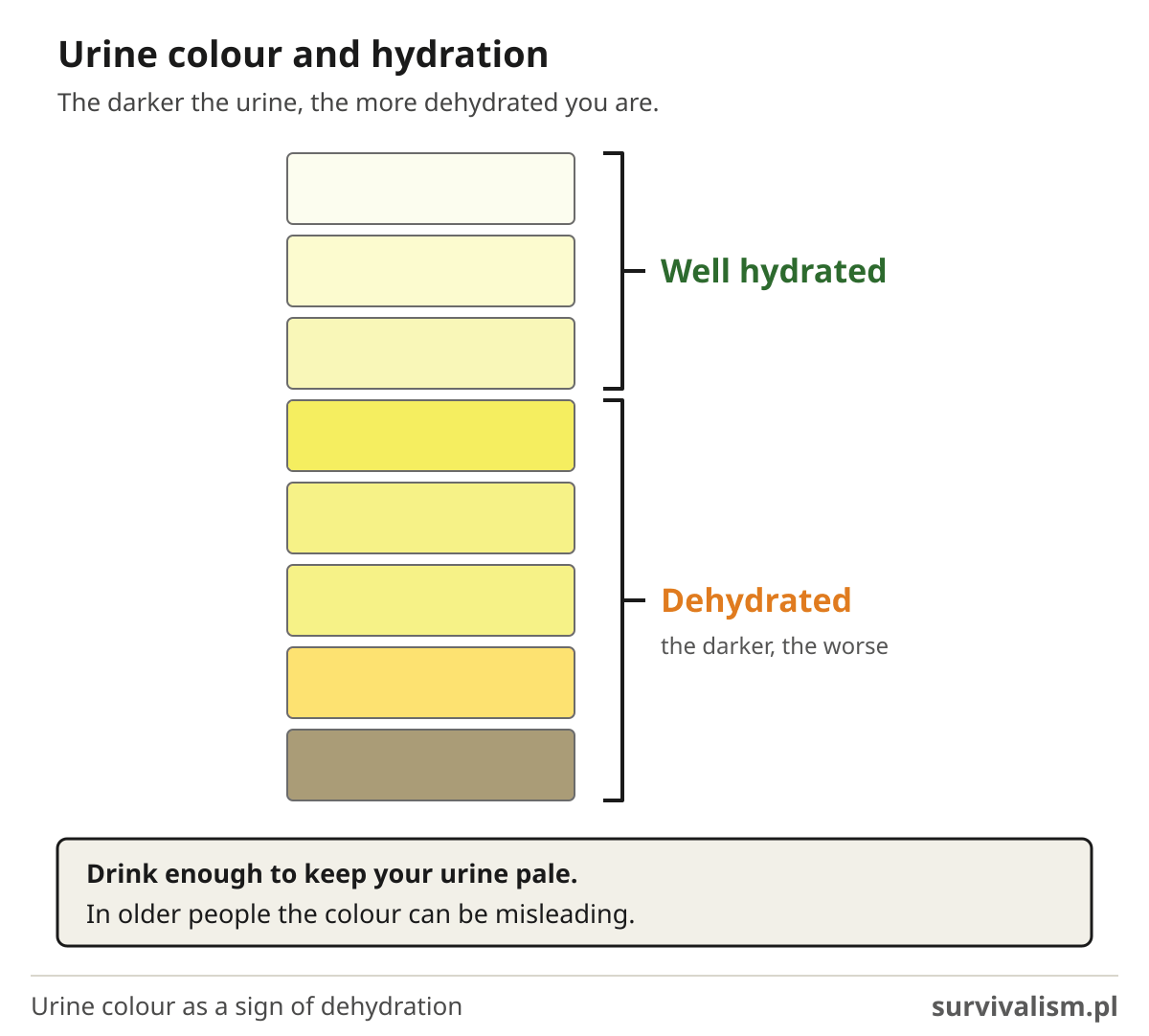
Another indicator of dehydration can be the colour of your urine. The general rule is that the darker the urine, the more dehydrated we are. So drink enough to keep your urine pale4.
The symptoms of dehydration get worse as the body’s total water loss grows. Studies have shown that even a small water loss of around 1-2%, while not dangerous to health, impairs cognitive performance11.
In older people the sense of thirst is weaker and does not match the body’s actual need for water, and on top of that it fades further with age14. Many elderly people suffer from symptoms of dehydration.
In older people, it is not only thirst and the skin test that can be unreliable, but also the colour of their urine15. If you look after an older person, don’t wait for them to ask for a drink: give them something to drink with every meal, keep a glass of water within their reach and serve foods with a lot of water in them more often, such as soup or melon.
Main causes of dehydration
There are many causes of dehydration, including4:
- high air temperature and humidity
- spending time at high altitude
- competitive and endurance sports
- various chronic illnesses
- not feeling thirsty
- taking medicines and other substances that dehydrate the body
- diarrhoea and vomiting
- a fever
- too much alcohol
Dehydration happens when water intake is lower than the amount the body loses through normal physiological processes, such as:
- breathing
- urinating
- sweating
How can you prevent dehydration?
In everyday life, thirst is usually a good enough signal to keep us properly hydrated. According to some experts, however, by the time we feel thirsty we are already dehydrated. So we should drink in advance, as it were - before thirst even sets in.
The minimum daily water intake varies with body weight, environment, diet, appetite, exertion and genetics. There is no single, fixed amount of water you should drink every day. As a rough guide, the figure used is 2 litres a day for women and 2.5 litres for men, including water from food16. In hot weather and during exertion you need more.
A marathon runner will need a great deal more water than someone who spends all day at a desk in an air-conditioned room. It is also worth knowing that we take in water not only as drinks but also through food. For example, many fruits and vegetables are more than 90% water.
In a warm, humid environment, for instance in the tropics, or during very intense exercise, the body’s water loss can rise sharply, because humans have a large and variable capacity to actively produce sweat. In men, water lost through sweat during sporting events can exceed 2 litres an hour, and during very intense, short bursts of effort in the heat it can reach as much as 3 - 4 litres an hour17!

During intense physical effort the body also loses electrolytes in sweat, especially sodium, which is essential for, among other things, a properly working heart. So when you are working hard physically, remember not only to replace the water you have lost but also to top up your electrolytes, mainly the sodium mentioned above.
How much should you drink in hot weather and on the trail?
For moderate exertion in the heat, a simple rule works well: a glass of water (about 250 ml) every 15 - 20 minutes, but no more than about 6 glasses (about 1.4 litres) an hour. If you are sweating for many hours, replace some of the water with an electrolyte drink18.
You can find out how much sweat you personally lose with no equipment other than a set of scales: weigh yourself before you set off and when you get back, in the same dry clothes, and add whatever you drank along the way. Every kilogram of difference is roughly a litre of sweat. If after the hike you weigh more than 2% less than before it (at 80 kg that is about 1.6 kg), drink more next time19.
In winter it is easy to forget about drinking, because in freezing weather thirst is weaker, which I write about in my article on the mountains in winter.
Rehydrating the body
With a small water loss, the simplest and most effective way to rehydrate is to drink plenty of fluids and cut down on the ways you are losing them. As with everything, though, moderation is advisable here too. Drinking too much water in a short time can lead to serious health complications, even death.
Drinking a large amount of water quickly upsets the body’s electrolyte balance. This disturbance of the body’s water balance is called hypotonic overhydration, or in other words: water intoxication. A telling example is a radio competition from 2007. The aim was to drink as much water as possible in a very short time. It ended tragically for one of the contestants: a woman who drank 7.5 litres died at home later that same day20.
The same thing happens on long hikes and in endurance races. Anyone who keeps drinking plain water beyond their thirst for many hours dilutes the sodium in their blood. This shows up as a headache, vomiting and confusion, in more severe cases as seizures, and without quick help it can be fatal12. The simplest protection: drink when you feel thirsty, and don’t force water down.
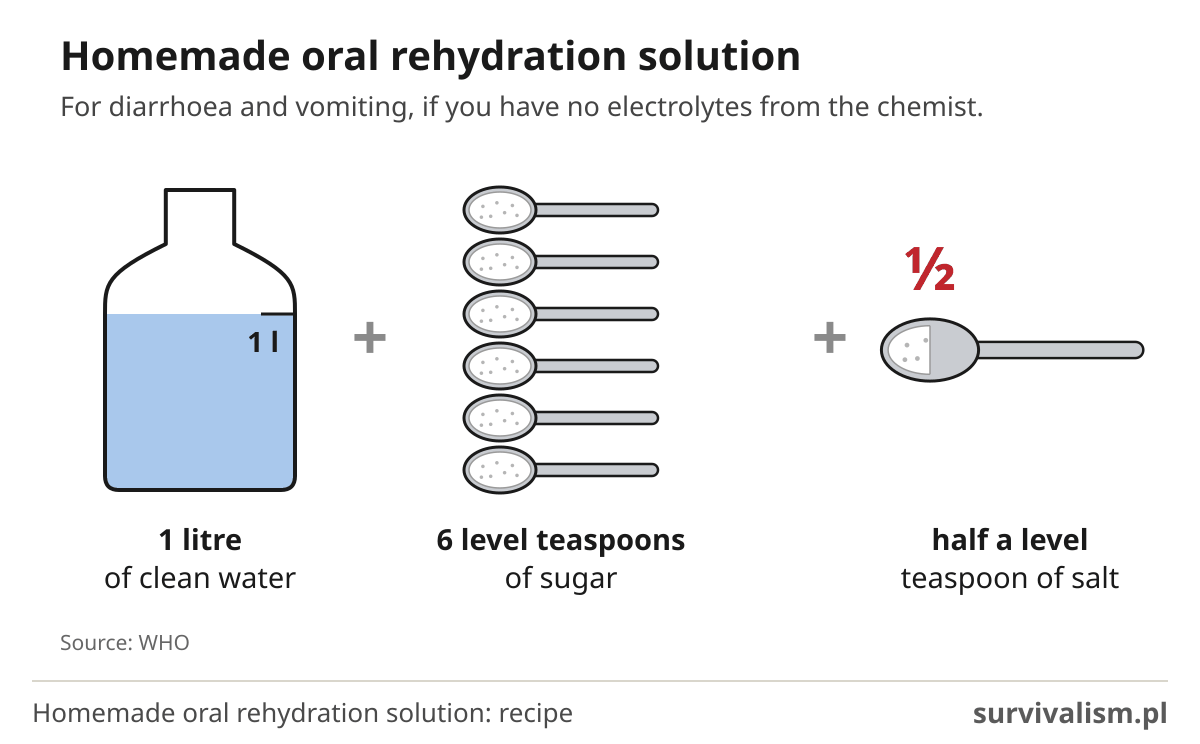
With diarrhoea and vomiting, water alone is not enough, because we lose salt along with the water. The best thing then is an oral rehydration solution (electrolytes from the chemist), and if you don’t have one, you can make it yourself: 6 level teaspoons of sugar and half a level teaspoon of salt to 1 litre of clean water21. In extreme cases of dehydration, drinking water may not be enough. Then the patient is rehydrated intravenously in hospital: drips with solutions containing the right amounts of essential electrolytes, such as saline.
Staying properly hydrated is key to our health and to good physical and mental condition. In an extreme situation you cannot overstate the value of a decent supply of drinking water. It is one of the very first things you should secure for yourself and your loved ones.
Think about it in advance, and be prepared.
Sources
- U.S. Geological Survey, “The Water in You: Water and the Human Body”: usgs.gov/special-topics/water-science-school
- Wikipedia contributors, “Dehydration” (English Wikipedia; the water deficit figures after F. Ashcroft, “Life at the Extremes”, 2000): en.wikipedia.org/wiki/Dehydration
- Institute of Medicine, “Dietary Reference Intakes for Water, Potassium, Sodium, Chloride, and Sulfate” (2005), chapter 4 “Water”: nap.nationalacademies.org/read/10925/chapter/6
- NHS, “Dehydration”: nhs.uk/conditions/dehydration
- Mayo Clinic, “Dehydration: Symptoms and causes”: mayoclinic.org
- NHS, “Heat exhaustion and heatstroke”: nhs.uk/conditions/heat-exhaustion-heatstroke
- U.S. Air Force, AFR 64-4 “Search and Rescue Survival Training”, vol. I (1985), p. 276, fig. 19-1 “Water Requirements”: archive.org/details/Afr64-4352-481Survivalmanual
- Poradnik bezpieczeństwa (the Polish government’s Safety Guide), „Długotrwały brak prądu (blackout)” (Prolonged power cut): gov.pl/web/poradnikbezpieczenstwa/dlugotrwaly-brak-pradu-blackout (in Polish)
- U.S. Army, FM 21-76 “Survival” (1992), pp. 16 and 136 of the PDF file: archive.org (PDF)
- CDC, “About Water Treatment Options When Hiking, Camping, or Traveling”: cdc.gov/drinking-water
- Riebl S.K., Davy B.M., “The Hydration Equation: Update on Water Balance and Cognitive Performance”, ACSM’s Health & Fitness Journal 2013, 17(6), pp. 21-28: pmc.ncbi.nlm.nih.gov/articles/PMC4207053
- Hew-Butler T. et al., “Statement of the Third International Exercise-Associated Hyponatremia Consensus Development Conference, Carlsbad, California, 2015”, Clinical Journal of Sport Medicine 2015, 25(4), pp. 303-320: pubmed.ncbi.nlm.nih.gov/26102445
- Goehring M.T. et al., “Measures of Skin Turgor in Humans: A Systematic Review of the Literature”, Wound Management & Prevention 2022, 68(4), pp. 14-24: pubmed.ncbi.nlm.nih.gov/35544778
- Kenney W.L., Chiu P., “Influence of age on thirst and fluid intake”, Medicine & Science in Sports & Exercise 2001, 33(9), pp. 1524-1532: pubmed.ncbi.nlm.nih.gov/11528342
- Hooper L. et al., “Clinical symptoms, signs and tests for identification of impending and current water-loss dehydration in older people”, Cochrane Database of Systematic Reviews 2015, CD009647: pubmed.ncbi.nlm.nih.gov/25924806
- National Institute of Public Health NIH - National Research Institute (Narodowy Instytut Zdrowia Publicznego PZH), „Normy żywienia dla populacji Polski” (Nutrition Standards for the Population of Poland) (2024), chapter „Woda” (Water), table 1 (PDF): ncez.pzh.gov.pl (in Polish)
- Taylor N.A.S., Machado-Moreira C.A., “Regional variations in transepidermal water loss, eccrine sweat gland density, sweat secretion rates and electrolyte composition in resting and exercising humans”, Extreme Physiology & Medicine 2013, 2(1), 4: pmc.ncbi.nlm.nih.gov/articles/PMC3710196
- CDC NIOSH, “Workplace Recommendations” (“Heat Stress” section): cdc.gov/niosh/heat-stress
- American College of Sports Medicine, Sawka M.N. et al., “Exercise and Fluid Replacement”, Medicine & Science in Sports & Exercise 2007, 39(2), pp. 377-390: pubmed.ncbi.nlm.nih.gov/17277604
- CBS News, “No Criminal Charges In Water Stunt Death” (2007): cbsnews.com
- WHO, “Cholera outbreaks” (questions and answers): who.int
The passages on the body’s water deficit, on the symptoms of dehydration and on older people, the list of causes of dehydration, and some of the information on preventing dehydration, on sweating and on rehydration are my adaptation of the article in footnote 2 (authors: Wikipedia contributors). The original is available under the Creative Commons Attribution-ShareAlike 4.0 (CC BY-SA 4.0) licence, and I share my adapted versions of these passages under the same licence.
Leave a comment