
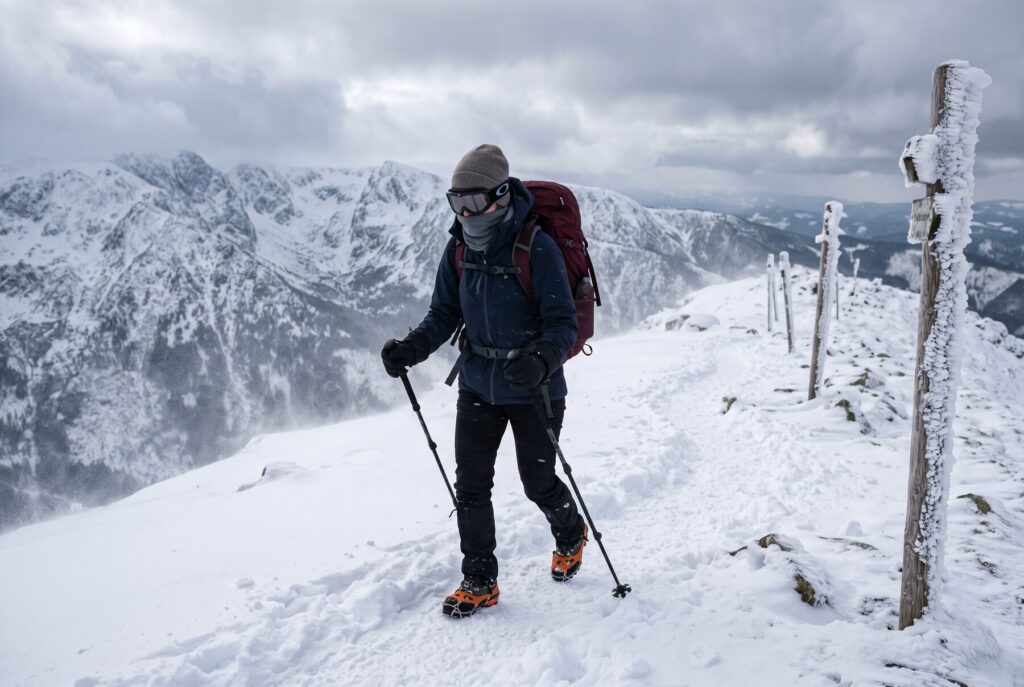
I have to admit that for a long time I didn’t go to the mountains in winter at all. I didn’t know what to expect there or how to go about it. Over time, though, mountain hiking became almost an addiction for me, and I couldn’t get through a whole winter without at least a few trips.
At first, before my first winter adventure, the very idea scared me a little. In my mind’s eye I saw myself buried up to my neck in snow, helpless and defenceless against wild animals attacking me. Seriously! It’s not funny! OK, maybe it is a bit 😉
The mountains in winter are a real treat for anyone looking for adventure
Looking back now, I can say that winter hikes are among the most exciting adventures I have ever had. What matters, though, is preparing for them well, and then they become a pleasure we keep coming back to and remember fondly.
In this article I cover where to go on your first trip, how to dress, what to put in your rucksack and how to recognise hypothermia or frostbite. At the end you’ll find a packing list.
For your first winter trip to the mountains, I suggest choosing mountains that are not too high or demanding. In my opinion the whole Sudetes range in south-western Poland is ideal for this: the stunning Table Mountains, which are relatively easy for beginners, the Owl Mountains with their highest peaks, Wielka Sowa and Mała Sowa, the Jizera Mountains, the Karkonosze (Giant Mountains) with the famous Śnieżka (these are a bit steeper and more dangerous, so it’s worth preparing better for them) and many, many more, plus the whole Ślęża Massif in the foothills of the Sudetes.
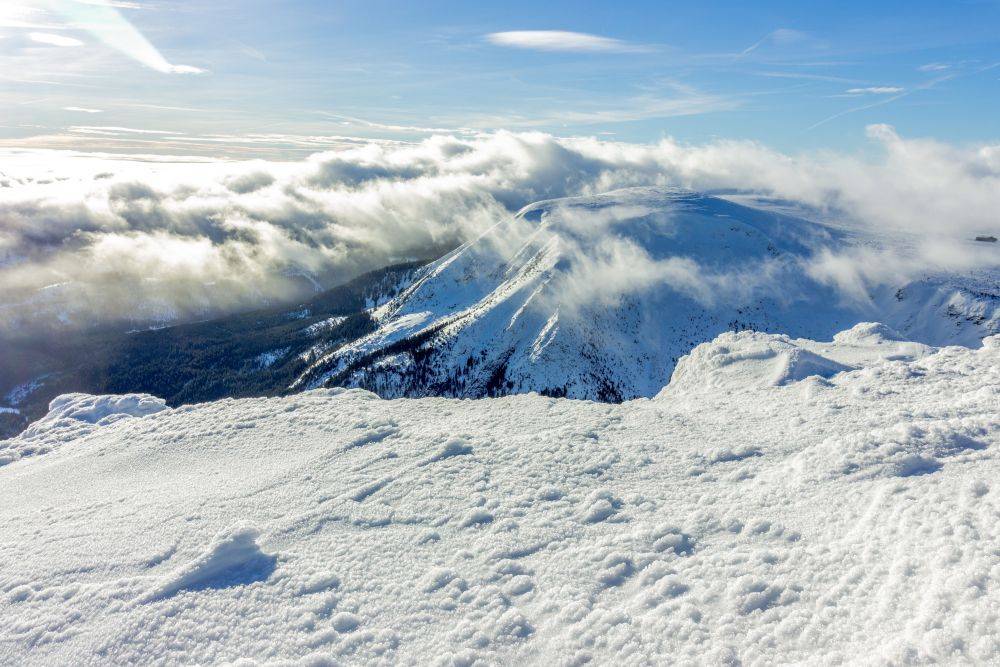
Winter clothing for comfort and warmth
Without doubt, the most important thing to get ready before a winter outing in the mountains is the right clothing. The general rule is that a walker’s winter clothing should consist of several layers.
The layer next to your skin
The layer closest to your body is there to keep you warm and to wick away the excess moisture that will certainly appear once we start sweating. There is a whole range of thermal underwear to choose from here. I myself, however, mostly wear cotton underwear, a natural material that has been used for generations. Maybe my attitude to cotton really is a bit old-fashioned by now and I’ve simply got used to it. Many people steer well clear of it in winter, and it’s hard to blame them: cotton soaks up sweat, takes a long time to dry, and when it’s wet against your skin it chills your body very quickly, especially when you stop in the frost1. That’s why I don’t recommend cotton to you. For a winter outing in the mountains, wear merino wool or synthetic base layers.
The middle layer and a warm jacket for stops
The next layer is there to keep the warmth in and - when needed - let the excess out. Believe me, after half an hour of hard walking you will very quickly find you’re as hot as in a sauna, with sweat running down your back. When that happens, you need to be able to let the excess heat out.
This is very important, because damp clothing chills your body very quickly, even after a short stop. When that happens, your body temperature swings quickly up and down. That is good neither for your health nor for how you feel in general. And a winter trip to the mountains is meant to be an adventure and a pleasure, not a cause of hypothermia.
When you stop, your sweat-soaked clothes will make you very cold in a short time. And when you walk, you will feel hot again just as quickly.
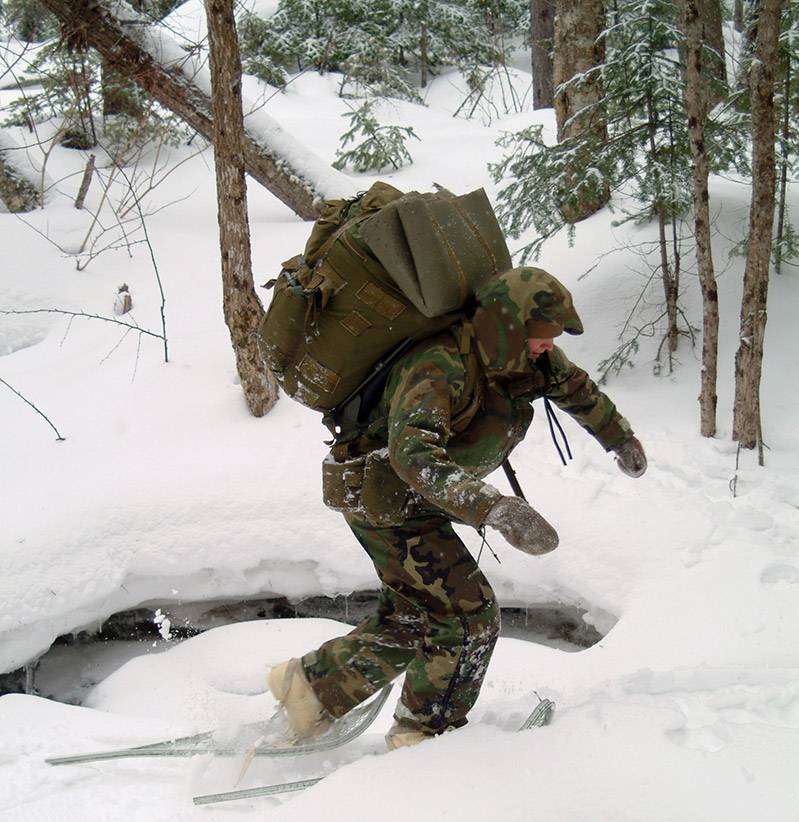
As soon as we feel ourselves getting hot and starting to sweat, we should be able to quickly unzip a layer to bring our body temperature down and let the excess evaporating sweat escape. I have personally walked with everything unzipped down to my T-shirt while the air temperature was well over ten degrees below zero.
For the middle layer, most people choose fleece or wool2. What matters is that you can unzip it or take it off quickly, because that’s the layer you use to regulate your temperature as you walk.
Put one more warm layer in your rucksack just for stops, for example a down jacket or one with synthetic insulation. You’re warm while walking, but when you stop, and especially when something forces you into a longer stop (a twisted ankle, losing the trail), you’ll get cold very quickly3. Put this jacket on as soon as you stop, and take it off just before you set off again.
The outer layer
The last layer of clothing is there to protect you from wind and from moisture in the form of rain and fog. Wind can chill your body much faster than low air temperature alone (at -10°C with a 40 km/h wind, the feels-like temperature drops to about -21°C), so make sure in advance that the outer layer you put on is windproof.
Boots
A very important part of the clothing you take on a winter mountain trip is your boots. Boots should be comfortable and high enough. They must fit snugly around the ankle to stop snow getting in. There is nothing worse than wet socks in winter. I go into detail on how to choose boots for the mountains in my guide to trekking boots.
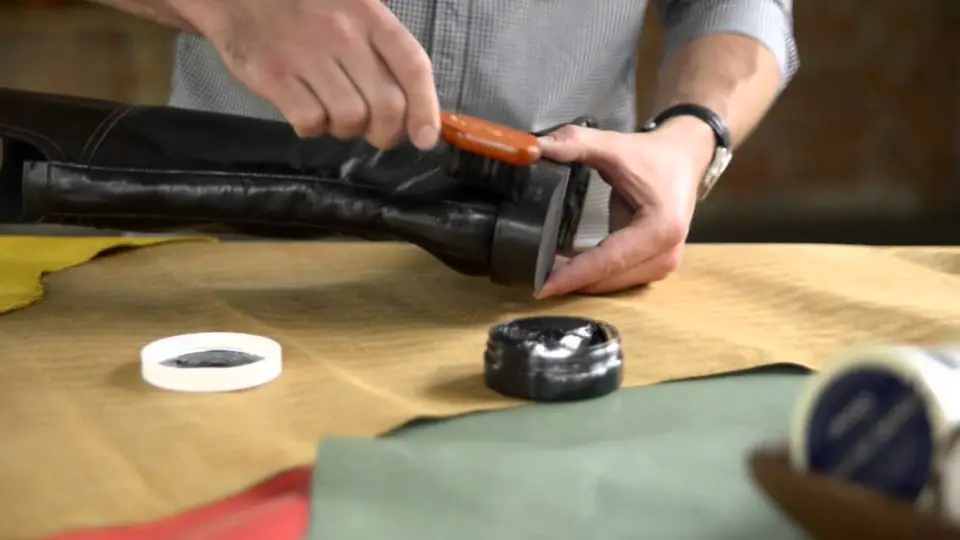
After every trip, dry your boots, but never put them close to a heat source to speed things up. Boots should dry at room temperature, at their own pace. Otherwise the leather may crack, and after a few trips your footwear will only be fit for the bin.
Also look after them properly and keep them greased. I used to use various kinds of shoe polish for this, but for a while now I have been using ordinary Vaseline with good results. That’s my way of doing it, though, not a recommendation. Makers of trekking boots tend to recommend wax and dedicated proofing products for leather, and some explicitly advise against oils and greases, because they weaken the leather and can make the rand and the sole come unstuck4. So with expensive boots, especially ones with a membrane, stick to the manufacturer’s instructions.
Microspikes, gaiters and poles
Boots aren’t everything. In winter it’s worth adding three things to your rucksack that make a huge difference even on easy trails.
Microspikes are light, spiked attachments that you pull on over your boots. On a packed, icy trail they grip much better than the best sole. Just remember that microspikes are not crampons. On steep and very icy sections they may not be enough, and there you need crampons and an ice axe, plus the skill to use them5.
Gaiters, covers you put on over your boots and trouser legs, are the answer to the problem I mentioned above: snow getting into your boots. Once, I could have used them for a completely different reason too. It was winter in the mountains, and the top layer of snow had frozen into a thin crust of ice. With every step my legs broke through it, and after a kilometre, maybe two, my shins were cut and bruised. I had to turn round and head home, because carrying on in ordinary trousers was simply impossible. I suspect it would have been much easier and more comfortable in gaiters.
Trekking poles help you keep your balance on slippery ground. I explain how to pace yourself on the trail in the article how to walk in the mountains without (almost) getting tired.
Head, hands, feet and eyes
Other items of clothing to think about are headwear, gloves and sunglasses.
Sunglasses with a UV filter (ideally ones that block at least 99% of UV radiation6) will protect your eyes from the sun’s rays, which become many times stronger when they reflect off snow. Wear them on cloudy days too. On longer trips, UV can lead to what’s called snow blindness, which is a sunburn of the eyes, and to irritated conjunctiva (the symptoms only appear a few hours later, so you won’t feel anything during the hike; they usually clear up within 1-2 days). It’s not pleasant at all - it feels as if someone had poured fine sand into your eyes.
When it is particularly cold, think about 2 pairs of gloves instead of one: directly on your hands, wear five-finger gloves made of fairly thin material, so you can still do fiddly jobs with your hands. Over them, pull on thicker mittens. They protect you better from the cold, and if you need to do something more precise, you can quickly take them off and just as quickly put them back on.
Remember warm socks too - wool ones are best (e.g. merino) or ones with some synthetic fibre mixed in (cotton socks soak up sweat and take a long time to dry, and there’s nothing worse than wet socks in winter). Some people also use a two-sock system: first they put on thin synthetic or merino socks to wick sweat away, and only then pull thicker ones over them to stop heat escaping through the feet.
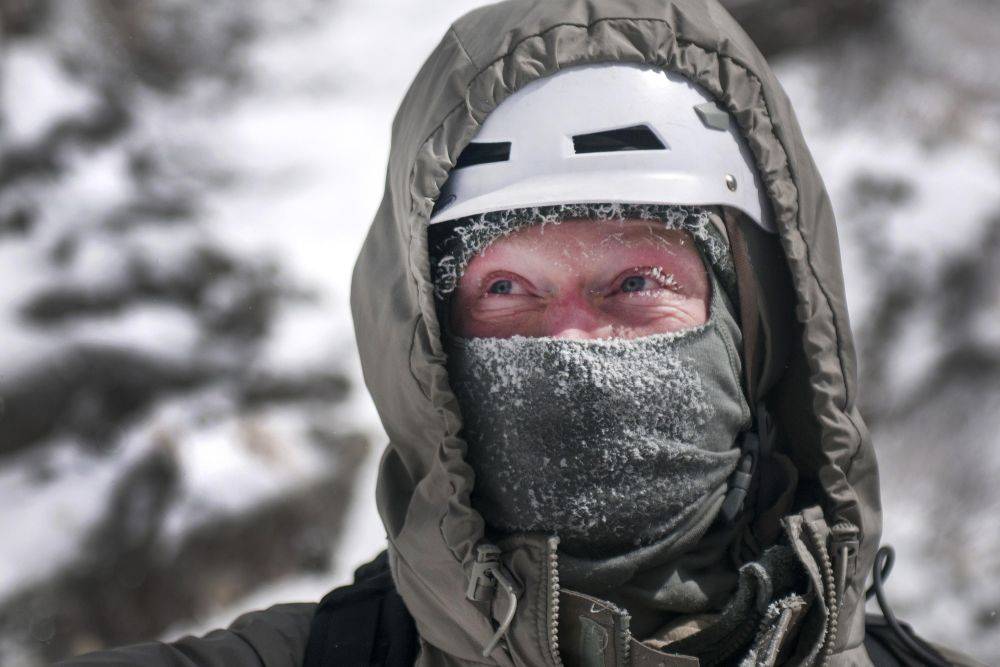
If you are planning to climb a peak, you will almost certainly be exposed to stronger or weaker gusts of cold wind, because near mountain summits there is no shelter at all and the wind can blow wherever it pleases. It is a good idea then to protect your head and neck properly. You can do that by pulling up your hood, and if it is really windy and cold, put a hat on under the hood as well. This double protection has worked for me many times. In extreme conditions it is also worth considering a balaclava to cover your face.
Plan enough time to get there and back
When planning your mountain trip, bear in mind that, generally - at least at our latitude - winter days are shorter. The time it takes to walk a route in winter is also a good deal longer than in summer. So it may turn out that, because your assumptions were too optimistic, night catches you out somewhere “in the middle of absolutely nowhere”.
How much shorter? For Karpacz, in the Karkonosze, it looks like this: on 21 December the sun rises at 7:57 and sets at 15:54, so the day lasts just under 8 hours. In mid-January it is light from 7:53 to 16:20, and in mid-February from 7:10 to 17:13, which is about 10 hours7. For comparison, on 21 June the day there lasts 16.5 hours. In December it is already getting dark after 16:00, because after sunset there are only about 40 minutes of twilight left, and in the mountains the sun can disappear behind a ridge even earlier.
That’s why you should set a turnaround time before you set off and stick to it, even if the summit is only a short way off. Work it out backwards: take the time you need for the descent (longer in winter than the time on the trail signpost) away from the time of sunset, and leave a margin for stops and surprises. Start as early as you can and keep track the whole time of how long you have been walking, so you can decide in good time whether to turn back or carry on8.
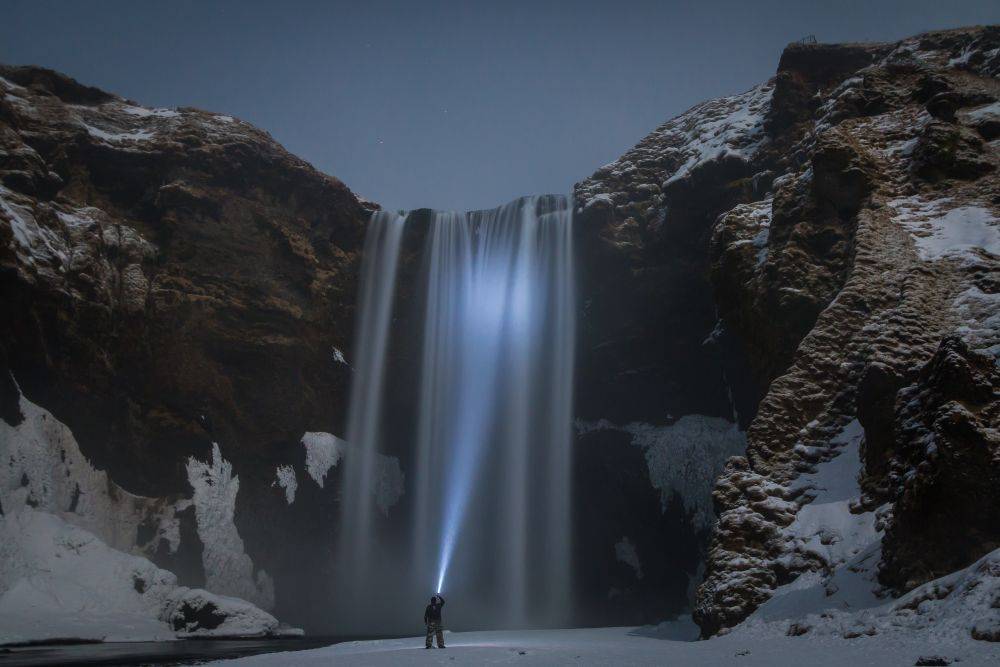
For surprises like that, always keep a torch (ideally a head torch) and spare batteries in your rucksack, so you can get home safely if you need to. In winter, visibility at night is surprisingly good, at least on a clear, moonlit night in open terrain (in a forest, in fog or in a blizzard it’s a completely different story). The white snow brightens the whole area, because it reflects the light of the moon and stars, and of other light sources. That lets you see far more detail of the terrain.
You might even be tempted - purely for fun - to go on a night-time winter hike in the mountains. That does come with some risk you need to take into account, though (if you do, then on a route you know, under a clear sky, with a head torch and spare batteries). Which brings us to the next important point.
Safety above all
As far as you can, make sure that nothing unpleasant will happen to you on the route you are taking. The mountains in winter can be dangerous, so:
- Check whether there is any avalanche risk on the route you have chosen9.
- Check the weather forecast for the day of your hike, and make it the forecast for the mountains, not for the town you are setting off from.
- If your route crosses frozen rivers or lakes, make sure the ice is thick enough to hold your weight (on the trail you usually have no way of checking this, and the ice on rivers and streams can be treacherous because of the current, so it’s best simply to go round ice like that). If you have even the slightest doubt about it, stay off the ice.
- If you have no experience of moving around the mountains in winter, go with someone who does, or consider choosing a different location or route.
- Take a charged mobile phone so you can call for help if needed (the emergency number in the Polish mountains is 985 or 601 100 300, and the Ratunek rescue app is handy too). Before you set off, tell someone which way you are going and when you will be back. Your phone can also serve as a compass, a map and a satnav. Remember that the battery drains much faster in the cold. So download offline maps in advance, and also pack a paper map and a compass you know how to follow a bearing with.
- Take microspikes for your boots. In winter they come in handy even on easy trails, and on an icy climb or descent they can save you from a fall.
- Take a head torch and spare batteries, even if you plan to be back before dark. The torch on your phone is bright, but a head torch leaves your hands free and doesn’t eat into your phone’s battery, which you had better save for navigation and calling for help.
- Take a warm jacket for stops and spare gloves.
- Don’t forget a basic first aid kit and a foil emergency blanket, a light sheet you can use to shield yourself or an injured person from the wind if there is an accident.
- Take at least one knife.
- Take at least one way of making fire. If you get lost and have to spend the night outdoors, a campfire can save your life.
Hypothermia and frostbite: how to recognise them and what to do
The title of this article promises you won’t freeze, so I also need to tell you how to recognise that a problem is starting. Both conditions creep up on you and are easy to miss, especially in yourself.
Hypothermia
Hypothermia is when your body temperature drops below 35°C (normal is around 37°C). Its symptoms are shivering, pale and cold skin, blue or grey lips, slurred speech, slow breathing, tiredness and confusion10, plus fumbling hands, drowsiness and memory problems11. If someone in the group starts slurring, stumbling and becoming apathetic, don’t put it down to ordinary tiredness. Hypothermia can set in even a few degrees above zero if someone is wet from sweat, rain or water and gets cold on top of that.
What to do until help arrives:
- call for help;
- get the casualty to a warm place as quickly as possible, or at least somewhere out of the wind (a mountain hut, a trail shelter, the sheltered side of some rocks);
- take off their wet clothes, wrap them in dry things, a sleeping bag, a blanket or a foil blanket, and cover their head;
- if they are fully conscious, give them a warm drink without alcohol and something sweet, e.g. chocolate;
- talk to them so they don’t fall asleep, and don’t leave them alone.
What not to do: don’t rub their arms or legs, don’t warm them up with a hot bath or a hot-water bottle, and don’t give them alcohol (I explain why below, in the section on food).
Frostbite
You can get frostbite at 0°C and below, most often on your fingers and toes, nose and ears12. At first the skin feels cold and hard, goes numb, prickles or burns, hurts, and turns red or pale. As the frostbite gets deeper, the skin hardens and freezes, may turn white, blue-grey or blotchy, swells and loses all feeling, and then blisters may appear. The trouble is that you often can’t feel a frostbitten spot, because it’s numb. So at every stop, glance at your companion’s face now and then, and get them to glance at yours.
What to do: get somewhere warm, or at least sheltered, as quickly as you can, take wet gloves, socks or a ring off the frostbitten area and wrap up in something warm. Put cold hands in your armpits, and warm a frostbitten spot on someone else with the heat of your own hands. In a mountain hut or at home you can put it in warm, but not hot, water. Don’t rub frostbite, not even with snow, and don’t warm it by a campfire, a stove or with a hot-water bottle, because numb skin won’t feel a burn. Don’t walk on frostbitten feet unless you have to11. Hard, frozen skin, swelling, loss of feeling or blisters are a matter for a doctor: call for help.
Winter food for mountain walkers
I have already written an article about food in the mountains, so here I will focus strictly on winter topics.
The mountains in winter are much “wilder” than at other times of year, and trips rarely follow nicely trodden trails cleared of snow. Sometimes you will also want to leave the marked path and push your way for a while through places where the snow comes up to your waist or even your armpits (just remember that off the trail in winter the risk of avalanches and of losing your way goes up). Moving in conditions like these takes enormous physical effort. The few times I found myself in that situation, I was moving so slowly that I felt I was marking time, while the energy I was putting in was comparable to a sprint.
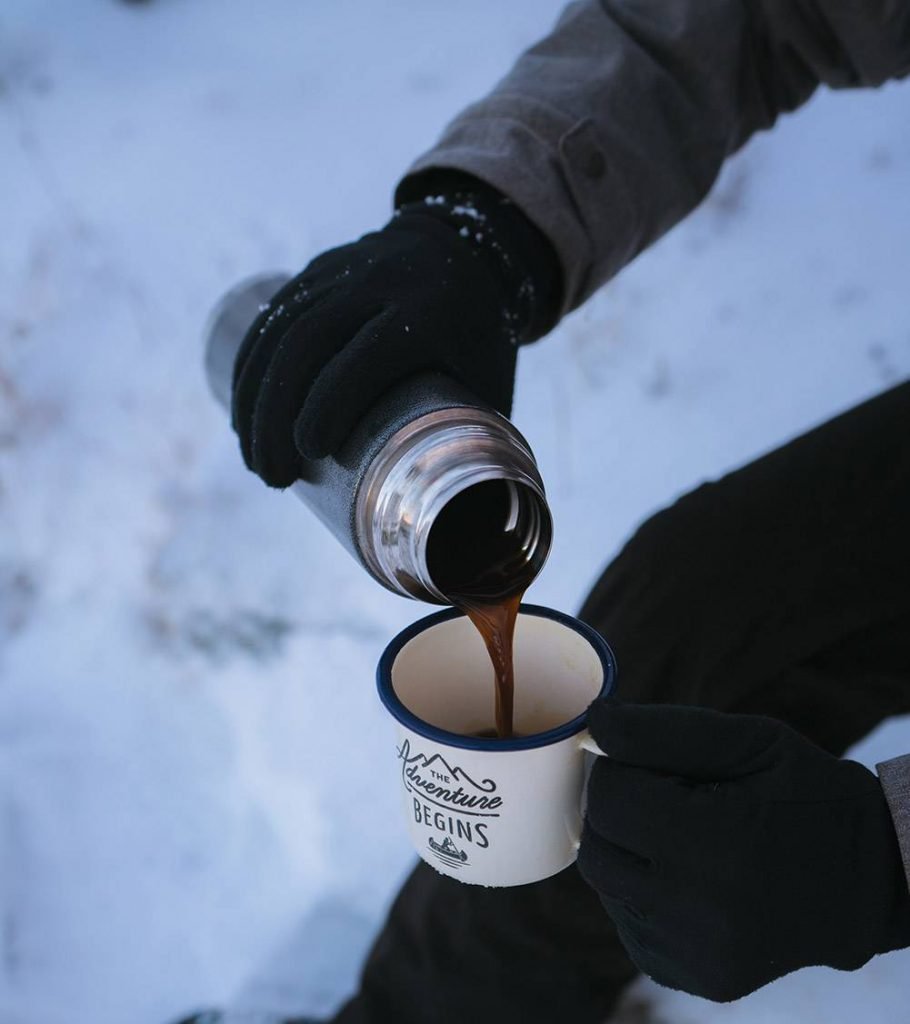
It is also a good idea to keep a few ordinary sweets somewhere in an easy-to-reach jacket or trouser pocket, so you can quickly pull them out and eat them without stopping when you need to. You can also take a flask with a hot caffeinated drink, usually coffee (although I often take yerba mate). Hot, sweet coffee never tastes better than when you drink it from a steaming cup during a break somewhere in a snowy wilderness.
Water in winter: a flask instead of a water bottle
In winter it’s easy to forget to drink. In the cold you simply feel less like drinking: cold can blunt your sense of thirst by as much as 40%, both at rest and on the move13. And yet you keep sweating, as I wrote above. So drink regularly, even when you don’t feel thirsty, for example at every stop. I explain how to tell that your body is short of water in the article on symptoms of dehydration.
Water in an ordinary bottle can freeze in a hard frost, so the basis is a flask of hot tea or coffee. If you take a bottle as well, keep it inside your rucksack wrapped in clothing, not in a side pocket out in the wind.
What to pack for a winter hike
Below is everything I wrote about above, in one place. You will find a similar list in the article on how to pack your own bug-out bag.
- merino wool or synthetic base layers
- a fleece or wool top (easy to unzip)
- a jacket and trousers that keep out wind and moisture
- a warm jacket for stops, down or synthetic
- high boots, dried after the previous trip
- gaiters
- microspikes
- trekking poles
- a hat, neck warmer or balaclava
- two pairs of gloves (thin five-finger gloves and thick mittens) and spares
- wool socks and a spare pair
- sunglasses with a UV filter
- a flask of hot tea or coffee
- food, and sweets in your pocket
- a head torch and spare batteries
- a charged phone with offline maps, and a power bank
- a paper map and a compass
- a first aid kit and a foil blanket
- a knife
- a way of making fire
- the mountain weather forecast and avalanche risk checked
- a turnaround time set
- someone knows where you are going and when you will be back
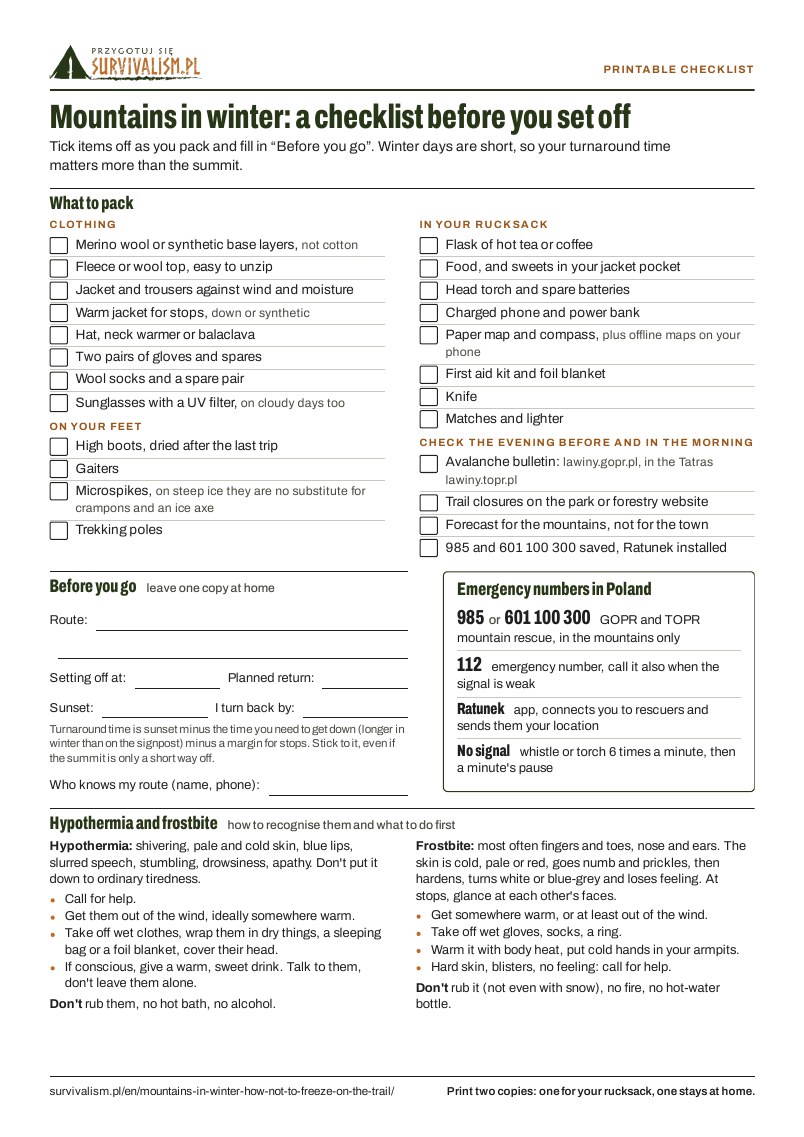
If you prefer ticking things off on paper, download this list as a PDF and print it before you set off.
Finally: planning is the key to success
My own experience is that a great many unpleasant surprises on the trail can be avoided with good planning and preparation. If you take into account everything I have listed and use a little common sense, you will keep the risk of unpleasant situations to a minimum. Then your first trip to the mountains in winter has a good chance of becoming one of many more to come.
See you on the trail!
Sources
- National Weather Service (Duluth), “Stay Safe in the Extreme Cold”: weather.gov/dlh/extremecold
- Tatra National Park, „Tatry zimą” (The Tatras in winter): tpn.gov.pl/tatry-zima (in Polish)
- GOPR, the Polish mountain rescue service, „Co warto zabrać w góry?” (What to take to the mountains?): gopr.pl/poradnik/co-warto-zabrac-w-gory (in Polish)
- Meindl USA, “How To Maintain Your Meindl Boots”: meindlusa.com
- Karkonosze National Park, „W Karkonoszach zimowe warunki na szlakach” (Winter conditions on the trails in the Karkonosze): kpn.gov.pl (in Polish)
- American Academy of Ophthalmology, “What is Photokeratitis, Including Snow Blindness?”: aao.org
- US Naval Observatory, “Complete Sun and Moon Data for One Day” (Karpacz, 50.78° N, 15.74° E, flat horizon): aa.usno.navy.mil
- GOPR, „Wskazówki dla turystów” (Tips for hikers): gopr.pl/poradnik/wskazowki-dla-turystow (in Polish)
- Avalanche bulletins: GOPR (the Karkonosze and the other mountains outside the Tatras) lawiny.gopr.pl, TOPR, the Tatra mountain rescue service (the Tatras) lawiny.topr.pl (in Polish)
- NHS, “Hypothermia”: nhs.uk/conditions/hypothermia
- CDC, “Avoid. Spot. Treat. Frostbite and Hypothermia” (PDF): cdc.gov
- NHS, “Frostbite”: nhs.uk/conditions/frostbite
- Kenefick R.W. et al., “Thirst sensations and AVP responses at rest and during exercise-cold exposure”, Medicine & Science in Sports & Exercise 2004, 36(9), pp. 1528-1534: pubmed.ncbi.nlm.nih.gov/15354034
Leave a comment