
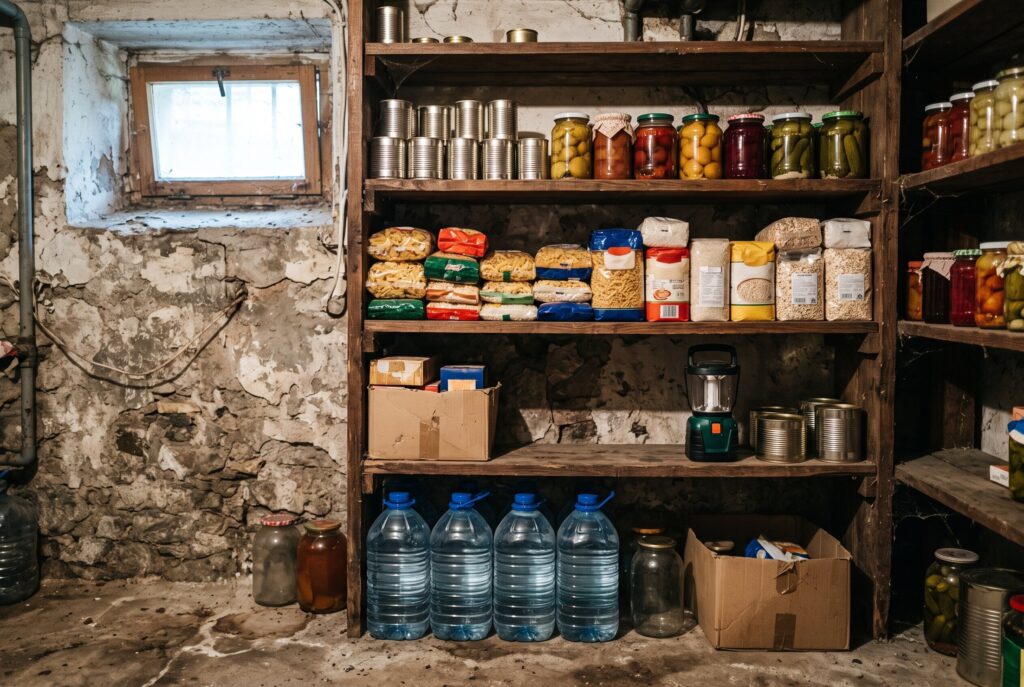
How many bottles of water do you have at home right now? Not in the shop round the corner, but at your place: in the cupboard, in the cellar, under the bed. And how much food could you eat without a fridge and without a cooker? Enough for a day? For three?
Most of us, being honest, would say: “well, there’s something”. And that “something” usually runs out at the first candlelit dinner 😉
In my piece on a blackout in Poland I wrote about where to get water once it stops coming out of the tap, and what is worth keeping in the pantry. Here we stay at home and go one step further. We’ll work out how much water and food your family needs for 3 days and for 2 weeks, where to keep it all and how to rotate your supply so you don’t throw half the pantry away every year.
How much water do you really need?
Let’s start with drinking. An adult needs about 2-3 litres of water a day, and it’s worth planning your supply at no less than 3 litres per person per day.1 Those 3 litres, though, only cover survival, meaning drinking and the water that goes into your meals.2
On top of that come cooking and hygiene. For basic cooking count on 3 to 6 litres per person per day, and for basic hygiene, such as washing your hands and face, 2 to 6 litres. Together with 2.5-3 litres for drinking, that gives you 7.5 to 15 litres per person every day. And that’s not all. An ordinary flushing toilet takes another 20-40 litres per person per day. With no water in the taps, the toilet cistern becomes the thirstiest piece of kit in your home.
So why are there so many different figures in the guides? American guides count a gallon, which is just under 4 litres, per person per day.3 You’ll also come across the advice of 14 litres per person per week, which is 2 litres a day.4 These figures don’t contradict each other at all, each one simply counts something different. 2 litres is a modest minimum for drinking, 3 litres is drinking with a small margin, and 7.5-15 litres is drinking, cooking and washing together.
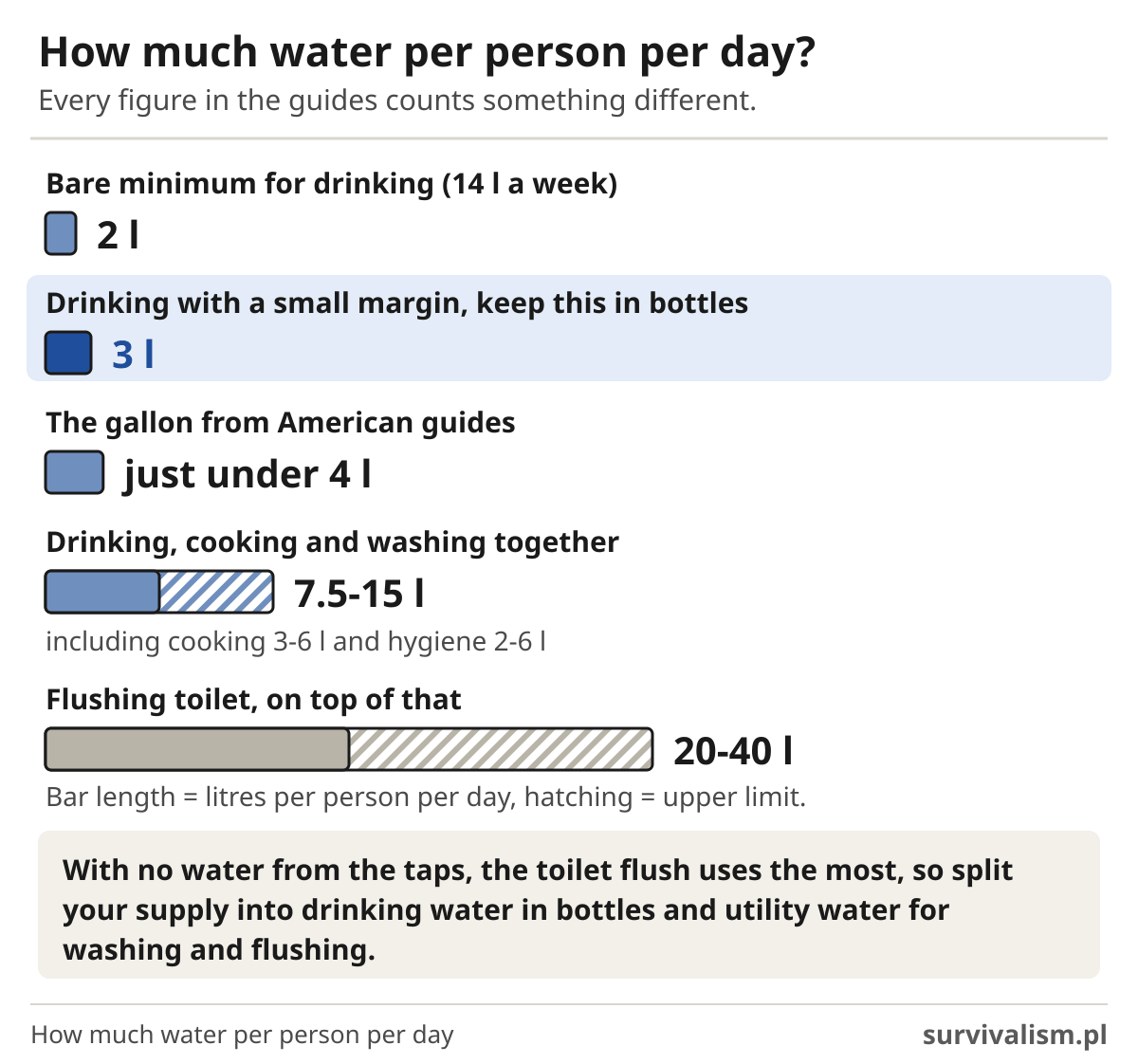
In my view the most sensible thing is to split your supply into two parts. The first is drinking water in bottles, counted at 3 litres per person per day. The second is “utility” water for washing, doing the dishes and flushing, which you pour into the bath, pots and containers as soon as things start to look tense. If needed, you can boil the utility water (more on that below).
Children, breastfeeding mothers and sick people need more water, and in hot weather the need can even double. Don’t ration drinking water. Drink what you need today and look for water for tomorrow.5 More than once I’ve caught myself going many hours without reaching for water, only to find all of a sudden that I was very thirsty. You can read how to tell that your body is already short of water in my piece on the symptoms of dehydration.
How many litres is that for your family?
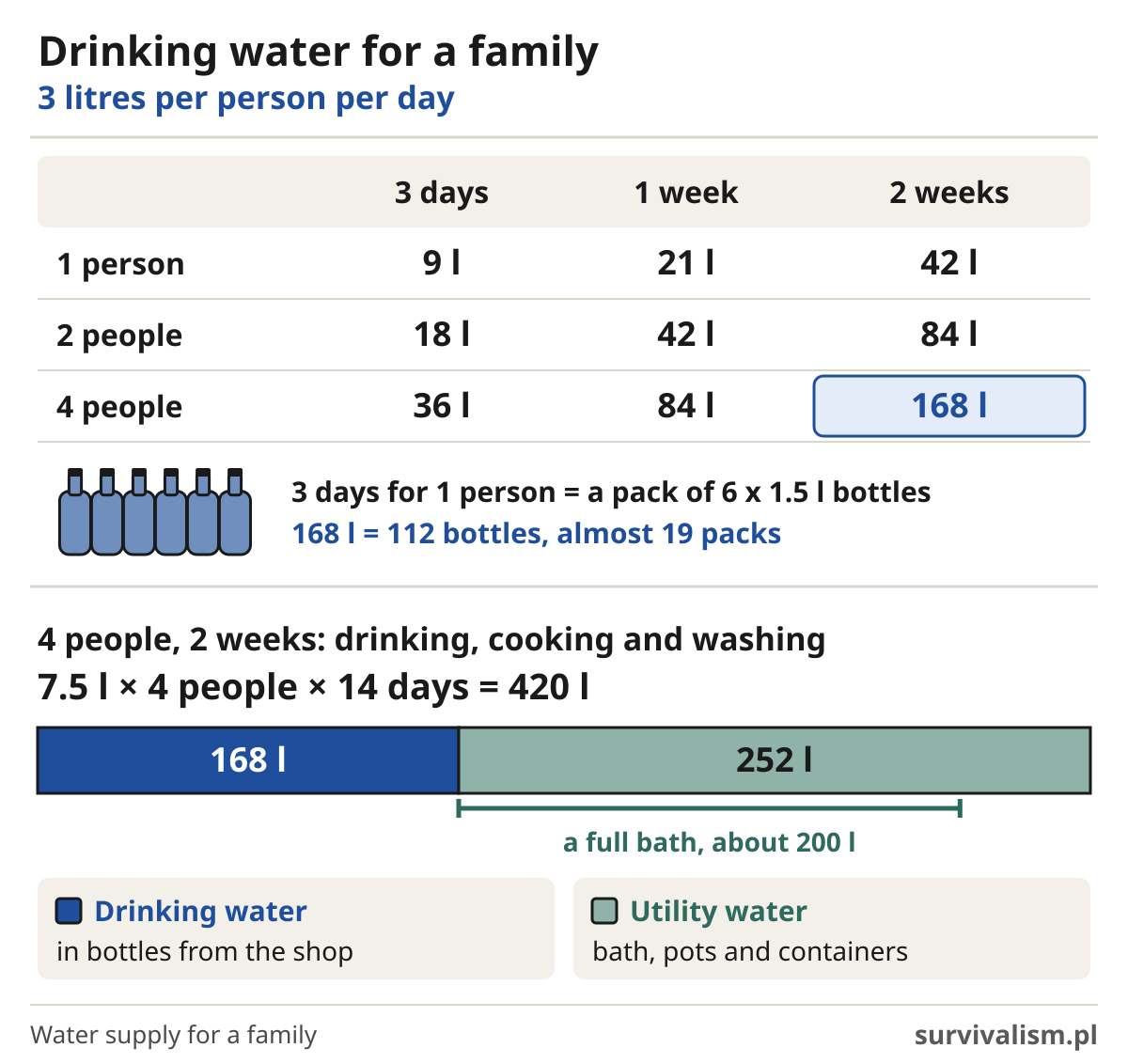
Let’s work through an example. At 3 litres per person per day, a 3-day supply is 3 x 3 = 9 litres per person, which is exactly what I counted for the bug-out bag. For a week it’s 21 litres, and for 2 weeks 42 litres per person. For a family it looks like this:
- 1 person: 9 l for 3 days, 21 l for a week, 42 l for 2 weeks;
- 2 people: 18 l, 42 l and 84 l;
- 4 people: 36 l, 84 l and 168 l.
So a family of four needs 168 litres of drinking water alone for 2 weeks. In 1.5 l bottles that’s 112 bottles, or almost 19 packs of 6. You can squeeze that into a cellar or a wardrobe, but certainly not into the cupboard under the sink.
Now let’s add cooking and hygiene. Even at the lower limit of 7.5 litres per person per day, the same family will use 7.5 x 4 x 14 = 420 litres over 2 weeks. You won’t fit that much water in a flat, unless you turn the bedroom into a storeroom 😉 But seriously, this is exactly why I split the supply into drinking water and utility water. The missing 420 - 168 = 252 litres of utility water is roughly a full bath (it holds about 200 litres) plus the pots and containers you fill as soon as a longer outage is announced.
Food: how much and what kind?
You’ll survive much longer without food than without water, but that’s no reason to skip it. I once did a week-long water-only fast, and after a few dozen hours I was thinking about almost nothing but food. Hunger is one of the strongest drives a human being has, and along with it your physical and mental performance drops. In a crisis you need a clear head, not thoughts circling round a sandwich.
How much food, then? The minimum used in humanitarian aid is about 2,100 kcal per person per day.6 For a family of four over 2 weeks that gives 2,100 x 4 x 14 = 117,600 kcal. Sounds abstract? Pick up any tin or packet of pasta. The calories are on the label, so you can simply add your supply up.
For your supply, choose food with a long shelf life that you can eat cold: bars, tinned food, ready meals (bigos, meatballs, beans in tomato sauce), crispbread and rusks. Avoid anything that needs a fridge or long cooking.4 You’ll find a list of products split into carbohydrates, protein and fats in the food section of the blackout piece, so I won’t repeat it here.
The most important rule, though, goes like this. Buy what your family will actually eat.7 Twenty tins of beans that nobody at home likes aren’t a supply, just a future problem for the bin 😉 But seriously, a supply nobody eats never gets rotated and ends up in the bin sooner or later. Also remember people on special diets and a manual tin opener Amazon store, affiliate link, opens in a new tab. It costs next to nothing, and without one you’ll only get some tins open with a knife.
A 3-day (72-hour) supply vs a 2-week supply
How many days is enough? The absolute minimum is 3 days.1 Some guides talk about at least 7 days,4 and others about 2 weeks for when you stay at home (and 3 days for when you have to evacuate).8 My advice is to build a supply for at least a week, ideally for two.
The difference, though, isn’t just that you buy several times more. A 3-day supply and a 2-week supply are a completely different kettle of fish.
For 3 days, a pack of water per person is enough (6 bottles of 1.5 l is exactly 9 litres), plus food from the fridge and the cupboard and a few tins and bars. You don’t need to cook or plan anything. You eat cold, drink from the bottle and sit it out.
With 2 weeks, problems turn up that simply don’t exist with 3 days:
- the water no longer fits under the bed, because 168 litres for four people already means a separate corner of the cellar or the shed;
- you have to cook, because 2 weeks on nothing but tins and rusks is torture, and cooking means fuel and a supply of it;
- hygiene and the toilet start eating up the utility water, and strong bags, a bucket with a lid and disinfectants become just as important as food;
- the supply has to be rotated.
The order you eat things in matters too: the fridge first, then the freezer, and only at the very end the supplies from the cupboard. Open the fridge and freezer as rarely as you can, because then they stay cold for longer.9
How to store water?
Bottled or tap water?
The safest option is factory-sealed bottled water. You don’t need to treat it in any way, and the expiry date is printed on the label.3 All you have to do is keep an eye on the date.
You can store tap water too, but sensibly. Only pour it into clean food-grade containers, never into a container that held screenwash or garden chemicals. The handiest is a jerrycan with a tap Amazon store, affiliate link, opens in a new tab, because you don’t have to lift it every time you pour. Label every container with a marker: “drinking water” and the date you filled it. Replace this water every 6 months.
In my view it’s best to combine the two. Drinking water in bottles from the shop, and tap water as a utility supply that you use up anyway when mopping the floors or watering the plants. When a longer outage is announced, you also fill everything you have (the bath, pots, bottles).
Where to keep water?
Keep water in a cool place, ideally at 10-21 °C, away from sunlight, petrol and pesticides.3 That’s why a garage with a fuel can in it, heat in summer and frost in winter is a poor place for a water supply. A cool cellar, a pantry or the bottom of a wardrobe in your flat will do a better job.
Stack the packs so you can see the dates on the labels. Otherwise the oldest bottle will always end up at the bottom of the pile, and you’ll only remember it when you move house.
Boiling, the simplest way to treat water
When you’re not sure whether water is safe to drink (because it has been standing too long, because it comes from an uncertain source, because something cloudy came out of the tap), boil it. Boiling is the simplest and a good way to disinfect water, just bear in mind that boiling doesn’t remove chemical contamination.10
Boil the water for at least 2 minutes, then leave it to cool without chilling it quickly. It isn’t only drinking water that should be boiled, but also the water for preparing meals, washing fruit and vegetables eaten raw, brushing teeth, washing up and bathing babies.11
If the water is cloudy, first let it settle or pour it through a clean cloth, a paper towel or a coffee filter, and only then boil it. Boiled water tastes… flat. Pouring it from one container to another a few times, or a pinch of salt per litre, will help.12
In my view this is one more argument for bottles. Every litre of boiled water costs gas from a cartridge or a cylinder that you won’t be able to buy more of in a crisis. And if you forget to replace the tap water, don’t pour it away, because once boiled it will do fine for washing up or washing.
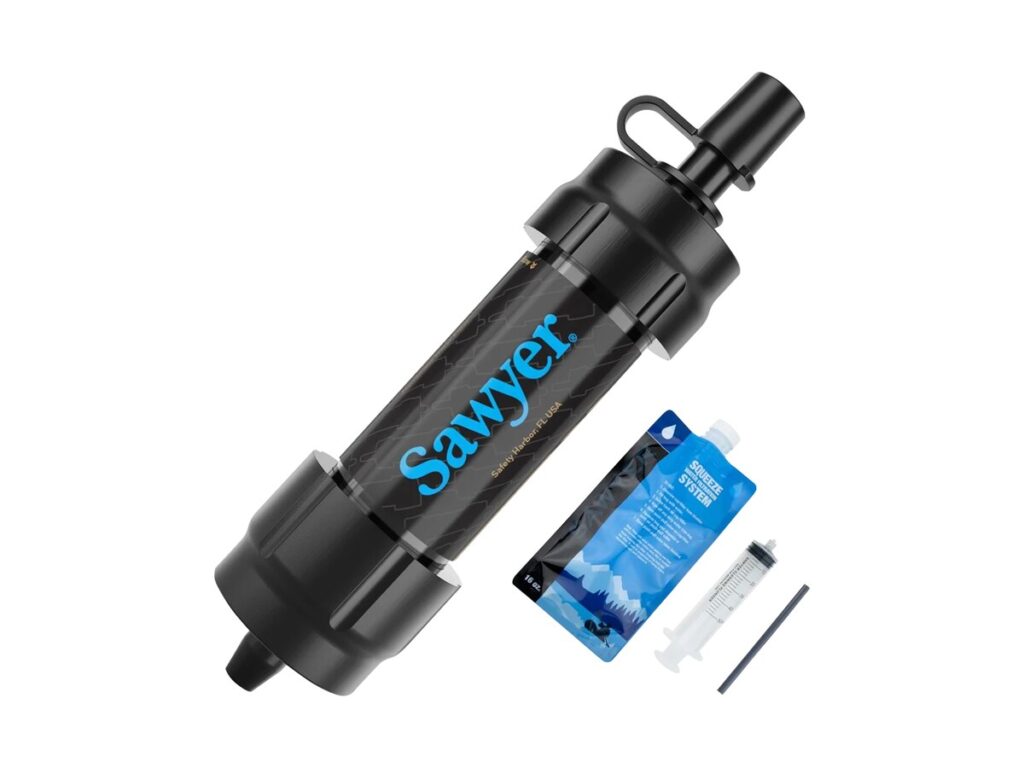
If you’d rather save gas, you can run river water or rainwater through a filter Amazon store, affiliate link, opens in a new tab. A filter like this stops bacteria and protozoa, but not viruses or chemicals, so it is no substitute for boiling tap water after a flood or a sewage failure.
 Amazon store, affiliate link, opens in a new tab
How to store food and keep track of dates?
Keep your food supply in a cool, dry and dark place.4 Tip dry goods such as flour, groats or oats into airtight jars Amazon store, affiliate link, opens in a new tab, because otherwise pantry moths will get into them sooner or later.
You’ll find two kinds of date on packaging, and it’s worth knowing how they differ. “Best before” is the date until which the product keeps its qualities if you store it properly, and once it has passed the product doesn’t have to go straight in the bin. “Use by” appears on products that go off quickly, and after that date the food is considered unsafe.13 That’s why for your supply, buy only products labelled “best before”. The ones marked “use by” are food for the next few days, not for the pantry.
Check your tins at every review. A tin that is bulging, open, damaged, or that spurts liquid or foam when you open it, goes straight in the bin. Never taste food to check whether it’s still good.14
Rotating your supply, or how not to throw food away
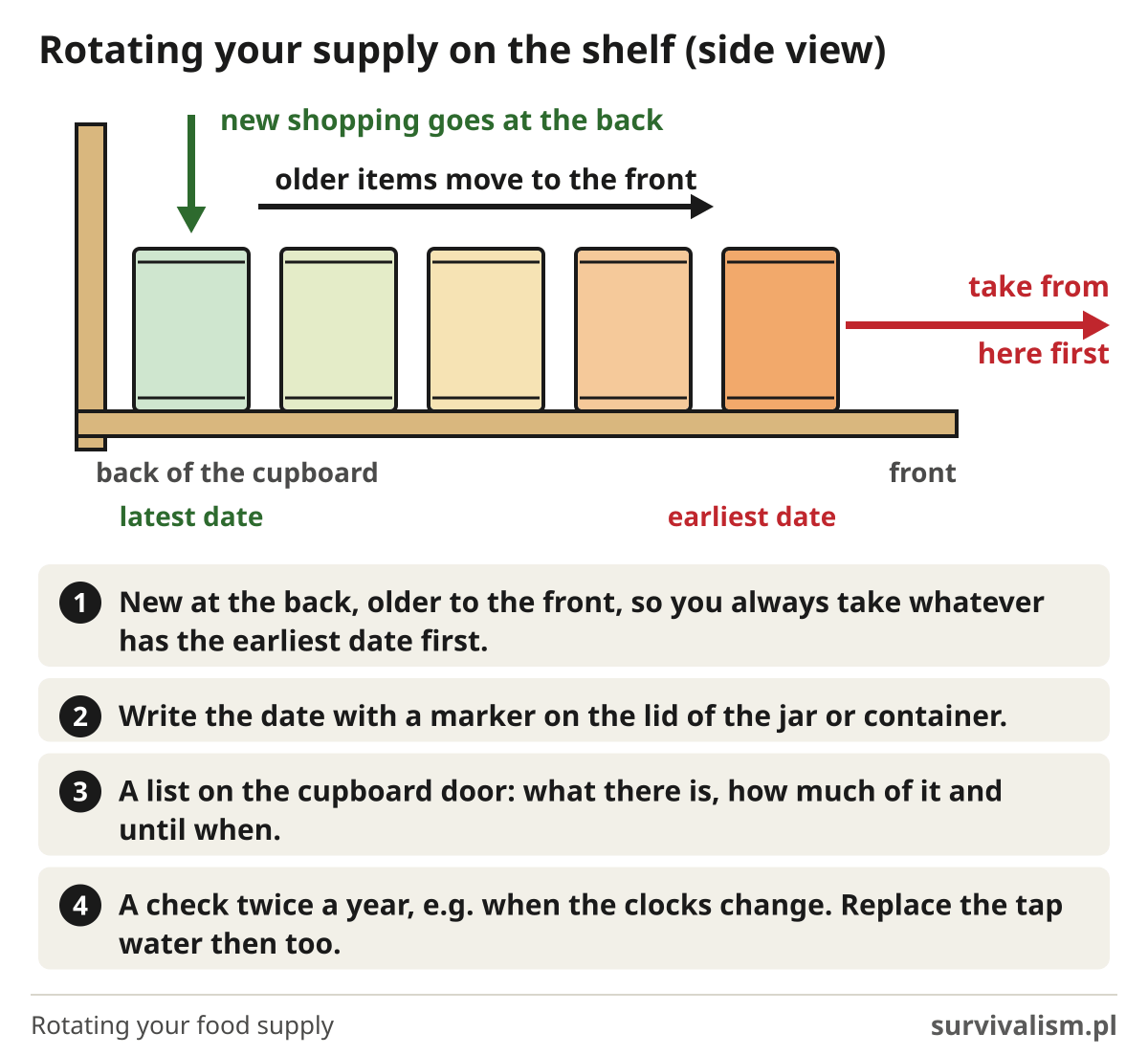
You can keep supplies in two ways: as long-life products with a distant date, and as products you use and replace as you go. Whichever way you choose, go through everything every few months and check the dates.1 Keep in stock what your household gets through day to day anyway. You eat the oldest products as you go, and buy new ones to take their place.
In practice it looks like this:
- put new shopping at the back of the shelf and move older items to the front, so you always take whatever has the earliest date first;
- write the date with a marker on the lid of the jar or container;
- stick a list on the cupboard door: what there is, how much of it and until when;
- do a review twice a year, for example when the clocks change, and replace the tap water then too, because you have to do that every six months anyway.3
Babies, regular medication and pets
A supply counted at “3 litres a head” works for healthy adults. If there is a baby at home, someone on regular medication, or a dog or a cat, you have to work that out separately.
Babies
If you’re breastfeeding, keep breastfeeding. It’s the safest way to feed a baby in a crisis.15 Breast milk needs neither clean water nor a sterilised bottle. Just remember that a breastfeeding mother may need more water than other adults.5
If you use formula, ready-to-feed liquid formula is the safest, because you don’t have to mix it with anything. Keep a supply of it for a few days. Make up powdered formula with bottled water if you’re not sure about the tap water, and when you can’t wash bottles properly, feed from a disposable cup. Throw away opened or prepared formula that was in the fridge while the power was off for 4 hours or more.
On top of that, nappies, wipes and water for washing the little one. You won’t be able to buy more nappies in a crisis, and a baby gets through… well, quite a lot of them 😉
Regular medication
Medicines you take regularly should be part of every home supply,1 and they’re the easiest thing to forget, because “you can always pop out to the chemist”. In a crisis the chemist may be closed or empty. Keep a supply for at least 7 days8 and rotate it the same way as food, meaning you buy a new pack before the previous one runs out, and always start with the oldest.
Medicines that have to be kept in the fridge (insulin, for example) and medical equipment that runs on electricity are a separate subject. It’s best to agree a plan for that situation with your doctor. Read the leaflets of the medicines you take, and do it today. They usually tell you how long the medicine lasts outside the fridge.
Pets
A dog or a cat eats and drinks too. Prepare a supply of food, drinking water and medicines for your pet for a few days, and for farm animals a supply of feed and water for 14 days.16 Keep pet food in an airtight, waterproof container.17 Add the water for your animals to the family total, instead of counting on “we’ll share somehow”.3
A meal without electricity in brief
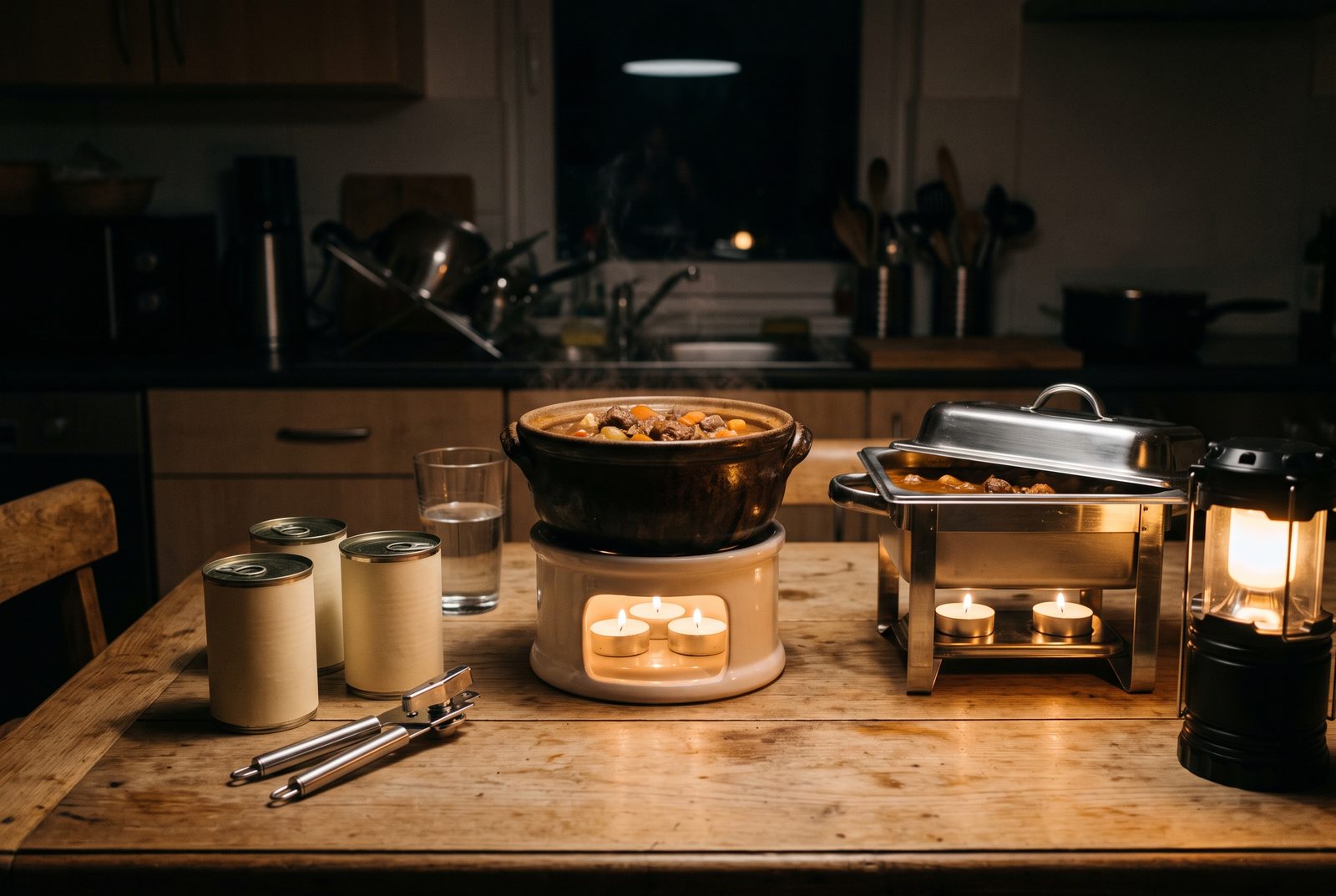
A barbecue and an ordinary camping stove are kit for outdoor use only, because indoors they risk carbon monoxide poisoning.7 To heat food at home you can use a tealight warmer, a fondue pot or a chafing dish, like the ones on a wedding buffet.
Plan your fuel too. Food that needs long cooking will, without fuel for long cooking, be eaten undercooked or not at all. That’s why for your supply you should choose food that only needs boiling water poured over it (couscous, porridge oats, instant soups), or food you can eat straight from the tin. Cooking dried beans or peas from scratch is a luxury in a crisis that isn’t worth the gas.
Where to start?
The worst thing you can do is read a piece like this and put the whole thing off “for some day”. Start with 3 days, this very week: a pack of water per person and some food you can eat cold. That’s one bigger shop, not a month-long project. Then, every time you go shopping, add something extra to the trolley (a pack of water, a tin, a packet of groats) until you get to a week, and then to 2 weeks. No panic and no stripping the shelves bare.
The point isn’t to scare anyone or to turn your flat into a warehouse. A crisis doesn’t have to mean war, sometimes a water main or power failure lasting a few days is enough. When it comes, you’ll meet everyone at the shop who also put their shopping off “for some day”. You’ll then be able to discuss, by the empty shelves, how unwise it was to put such things off until later. If you’d rather have a supply list on paper, download the Safety guide as a PDF (in Polish), print the page with the list and stick it on the fridge.
I’ve done my best to make sure every figure in this piece has a source, but I may have missed something. How do you keep track of the dates in your pantry? Do you have your own way of rotating supplies, or have you spotted a mistake here? Let me know in the comments. I read every comment and reply to most of them.
Sources
- Safety guide (gov.pl, 2025), “Przygotuj swoje otoczenie” (in Polish): gov.pl/web/poradnikbezpieczenstwa/przygotuj-swoje-otoczenie
- World Health Organization (WHO), “Technical Notes on Drinking-Water, Sanitation and Hygiene in Emergencies. 9: How much water is needed in emergencies”: cdn.who.int/media/docs/default-source/wash-documents/who-tn-09-how-much-water-is-needed.pdf
- CDC, “How to Create an Emergency Water Supply”: cdc.gov/water-emergency/about/how-to-create-and-store-an-emergency-water-supply.html
- Government Centre for Security, “Bądź gotowy! Poradnik na czas kryzysu i wojny” (in Polish): gov.pl/attachment/0d3deb41-aa91-4697-867a-45bf2f5710e4
- Ready.gov, “Water”: ready.gov/water
- UNHCR, “Emergency food assistance standard”: emergency.unhcr.org/emergency-assistance/food-security/emergency-food-assistance-standard
- Ready.gov, “Food”: ready.gov/food
- American Red Cross, “What Do You Need In a Survival Kit”: redcross.org/get-help/how-to-prepare-for-emergencies/survival-kit-supplies.html
- Safety guide (gov.pl, 2025), “Długotrwały brak prądu (blackout)” (in Polish): gov.pl/web/poradnikbezpieczenstwa/dlugotrwaly-brak-pradu-blackout
- Chief Sanitary Inspectorate, “Informacja dla powodzian o wodzie przeznaczonej do spożycia” (in Polish): gov.pl/web/gis/informacja-dla-powodzian-o-wodzie-przeznaczonej-do-spozycia
- District Sanitary and Epidemiological Station in Piaseczno, “Komunikat nr 9/2026 w sprawie warunkowej przydatności wody do spożycia przez ludzi z wodociągu Literatów” (in Polish): gov.pl/web/psse-piaseczno/komunikat-nr-92026-w-sprawie-warunkowej-przydatnosci-wody-do-spozycia-przez-ludzi-z-wodociagu-literatow
- CDC, “How to Make Water Safe in an Emergency”: cdc.gov/water-emergency/about/index.html
- Chief Sanitary Inspectorate, “Najlepiej spożyć przed, należy spożyć do - co to oznacza i do kiedy produkt może znajdować się w obrocie?” (in Polish): gov.pl/web/gis/najlepiej-spozyc-przed-nalezy-spozyc-do-co-to-oznacza-i-do-kiedy-produkt-moze-znajdowac-sie-w-obrocie
- CDC, “Keep Food Safe After a Disaster or Emergency”: cdc.gov/food-safety/foods/keep-food-safe-after-emergency.html
- CDC (Infant and Young Child Feeding in Emergencies Toolkit), “Special Considerations”: cdc.gov/infant-feeding-emergencies-toolkit/php/special-considerations.html
- Safety guide (gov.pl, 2025), “Zadbaj o zwierzęta” (in Polish): gov.pl/web/poradnikbezpieczenstwa/zadbaj-o-zwierzeta
- Ready.gov, “Pets”: ready.gov/pets
Leave a comment