
January, evening, a dozen or so degrees below zero outside. Suddenly the lights go out and the fridge goes quiet. For the first hour nothing happens, the flat is still warm. But put your hand on the radiator after two or three hours. What will you do if the power isn’t back by morning? And what if it’s not back until the end of the week?
I’ve already written about the blackout itself and about stocks of water and food in the post on how to survive without electricity in Poland, so here I’ll take a closer look at heating. In winter without electricity the danger isn’t only the low temperature itself, but also carbon monoxide. Carbon monoxide is the more dangerous of the two, because you won’t smell it. More on that later in the article.
This whole article describes an extreme situation that may or may not happen. Even so, I think we should be prepared for it if we take our survival and safety seriously. More than one disaster and more than one war have already shown that what we take for granted, all the achievements of modern technology, collapses like a house of cards when one element is missing, the one our whole civilisation is built on. I mean electricity, of course.
Why does the radiator go cold when there’s still gas?
Many people think a power cut doesn’t affect a gas boiler, because gas comes through a pipe, not a cable. Nothing could be further from the truth - a modern gas boiler stops working without electricity, because the ignition, the electronics, the fan and the pump that pushes hot water to the radiators all need power.1
It’s similar with boilers that have an automatic feeder, pellet boilers for example - without electricity the feeder, the blower and the controller stop, and the embers in the firebox can overheat the boiler, because the pump is no longer carrying the heat away.
Live in a block of flats on district heating? Don’t count on the radiators holding out either. A long blackout cuts off your water, heating, internet and phone all at once.2 Without electricity only the simplest devices work: a fireplace, a pot-bellied stove and other stoves without a water jacket or electronics. In other words, the old smoke-belching stoves work, and most of what has been built in the last few decades and has electronics in it is out.
Keep the heat in first
If the power is out for a long time, start with the simplest things. Before you start working out what to heat with, hold on to the heat you already have and make it escape as slowly as possible.
One room instead of the whole flat
Gather the whole household in one room.2 Choose a small room with a small window that you can also sleep in. Shut off the rest of the flat. Close the doors to the rooms you’re not using, stuff the gaps under the doors with towels or old rags, and at night cover the windows with thick curtains or blankets.3
How warm should that room be? Ideally at least 18°C.4 Without electricity you probably won’t manage that, but it’s a good yardstick, because every degree less has to be made up with clothes and blankets. Keep a particularly close eye on people over 65, children under 5, pregnant women and the chronically ill, because they feel the effects of the cold the fastest.
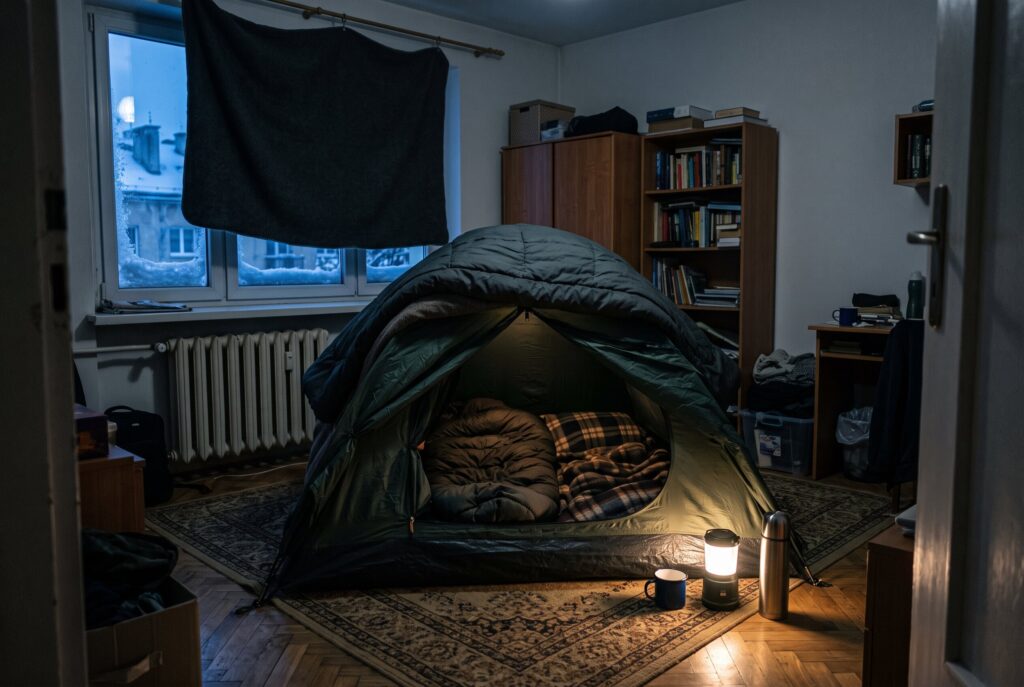
A tent in the room
The smaller the space you heat, the better. Extreme situations call for unconventional solutions. If you have a tent, pitch it in the room, and if you don’t, build a makeshift “den” out of blankets and chairs, or even a “canopy” over the bed. Your own breath and body will warm a small space, and the more people inside, the warmer it gets. An ordinary camping tent is all you need. The kids will probably think it’s the best adventure of the whole winter 😉
Sleep in a sleeping bag, and put a duvet or a blanket on top of it as well. If you’re sleeping on the floor, put a sleeping mat Amazon store, affiliate link, opens in a new tab, a blanket or anything else that will insulate you from the floor under the sleeping bag. A sleeping bag squashed under your body weight doesn’t keep you warm well, so you need insulation underneath.
Layers, a hat and dry clothes
Dress in layers, the way you would for a winter trail. When it’s cold, don’t worry about how you look, just wrap yourself up completely, head included, in extra clothes and blankets.3
Watch out for just one trap. Without electricity you’ll be carrying water up the stairs, bringing in firewood, clearing snow off the car. You’ll sweat, and then you’ll sit down in a cold room in a damp T-shirt that will start drawing the heat out of you. I’ve walked winter trails with my clothes unzipped right down to my base layer, at a dozen or so degrees below zero, precisely to let out the excess heat and sweat, and even so, at a stop a damp base layer can chill me badly within 10 minutes. So when you’re working hard, unzip or take off a layer, and afterwards change into dry clothes.
Put a hat on at night. In the mountains, when it’s very windy, I put on a hat with a hood over it, and that double system has worked for me many times. There’s no wind in a cold flat, but don’t leave your head uncovered anyway, because your head and the back of your neck give off a great deal of precious heat.
Hot food, a flask and a hot-water bottle
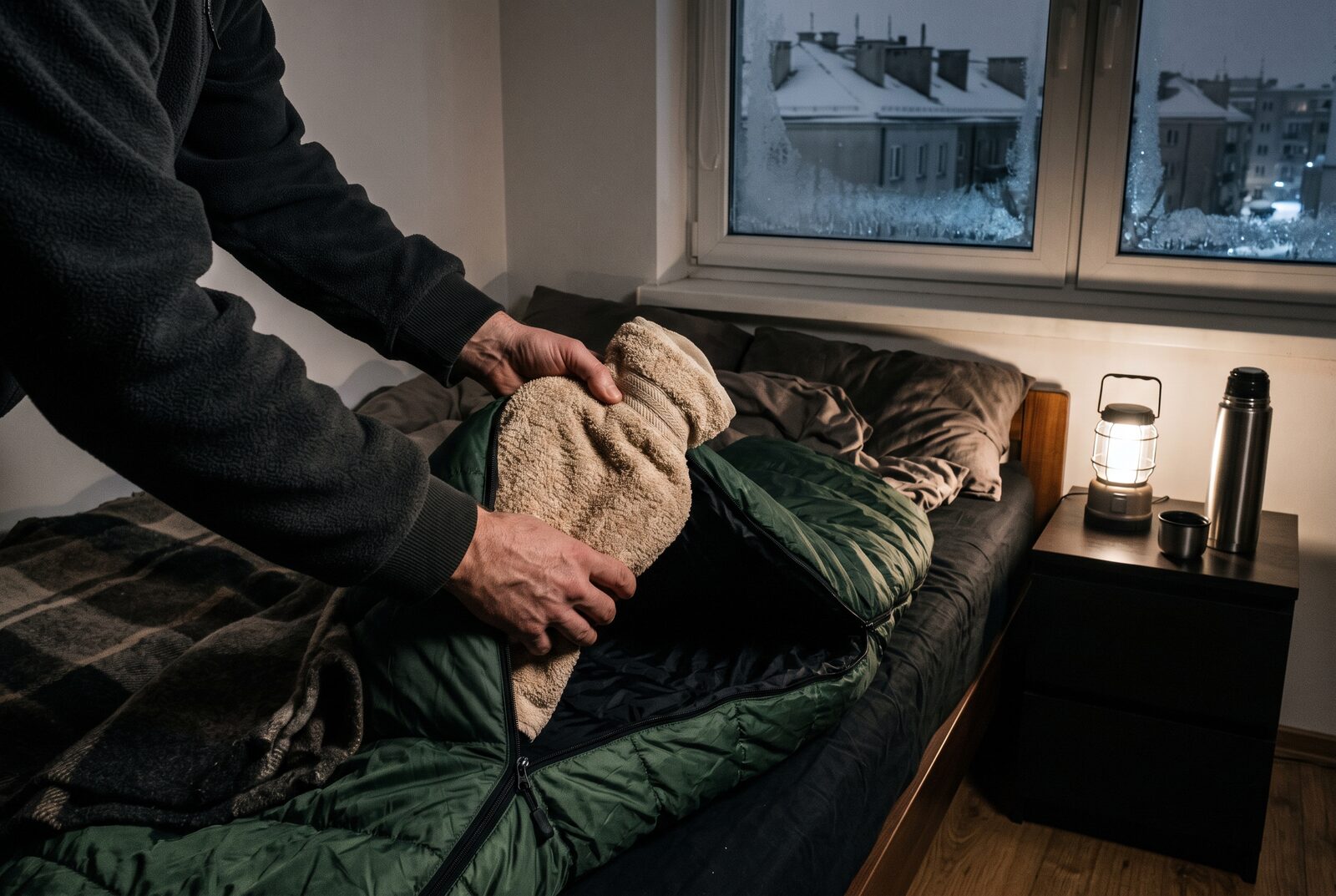
Your body heats itself from the inside like a stove, and every stove needs fuel. For a human, that fuel is food. Eat regularly and drink warm, sweet drinks or fatty broth.3 Fat not only provides energy, it’s also a good store of heat in itself. If you have something to boil water on, boil more at once and pour it into a flask Amazon store, affiliate link, opens in a new tab, and the hot tea will last you for many hours. I often take a flask of Yerba Mate into the winter mountains, and I don’t think any drink warms you up better than hot, sweet coffee from a flask. It’s also a big boost to morale, and in a crisis you can’t overstate how much that matters.
While we’re here, let’s deal with one myth about alcohol. In simplified terms you could say it does warm you up, but in most cases you’ll lose more heat than if you hadn’t drunk it. It widens the blood vessels in your skin, so you may genuinely feel warm, but that happens at the expense of heating your vital internal organs. In other words, heat flows away from the critical organs to the skin, which can be useful, for example when there’s a risk of frostbite, but only when you know help has already arrived or is just around the corner. Otherwise alcohol will do you more harm than good.
Before you go to sleep, slip a hot-water bottle filled with hot but not boiling water and wrapped in a towel into your sleeping bag. It’s a way to get a warm bed, not a treatment for hypothermia. Don’t put someone who is already chilled through into a hot bath, and only put a hot-water bottle on them through fabric, in the armpits and on the chest, not on the hands and feet.
What can you heat with without electricity?
Most of the heat sources you’ll have access to that don’t use electricity need fire. And fire in a closed room uses up oxygen and gives off fumes. Only as much exhaust can flow out as fresh air flows into the room.5 That’s why, whenever there’s a flame in the house, open a window a crack, even if you begrudge every bit of heat. You simply have to find a sensible compromise between warmth and safety here.
A fireplace and a wood-burning stove
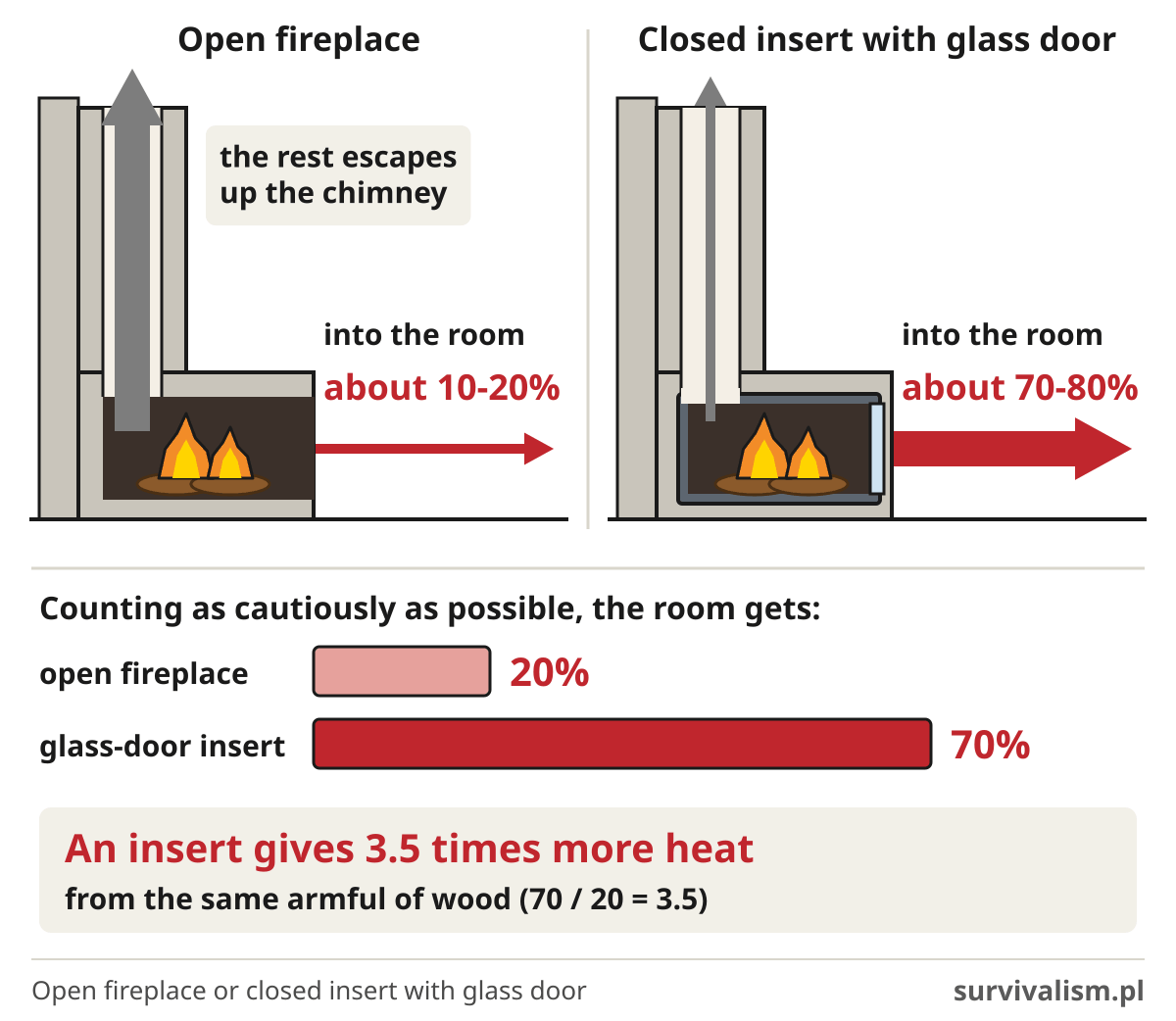
If you have a fireplace or a pot-bellied stove at home, you have the best thing you could hope for in a winter blackout. Just remember that not all fireplaces are equal. An open fireplace gives the room only about 10-20% of the energy in the wood, because the rest escapes up the chimney, while a closed insert with a glass door gives about 70-80%.6 Counting as cautiously as possible, 70% against 20%, an insert will give you three and a half times more heat from the same armful of wood.
A fireplace with a water jacket has pumps, so without electricity it has the same problem as a boiler.1 There’s also a trap hardly anyone thinks about. If the fireplace spreads heat around the house through ducts with an electric fan, then when the power goes the fan stops, and the hot air stays in the ducts and heats up everything around them. Fires have already started that way. In my view, with a fireplace like that it’s best - if you light it at all - to keep the fire small while the power is out.
If you like DIY, an interesting option is a rocket stove. The version with a thermal mass, connected to a chimney, keeps heating long after the fire has gone out. A small camping rocket stove, though, is a burner for cooking outdoors, not a heater for a room.
Dry wood and a clear chimney
If you have a choice, burn only dry wood. Freshly cut wood can be as much as 50-60% moisture and has to dry for 12-24 months to get below 20%.1 So a tree felled during a blackout won’t warm you, it’ll just fill the place with smoke and soot up the chimney. Don’t burn rubbish, plastic, clothes or chipboard furniture, because they give off toxic smoke.5 But if the choice is between the cold and a wooden chair, the chair goes in the stove 😉
Gas and catalytic heaters
A catalytic heater has no flame, so it’s tempting to think of it as safe. That’s an illusion, because it burns gas too, just without a flame. Catalytic heaters and gas patio heaters are not suitable for indoor use.7 The only heater that belongs in a flat is one the manufacturer explicitly approves for indoor use.
Don’t heat yourself with a gas hob either. Burning gas for a long time noticeably reduces the amount of oxygen in the air,8 and a hob burner isn’t made to heat a closed room for hours. You can use a gas hob in a different way, though. Boil a large pan of water, fill hot-water bottles or ordinary bottles and put them under the duvet or in the sleeping bag. The heat stays where you need it, and the hob doesn’t have to run for hours.
A flowerpot and candles
The flowerpot trick goes round the internet every winter. You put two clay flowerpots upside down over four tealights, and the clay heats up to around 50-70°C and gives off heat to the room.7 It looks clever, so let’s do the maths. One tealight has an output of about 32 W.9 Four together give about 130 W (4 x 32 = 128 W). The pot only collects the heat from the candles and gives it off a bit more slowly.
For comparison, a 2 kW fan heater gives 2,000 W.1 To replace it you’d need about 15 of these sets (2,000 / 130 ≈ 15), which is 60 candles. That’s more of a birthday cake than heating. A flowerpot with candles gives off as much heat as the candles alone, and not a single watt more.
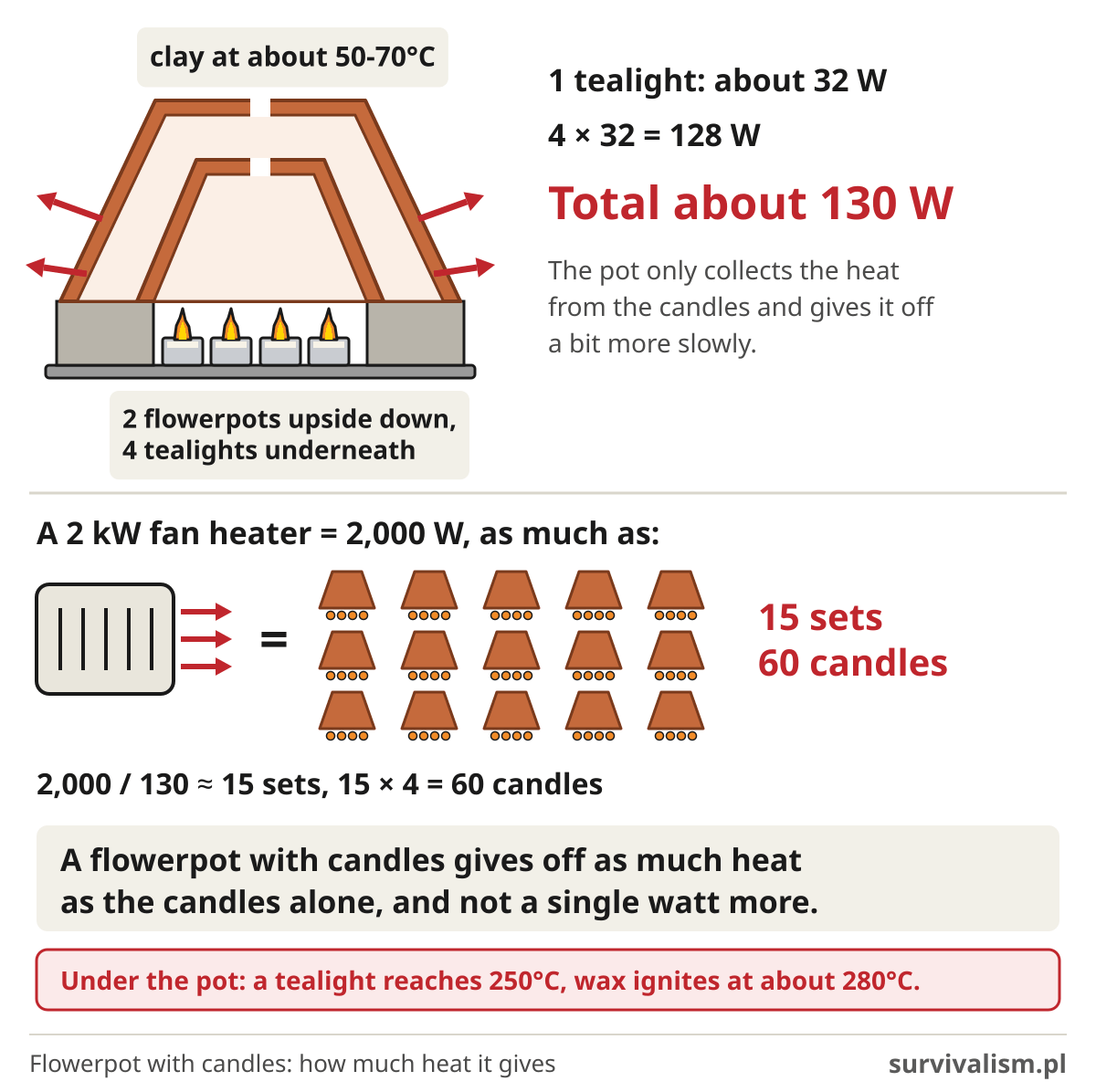
Worse still, it’s not just weak but dangerous too. A single tealight can heat up to 250°C. When several stand close together and the heat is trapped under the pot, within seconds you can get a wax fire, and wax starts burning at around 280°C. The flame can then suddenly shoot up as much as a metre.10 Under the pot it spreads sideways and easily reaches the curtains. Don’t put that kind of fire out with water, just as you wouldn’t with burning oil in a frying pan, but smother it with a fire blanket.
In my view, keep candles for light, not for heat. Just be careful which candles you buy. Supermarkets, especially on special offer, sell big sets of candles that say in the small print they’re for outdoor use only. Before you light one indoors, read the label.
Generator
In a house with a gas boiler, a generator is the simplest way to get normal heating back. The boiler together with its pumps usually draws less than about 400 W, so even a small 1-2 kW generator will run it with ease.1 To connect it you need a mains-generator changeover switch, and that’s a job for an electrician,11 not a task for a winter evening by torchlight.
A generator has a combustion engine, so it produces carbon monoxide. Always put it outdoors, at least 6 metres from doors and windows12. A balcony in a block of flats doesn’t meet that condition, because it’s always right next to a window or a door, which is why a generator is practically out of the question in a flat.
The car
A car with fuel in the tank is a heated cabin where you can warm up for a while and charge your phone. If you’re sitting in the car, run the engine and the heater for about 10 minutes every hour, open one window slightly and check that the exhaust pipe isn’t blocked with snow, because that risks carbon monoxide poisoning.35
In my view, though, the fuel in the tank is better kept for getting away. If the blackout drags on and you have somewhere to go, it’s better to set off with a packed bug-out bag than to burn through the tank parked outside your block of flats.
What never to do
There are a few things you should never do, however cold it gets. Don’t bring a barbecue indoors, whether it runs on charcoal, briquettes or gas.10 Don’t light a fire in anything that has no chimney. Don’t heat yourself with a gas oven.12 And don’t fall asleep next to any heater that isn’t connected to a chimney.
Carbon monoxide, the enemy you can’t smell
I’ve already mentioned the danger of carbon monoxide. It’s finally time to go into it a bit more, so that you know what you’re dealing with and what your biggest threat is when you try to keep warm by unconventional means.
Where it comes from and why it kills
Carbon monoxide is produced by the incomplete burning of almost any fuel: wood, coal, gas, oil, petrol or paraffin. Incomplete burning happens when too little air reaches the fire, for example because of airtight windows, taped-over vents, a blocked chimney or a firebox shut down too early.5 In other words, exactly when you’re doing everything you can in winter to stop the heat escaping.
You can’t see, hear or smell carbon monoxide. From 1 October 2025 to 12 January 2026, so in just over three months, carbon monoxide killed 31 people in Poland and poisoned 669.13
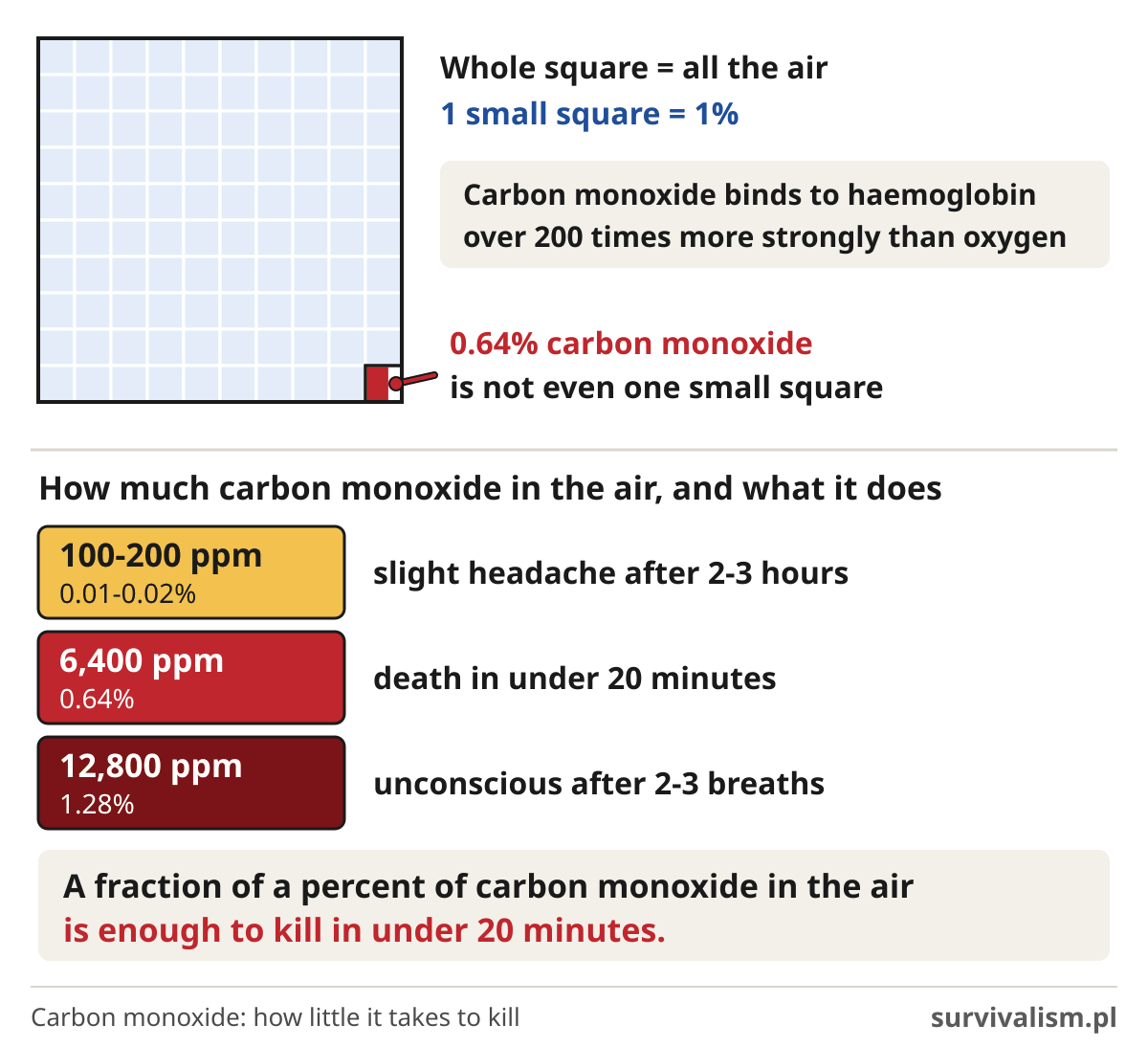
Why is it so effective? It binds to the haemoglobin in your blood more than 200 times more strongly than oxygen,14 so your blood stops carrying oxygen to your brain and heart, even though you’re breathing perfectly normally. Trace amounts are enough. At 100-200 ppm, i.e. 0.01-0.02% carbon monoxide in the air, you get a slight headache after 2-3 hours. At 6,400 ppm (0.64%, not even 1%!) death comes in under 20 minutes, and at 12,800 ppm (1.28%) you lose consciousness after 2-3 breaths. A fraction of a percent of carbon monoxide in the air is enough to kill in under 20 minutes.
Symptoms of carbon monoxide poisoning
Mild poisoning means a slight headache, nausea, vomiting, tiredness and weakness. With moderate poisoning the headache gets worse, and then come drowsiness, confusion and loss of balance, difficulty breathing, rapid breathing and an irregular heartbeat. Severe poisoning means seizures and loss of consciousness.5 The worst part is that someone affected by carbon monoxide becomes weak and dazed, stops judging the danger and simply doesn’t get out, until they finally lose consciousness.
In winter, in a chilled flat, it’s a double trap, because a headache, tiredness and drowsiness are easy to put down to the cold, a sleepless night and stress. If you get drowsy and your head starts to ache near a heater, don’t lie down to sleep, open the window.
The most vulnerable are babies (their blood binds up to twice as much carbon monoxide), children, pregnant women, older people and people with heart and lung conditions. Notice that it’s almost the same list as for the cold. The same people get cold the fastest and get poisoned the fastest.
Carbon monoxide alarm
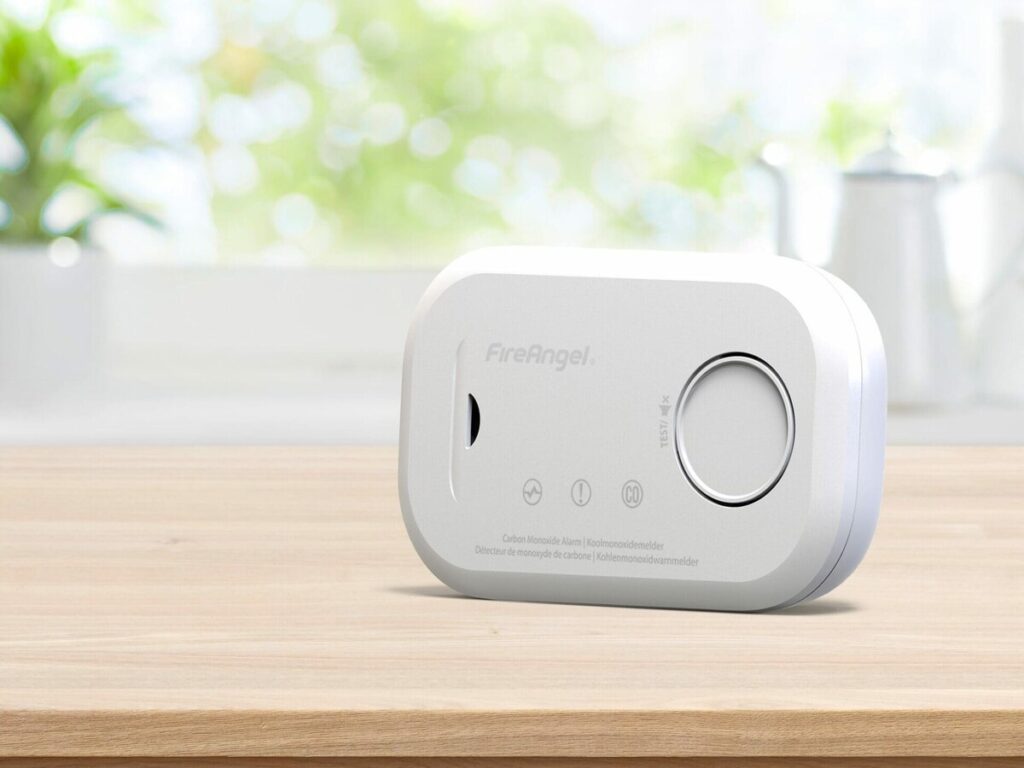
In my view a carbon monoxide alarm Amazon store, affiliate link, opens in a new tab is the cheapest insurance you can have whenever there’s a flame in the house. Without electricity only a battery-powered one will be any use, so check what powers yours. Put it 1-3 metres from the source of combustion, at eye level, and test it every month.15 Put a second one in the part of the home where you sleep.5
 Amazon store, affiliate link, opens in a new tab
Every now and then, also check that the ventilation works. Hold a sheet of paper against the air vent. If the draught is good, the paper will stick to the vent.
What to do when the alarm goes off
Open the windows, get everyone out into the fresh air, walking them out or carrying them, and call for help if you can. Loosen the casualty’s clothing, undo their belt and buttons, but don’t undress them, because in winter that can easily chill them. If they’re not breathing, start rescue breaths and chest compressions.5 If you can, turn the heater off on your way out, but don’t stay inside a moment longer than you have to.
In my view
In my view the order is simple. First keep the heat in: one room, covered windows, a tent or a blanket den, a sleeping bag, a hat and something warm to drink. Only then add heat, and only with something that has a chimney, or something the manufacturer approves for indoor use.
Buy a battery-powered carbon monoxide alarm now, before winter comes.
I couldn’t find a full summary of the last heating season, which is why I give the carbon monoxide death toll only up to mid-January. By the end of the winter it could only have gone up.
And how is it for you? Do you heat with gas, district heating, or maybe you have a pot-bellied stove or a fireplace at home? Do you have a tried-and-tested way to get through a cold night without electricity? Let me know in the comments, and I’ll gladly add the most interesting ideas to the article.
Sources
- ogrzacdom.pl, Nikon Gawryluk, “Źródła ogrzewania. Jak przetrwać awarię?” (in Polish): ogrzacdom.pl/artykul/413,zrodla-ogrzewania-jak-przetrwac-awarie
- Safety guide (gov.pl), “Długotrwały brak prądu (blackout)” (in Polish): gov.pl/web/poradnikbezpieczenstwa/dlugotrwaly-brak-pradu-blackout
- CDC, “Safety Guidelines: During & After a Winter Storm”: cdc.gov/winter-weather/safety/stay-safe-during-after-a-winter-storm-safety.html
- NHS, “Winter vaccinations and winter health”: nhs.uk/live-well/seasonal-health/keep-warm-keep-well
- State Fire Service, Wałbrzych City Headquarters, “Tlenek węgla (Czad)” (in Polish): gov.pl/web/kmpsp-walbrzych/tlenek-wegla-czad
- Przegląd Pożarniczy, Tomasz Sawicki, “Bezpieczny kominek” (in Polish): ppoz.pl/czytelnia/rozpoznawanie-zagrozen/Bezpieczny-kominek/idn:1479
- Feuerwehr Wickede (Ruhr), “Gefahr durch Teelichtöfen” (in German): feuerwehr-wickede.de/gefahr-durch-teelichtofen
- State Fire Service, Opole Regional Headquarters, “Gaz w domu” (in Polish): gov.pl/web/kwpsp-opole/prewencja-spoleczna-porady-gaz-w-domu
- Wikipedia, “Tealight”: en.wikipedia.org/wiki/Tealight
- Freiwillige Feuerwehr Hagelstadt, “Warnung vor Teelichtöfen” (in German): hagelstadt.feuerwehren.bayern/infos/warnung-vor-teelichtofen
- De Dietrich, “Czy kocioł gazowy działa bez prądu?” (in Polish): dedietrich.pl/blog/czy-kociol-gazowy-dziala-bez-pradu
- CDC, “Avoiding Carbon Monoxide Poisoning”: cdc.gov/natural-disasters/psa-toolkit/avoiding-carbon-monoxide-poisoning.html
- State Fire Service, National Headquarters, “Uwaga na tlenek węgla i pożary” (in Polish): gov.pl/web/kgpsp/uwaga-na-tlenek-wegla-i-pozary
- Przegląd Pożarniczy, Tomasz Sawicki, “Ale czad!” (in Polish): ppoz.pl/czytelnia/rozpoznawanie-zagrozen/Ale-czad/idn:1093
- State Fire Service, National Headquarters, “Sezon grzewczy 2025/2026. Sprawdź, jak chronić siebie i swoich bliskich” (in Polish): gov.pl/web/kgpsp/sezon-grzewczy-20252026-sprawdz-jak-chronic-siebie-i-swoich-bliskich
Leave a comment