
A rocket stove is a wood-burning firebox shaped like the letter J or L. You push sticks into a short feed opening, the fire burns in a horizontal channel, and the hot gases escape upwards through an insulated vertical channel. Its proper name is the heat riser, and in this article I simply call it the chimney. Most of the smoke burns off in this hot channel, and the draught is so strong that a well-lit stove roars audibly. That sound, as is usually assumed, is where the name comes from. A small rocket stove is for cooking, while a large stove with a heavy thermal mass (RMH) heats a house.
An introduction to rocket stove technology
If you have landed here, you have probably already heard of the rocket stove and you are curious what lies behind this intriguing name. When I got interested in the subject, I searched thoroughly through Polish and English-language sources, because rocket stoves are an interesting and fascinating topic. I even found plans and technical drawings that any DIY enthusiast can use to build their own rocket stove for all sorts of uses. So if you have the right tools and materials, it is a fairly simple process.
Before we dive in, let’s start with the basics. A rocket stove, known in Polish as “piec rakietowy“, is a heating appliance that has been gaining popularity lately thanks to its efficiency and practicality. But watch out! Do not confuse it with a Rocket Mass Heater (RMH), even though both technologies are based on similar principles. The main difference is that a rocket stove is focused on heating up quickly and is used mainly for cooking, while an RMH is designed to store heat and is used mainly to heat a house, although you can cook on it too. There are also many designs in between, but more on that later in the text.
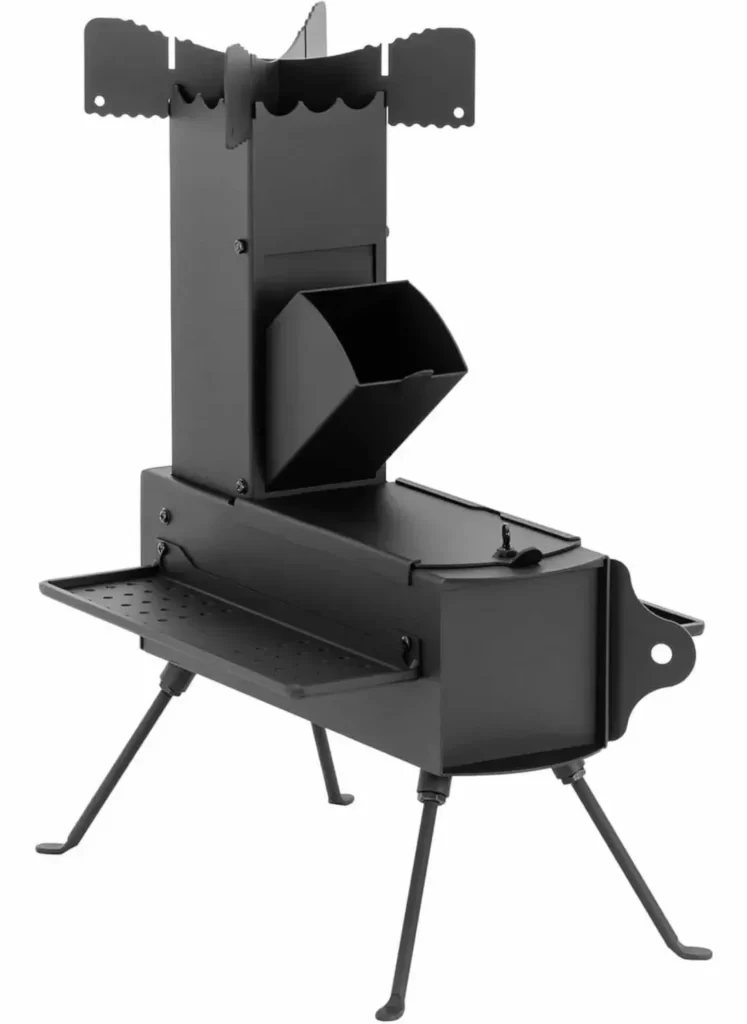
One of the reasons the rocket stove gets so much attention is its ability to burn fuel efficiently with minimal smoke and very efficient combustion. That makes it an efficient and economical solution. So the rocket stove is becoming an attractive alternative to traditional heating systems, not only at home but also outdoors, for camping and hiking. You can also buy light, folding rocket stoves that are easy to take into the field.
Many of you may be wondering: where does the name “rocket” come from? The popular explanation goes like this: the sound the stove makes while it is running is like a rocket taking off. And also, of course, its ability to burn fast and efficiently thanks to a design that looks a bit like a rocket engine. The Dakota fire hole works on a similar principle, and I wrote about it in more detail in the article Popular types of campfire: 8 kinds of fire everyone should know.
In the following sections, I will take you through the advantages, working principles and practical uses of the rocket stove.
6 undeniable advantages of using a rocket stove
I am genuinely impressed by how versatile the rocket stove is, and not long ago I knew nothing about it. I would like to share with you six key advantages of this innovative solution. If you are wondering whether a rocket stove is right for you, read on!
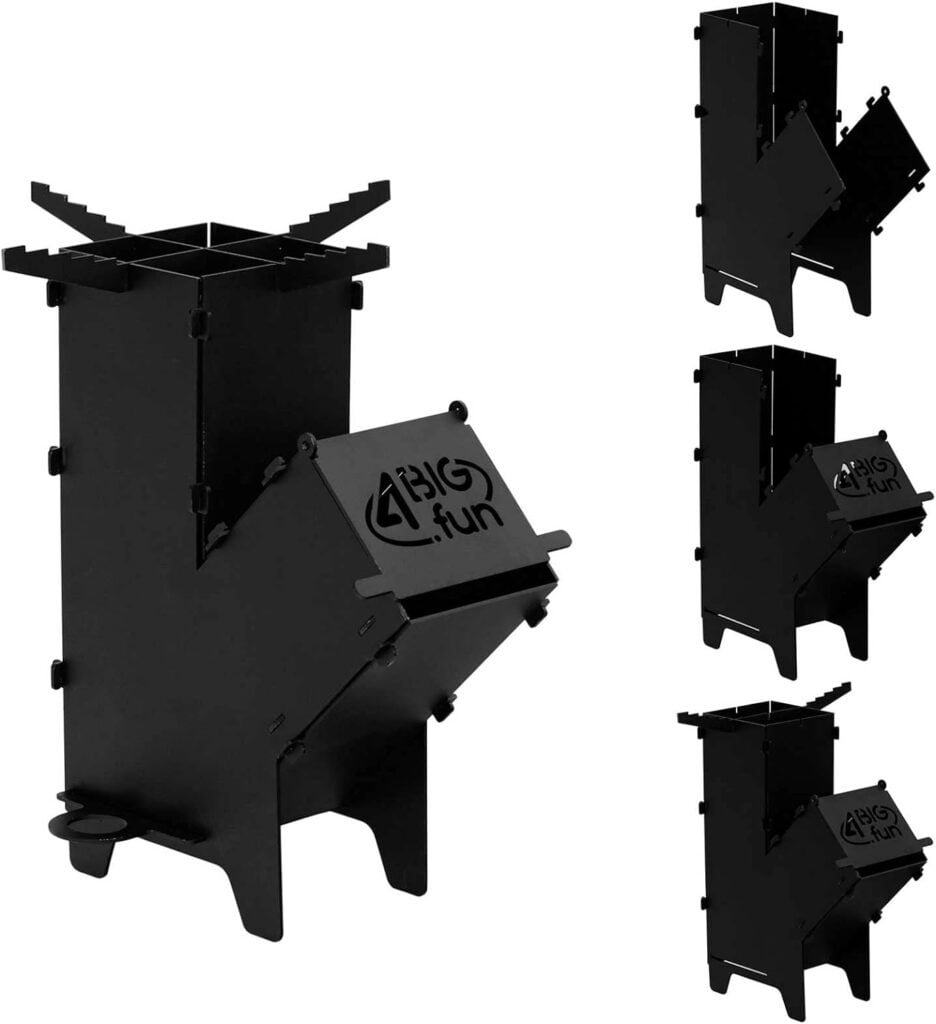
- Energy saving: One of the rocket stove’s main strengths is its remarkable energy efficiency. Compared with traditional stoves, a rocket stove uses less fuel to produce the same amount of heat. In practice, that means saving not only money but also resources. Here is what a 2008 study by the Aprovecho Research Center says about the efficiency and fuel savings of the rocket stove:
In field tests in India, rocket stoves used 18 to 35% less fuel than traditional cookstoves and reduced fuel use by 39-47% compared with a simple, traditional open three-stone fire.
(This refers to rural kitchens in India, not to home heating stoves.) - Fuel flexibility: Do not limit yourself to wood! A rocket stove can run on different kinds of fuel, such as wood, oil, pellets or coal, although each of them needs a different design (a basic rocket stove is designed for dry, thin wood: sticks and branches; do not burn coal or oil in a stove built for wood). That gives you more flexibility and lets you adapt the stove to the resources available locally.
- Simple to build: Thanks to the many guides and materials available, building your own rocket stove is now within everyone’s reach. You can use all sorts of materials, even barrels, pipes and ordinary tin cans, which makes it an ideal solution for DIY enthusiasts.
- High combustion temperature: One of the secrets of the rocket stove’s efficiency is its ability to reach very high combustion temperatures. In practice, that means cleaner burning and better use of fuel.
- Safety: How safe a rocket stove is depends above all on how well it is made. A well-built one burns fuel cleanly, with little smoke, but a camping stove has a very hot casing and its legs are set close together, so it is easy to knock over. Stand it on a level, non-flammable surface, away from dry grass.
- Proven design: Finally, a bit of trivia: the rocket stove is not a novelty at all. Larry Winiarski of the American organisation Aprovecho began developing it in the early 1980s with kitchens in developing countries in mind. For those who value simple, proven solutions, a rocket stove is a must.
To sum up, a rocket stove is not only an efficient and eco-friendly way to heat your home or cook, but also a real investment. If you do not like pointlessly “burning your money”, a rocket stove will certainly live up to your expectations!
Disadvantages and limitations of a rocket stove
Since I have covered the advantages, it is only fair to write about the disadvantages too. Ianto Evans and Leslie Jackson, the authors of the book “Rocket Mass Heaters”, devote a whole chapter to them1, and most of what follows comes from there.
First, a rocket stove needs constant feeding. Only the ends of the sticks burn, so you add wood often. In a large mass heater with a channel of about 20 cm that means roughly every hour or two, and in a smaller one even more often. It will not keep a clean fire going all night, so you light it again from scratch every day.
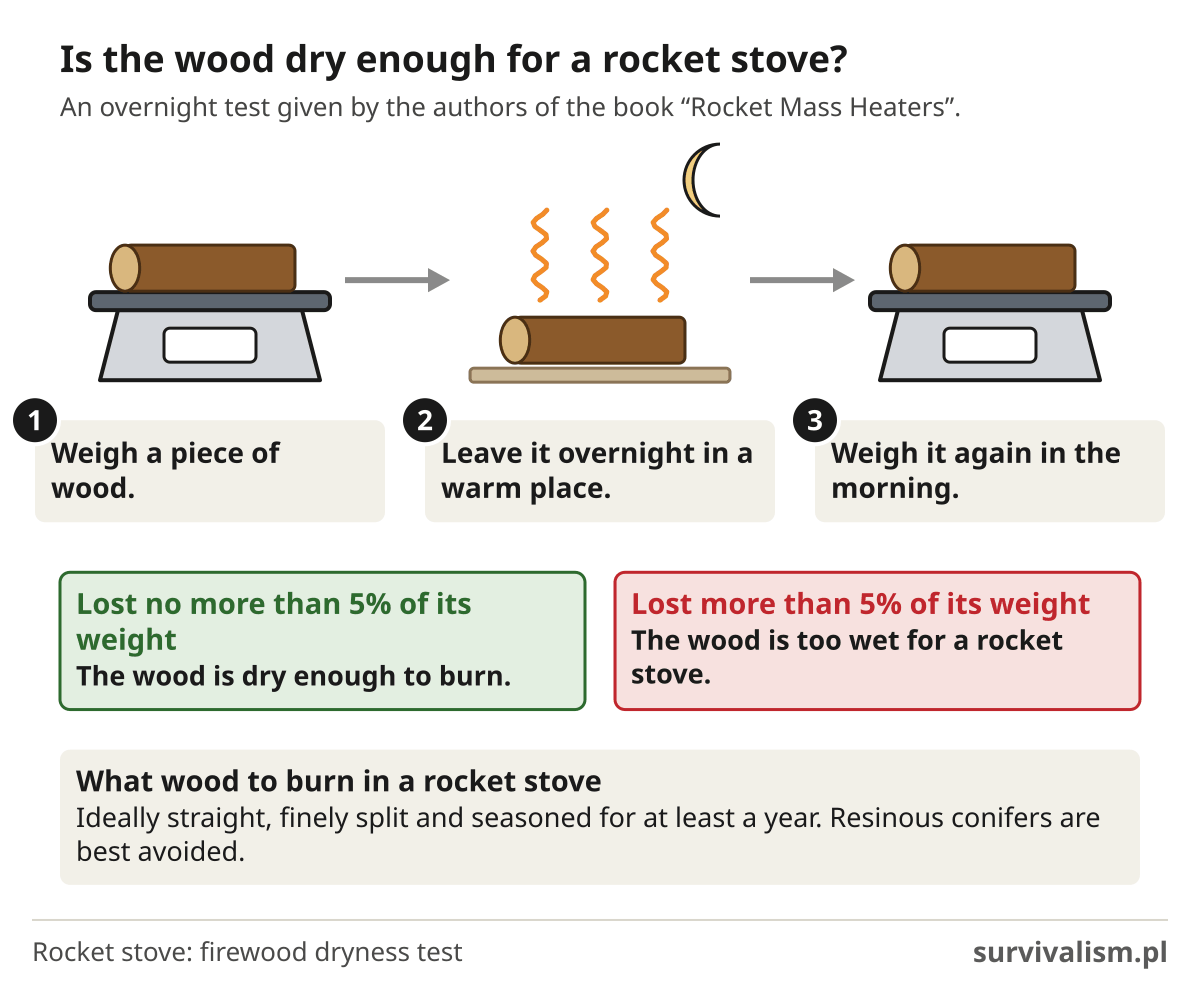
Second, it only likes dry wood, ideally straight, finely split and seasoned for at least a year. The authors give a simple test. A piece of wood left overnight in a warm place should not lose more than 5% of its weight. Resinous conifers are best avoided.
Third, it takes practice. According to the authors, it is a stove for an attentive operator, and if it is run badly it pays you back with smoke in the house or trouble getting it lit. They also say honestly that some stoves simply refuse to work, and that it is not a stove for someone who lives in a rented house.
Then there are smaller things. The stove roars, the ash has to be cleared out regularly, and the hottest spots (around the combustion tunnel and the metal inner chimney) burn through over time and need replacing. A large mass heats up slowly, so do not count on it to warm up a cold house quickly. The mass version is also simply heavy: a stove with a 20 cm channel means 8-9 m of channel in the bench and 1 to 3 tonnes of mass, so the floor has to be able to take it.
How a rocket stove works: a simple guide
The first time I heard about the rocket stove, it immediately piqued my curiosity. The name sounds intriguing, doesn’t it? But what lies behind it, and how does a design like this actually work? I decided to take a closer look.
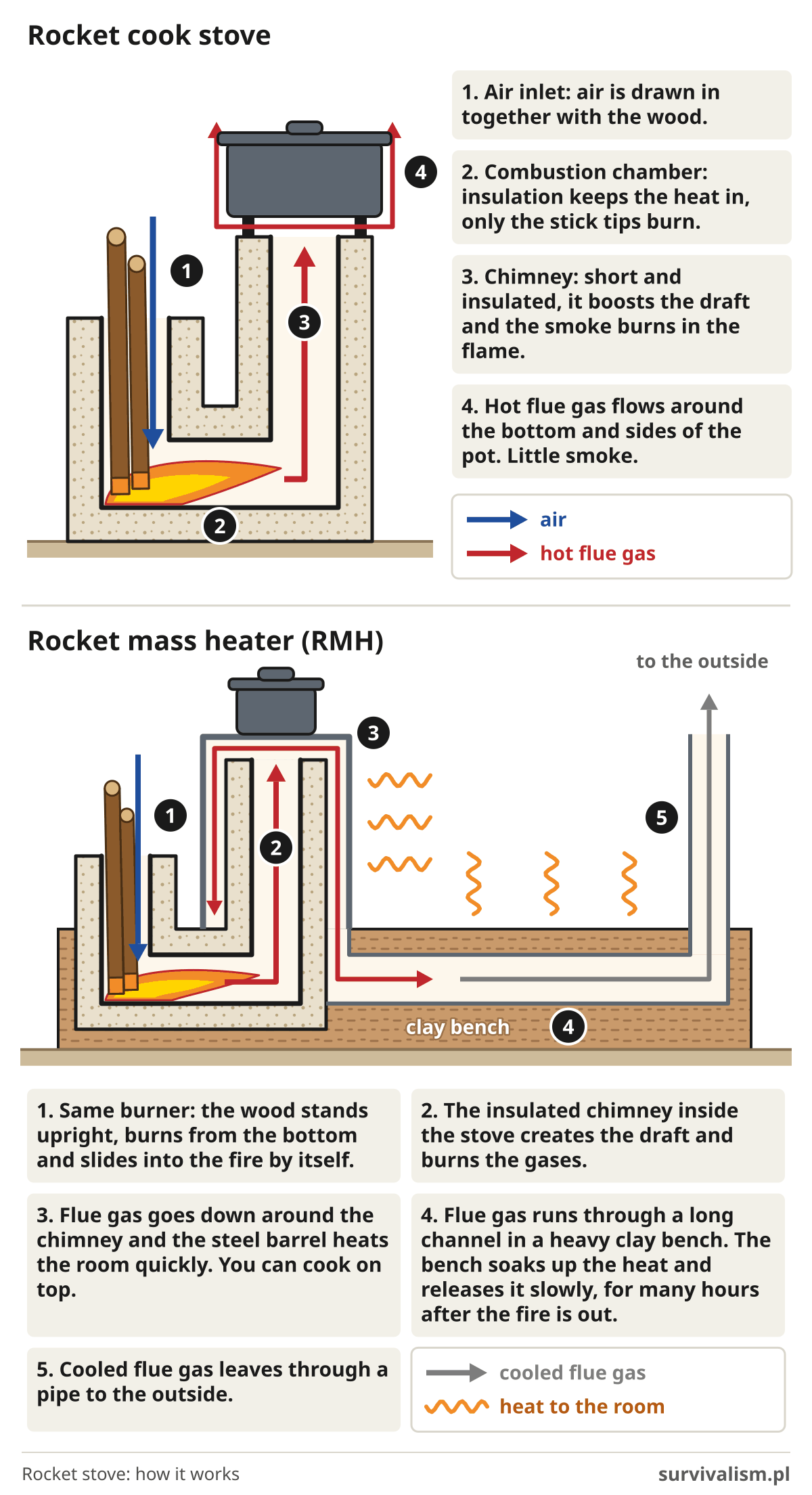
A rocket stove, also called a rocket cook stove, is an exceptionally efficient stove for cooking, and in the version with a thermal mass (RMH), for heating as well. Its design is simple, but the way it works rests on a few key principles:
- Strong air circulation: One of the main parts of a rocket stove is the combustion chamber. Thanks to this design, to put it very simply, air is drawn in at the inlet and moves quickly towards the outlet (the chimney), which promotes intense combustion by supplying extra oxygen and carrying away the gaseous products of combustion.
- High combustion temperature: A rocket stove can reach much higher temperatures than traditional stoves. This is down to the efficient airflow and the insulation, which keeps the heat inside the combustion chamber. The high temperature ensures that the wood burns almost completely, producing very little smoke and soot.
- Energy efficiency: Thanks to its particular design and intense combustion, a rocket stove uses less fuel than traditional fires (nearly 50% less than an open campfire!).
It is also worth pointing out the difference between a rocket stove (the cooking version) and a Rocket Mass Heater (RMH). While both work on similar principles, an RMH is a system that combines a rocket stove with a large thermal mass (for example a clay bench), which stores the heat for a long time.
Besides the advantages above, it is worth noting how easy a stove like this is to assemble and use. If you are thinking of building your own rocket stove, I am sure you will be surprised how few materials you need and how simple its design is. On top of that, in most designs the fuel in a rocket stove is gravity-fed, which means you do not need any special feeders, as you do, for example, with the pea coal boilers (ekogroszek) common in Polish homes.
To sum up, the rocket stove is a real masterpiece in the world of heating systems. It combines a simple build with energy efficiency, which makes it an excellent solution for anyone looking for eco-friendly and economical ways to heat. If you are as excited about this topic as I am, I recommend exploring further and testing a rocket stove in practice, and the information in the rest of this article will help you with that.
Types of rocket stove: choosing the ideal one for your home
When I first got interested in rocket stoves, I was surprised by how varied they are. They may look alike at first glance, but it turns out there are several different types and variants of these devices.
- Basic rocket stove: This is the simplest version, focused mainly on burning wood efficiently with minimal smoke.
- Rocket stove with a water jacket: This type of stove has a built-in water jacket, which can be used to heat water in the house. It is a great solution for anyone who wants to make the most of the energy the stove produces.
- Rocket stove for alternative fuels: Some rocket stoves are designed to burn not only wood but also oil or pellets. I have certain moral reservations about the oil-burning kind, but more on that later in the text.
- DIY rocket stove: For DIY enthusiasts there are rocket stove designs made from a barrel, a pipe or even a set of 3 food tins. Although they take more work to put together, they give you a huge sense of satisfaction at having made something with your own hands.
The English-language Wikipedia, on the other hand, suggests a different classification, which applies to rocket mass heaters (RMH):
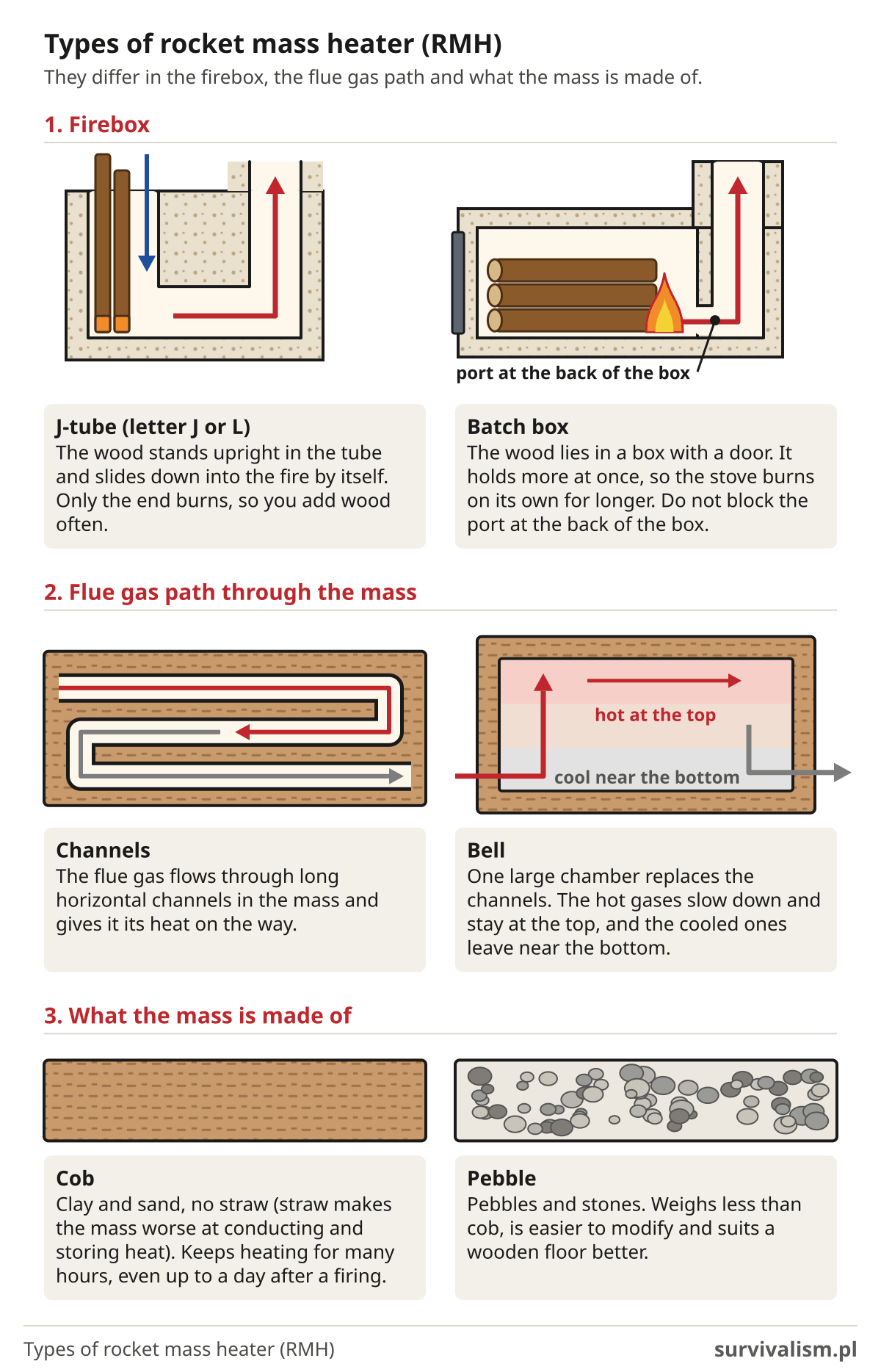
- Style with a J- or L-shaped tube (J-tube) In the earliest and most popular form, wood is gravity-fed into a “J”-shaped burn tube, from which the hot gases pass into a well-insulated secondary combustion chamber made of firebrick or ceramic. The exhaust from this chamber flows through horizontal metal ducts embedded in a massive heat store. The heat store is big enough to hold heat for many hours and can form part of the structure of the building. These heaters can be used in eco-building and in permaculture projects.
- Box style or batch box Newer alternative designs introduced a horizontal firebox called a “batch box”, which leads into a vertical heat riser or secondary combustion chamber. Compared with a conventional “J”-tube stove, a batch box can be loaded with more wood at once, so it can run on its own for longer. The horizontal flow through the mass can be replaced by a heavy “bell” with a larger cross-section, where the hot gases slow down and stratify, and the cooled gases leave near the bottom, as in some masonry heaters. To ensure proper airflow, the vertical port at the back of the box should not be blocked. Compared with the “J”-tube style, a batch box heater can take longer to build.
- Cob style (clay and sand) The heat channel of a rocket heater in this style is made from a mix of clay and sand, but without straw, because straw lowers the thermal conductivity and heat capacity of the mass. A mass made from this mix can absorb heat and hold it for a long time. This lets it heat a room for many hours, even up to a day after the fire has gone out1, which reduces the amount of wood needed.
- Pebble style Invented by Paul Wheaton (his first designs, as he writes himself, date from 2010), this style of rocket heater uses pebbles and stones to help store heat. Compared with cob rocket heaters, pebble heaters weigh less, so they are easy to move and modify. Their light build also makes them better suited to rooms with wooden floors. The pebble core also gives them a different, attractive look compared with clay and straw.
If you decide to buy a rocket stove or build one yourself, there are a few key factors to bear in mind. First, think about what your main goal is: is it heating your home efficiently, heating water, or maybe experimenting with DIY? Second, consider what fuel is available in your area. Some types of stove may suit your situation better than others.
I hope this guide helps you make an informed decision when choosing a rocket stove.
Rocket stove construction diagram
When I first heard about the rocket stove, I was really intrigued, but also a little sceptical. How can such a simple device be so efficient, cheap and effective all at once? The answer lies in its well-thought-out yet simple design.
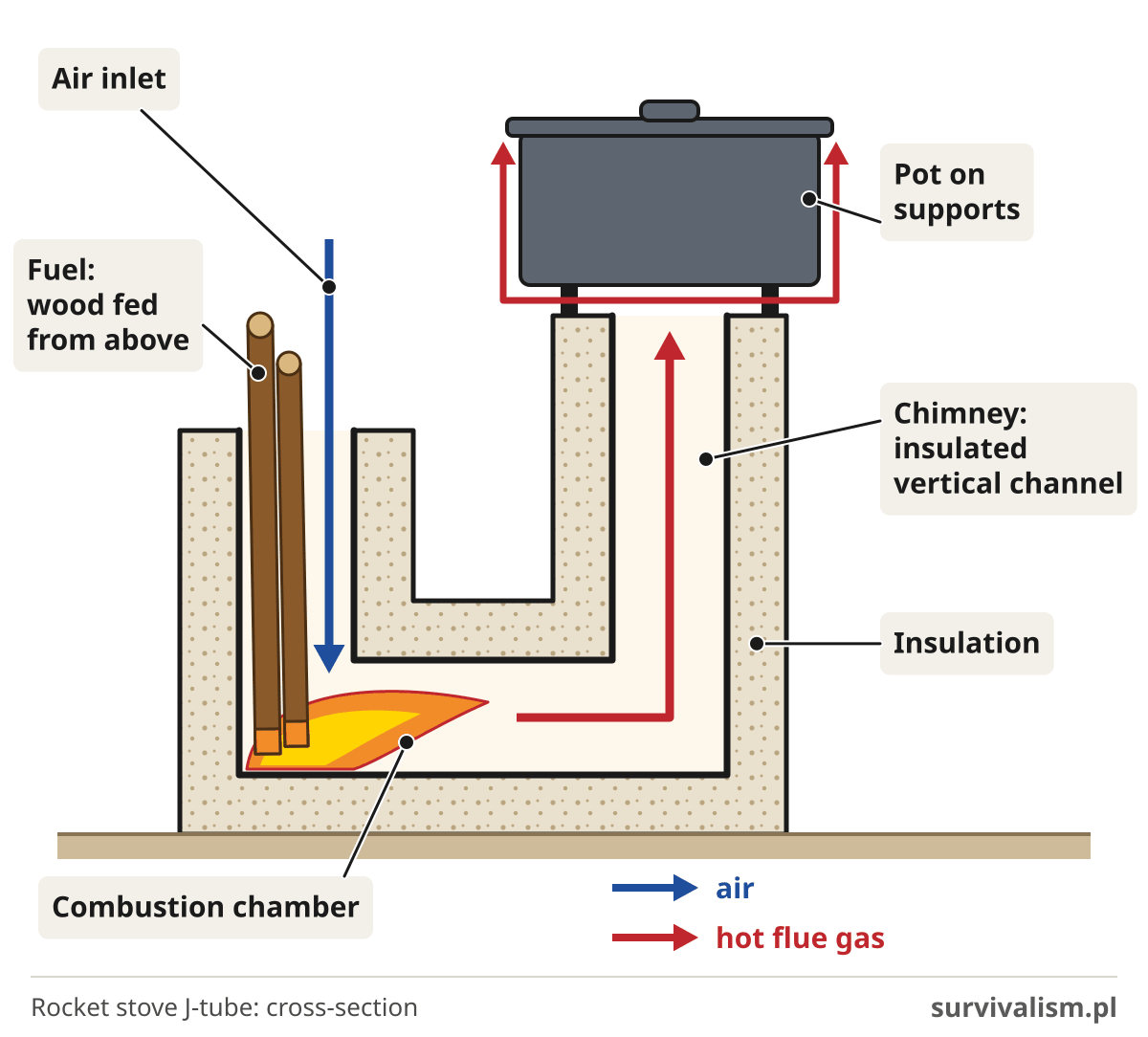
Air inlet
One of the key parts of a rocket stove is the air inlet. This is where air is drawn into the stove, which makes efficient combustion possible. A well-designed inlet ensures the best possible air supply, which in turn keeps the stove working efficiently.
- Channel cross-section: Getting the size of the channel’s cross-section right is the key to the best possible airflow.
- Material: Usually made of fire-resistant ceramic or metal.
Combustion chamber
The combustion chamber is the heart of a rocket stove. This is where the wood or other fuel burns, and a well-designed chamber makes the process as efficient as possible.
- Shape: Often a cylinder, cone or rectangle, depending on the type of stove.
- Location: Right next to the air inlet.
- Function: To get as much heat as possible out of as little fuel as possible.
Chimney
What makes a rocket stove stand out is its tall chimney (or more precisely, an insulated vertical channel right above the combustion chamber; in a stove for the home, the flue gas then goes out through an ordinary chimney). It gets the hot air and smoke out of the stove quickly, which keeps the fuel burning steadily and efficiently.
- Height: The taller the chimney, the better the draught, although that is not always what you want (in a cooking stove the vertical channel is usually about 2-3 combustion chamber diameters tall2, and its cross-section is the same as that of the inlet3).
- Construction: Often made of metal or other materials that can withstand high temperatures, ideally surrounded by insulation, because that is what keeps the temperature inside high. If you want to cook on your stove, this is where you put the pot supports.
Insulation
Insulation plays a key role in how efficient a rocket stove is: without it, it is hard to get the high temperature and clean burning that are its greatest strengths. Proper insulation ensures that the heat does not escape from the stove, but goes where it is needed.
- Material: Something light and heat-resistant, ideally full of tiny air pockets: ceramic insulation Amazon store, affiliate link, opens in a new tab, perlite, vermiculite Amazon store, affiliate link, opens in a new tab, pumice or wood ash. Clay and sand are best kept away from the fire itself, because they are heavy and soak up the heat themselves first3. Cut ceramic fibre blanket wearing gloves and a dust mask, because its fibres irritate the skin, eyes and throat.
- Location: Around the combustion chamber and the air supply channel.
Of course, there are many other nuances and details about rocket stoves that we could go into. Nevertheless, I hope this short overview has given you a solid grounding and inspired you to explore the subject further. If you are as fascinated by this technology as I am, I recommend more experimenting and learning!
Rocket stove with a water jacket: advantages and potential
When we think of a rocket stove, we often picture a simple, efficient design. But what if we added the ability to heat our home? Well, a rocket stove with a water jacket is an innovative approach that could revolutionise the way we see traditional heating systems. In this section we will look at how this technology works and what benefits it brings.
A rocket stove with a water jacket is not just another stove. The water jacket makes it not only an efficient source of heat but also a versatile way to heat water for the house. But how does it work?
What is a water jacket?
A water jacket is a way of heating many parts of your home from a single fireplace. It is most often a steel tank or a coil filled with water, placed right in the firebox and connected to the central heating system. In a rocket stove with a water jacket, however, the coil must not be in direct contact with the flames and embers, so bear that in mind when building your own stove.
The water jacket lets you distribute heat to other rooms in the house. Importantly, there is no need to add extra pumps - hot water circulates naturally, because it is lighter than cold water and rises by itself (this is called gravity circulation). All you need to do is fit an expansion tank at the highest point of the system to enjoy warmth throughout the house. (Note: a water jacket on a wood-burning stove makes it a central heating installation. In an open-vented system it needs an open expansion vessel and safety pipes without shut-off valves, and the vessel must be protected from freezing, because a badly protected jacket can burst.) Thanks to the savings from burning wood or pellets, the investment in this technology can pay for itself, although how quickly depends on the cost of building it, the price of fuel and what you used to heat your home with before.
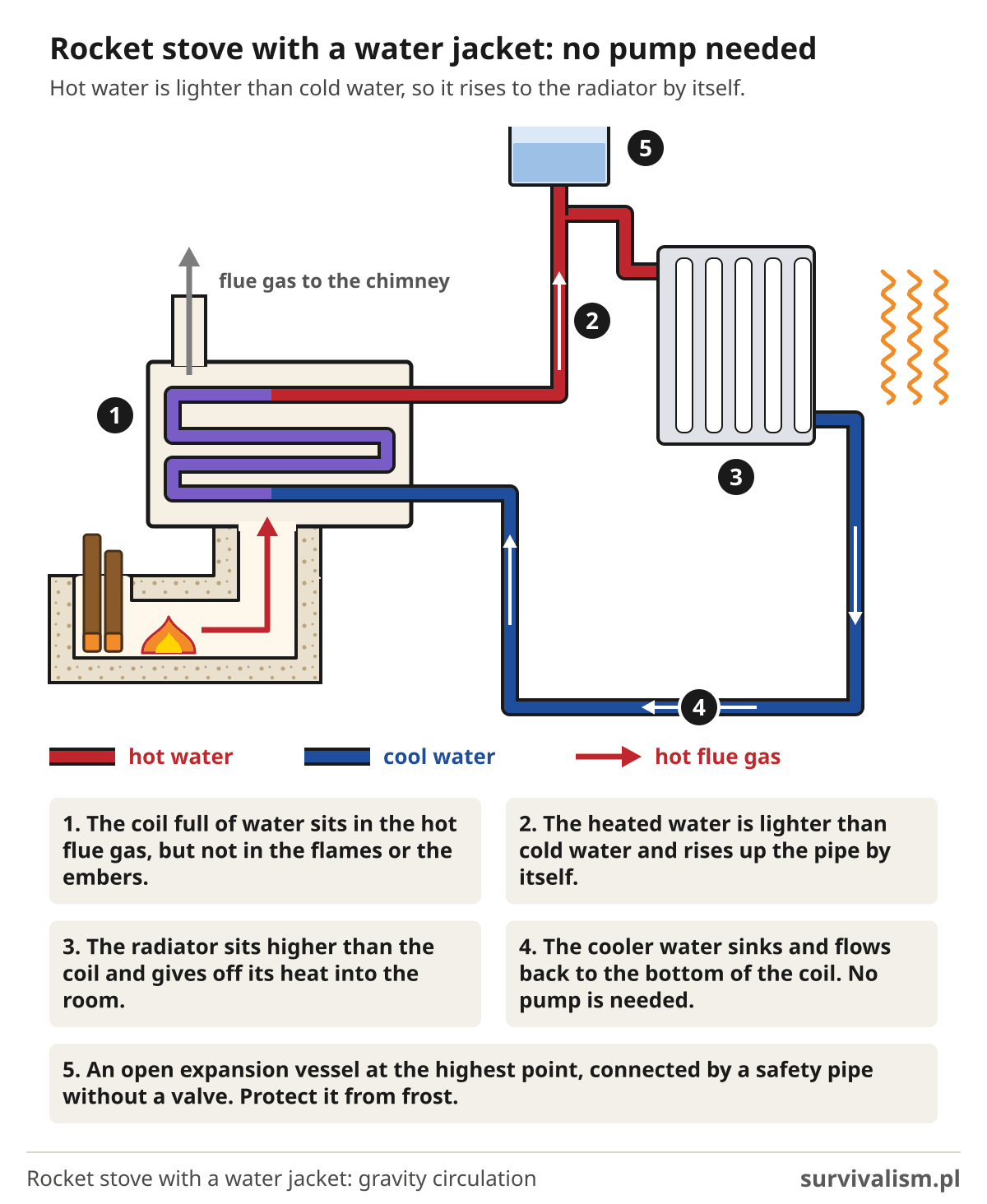
- How it works: In a rocket stove with a water jacket, water is held in a tank surrounding the combustion chamber. When the stove heats up, the water in the jacket heats up too. This simple yet brilliant approach gives you hot water almost straight away.
- Versatility: As well as heating, this stove also supplies hot tap water. It can serve as the main source of heat for your home while also feeding the hot water system.
- Efficiency By using the natural circulation of water, a rocket stove with a water jacket is more efficient than traditional heating systems. This results in lower fuel consumption and greater output.
- Cost: Buying a rocket stove with a water jacket may be more expensive at first, but in the long run it saves on the cost of heating and hot water. That way the investment can pay for itself over time.
If you are thinking of upgrading your heating system or looking for an efficient source of hot water, a rocket stove with a water jacket is a solution worth considering. By combining the simple design of a rocket stove with the benefits of a water jacket, you get a solution that is not only efficient but also very economical.
I encourage you to read up on this technology and consider putting it in your own home, but you are unlikely to find a ready-made rocket stove with a water jacket in a shop. That leaves either ordering one from a stove fitter or making it yourself.
What are the dimensions of a rocket stove? Dimensioned drawing
This is a J-shaped stove with a feed tube set at 45°, welded from 100 x 100 x 3 mm box section. You put the wood into the angled feed tube (3) and it slides down onto the fire grate (A), which is simply the holes drilled in the top wall of the lower channel (2), right under the chimney. Air comes in through the open ends of that channel and rises through the grate holes into the embers, and the smoke and heat go up the chimney (1) straight to the pot. No wood goes into channel 2, it only brings in air, and part 6 is the pot support, not the grate.
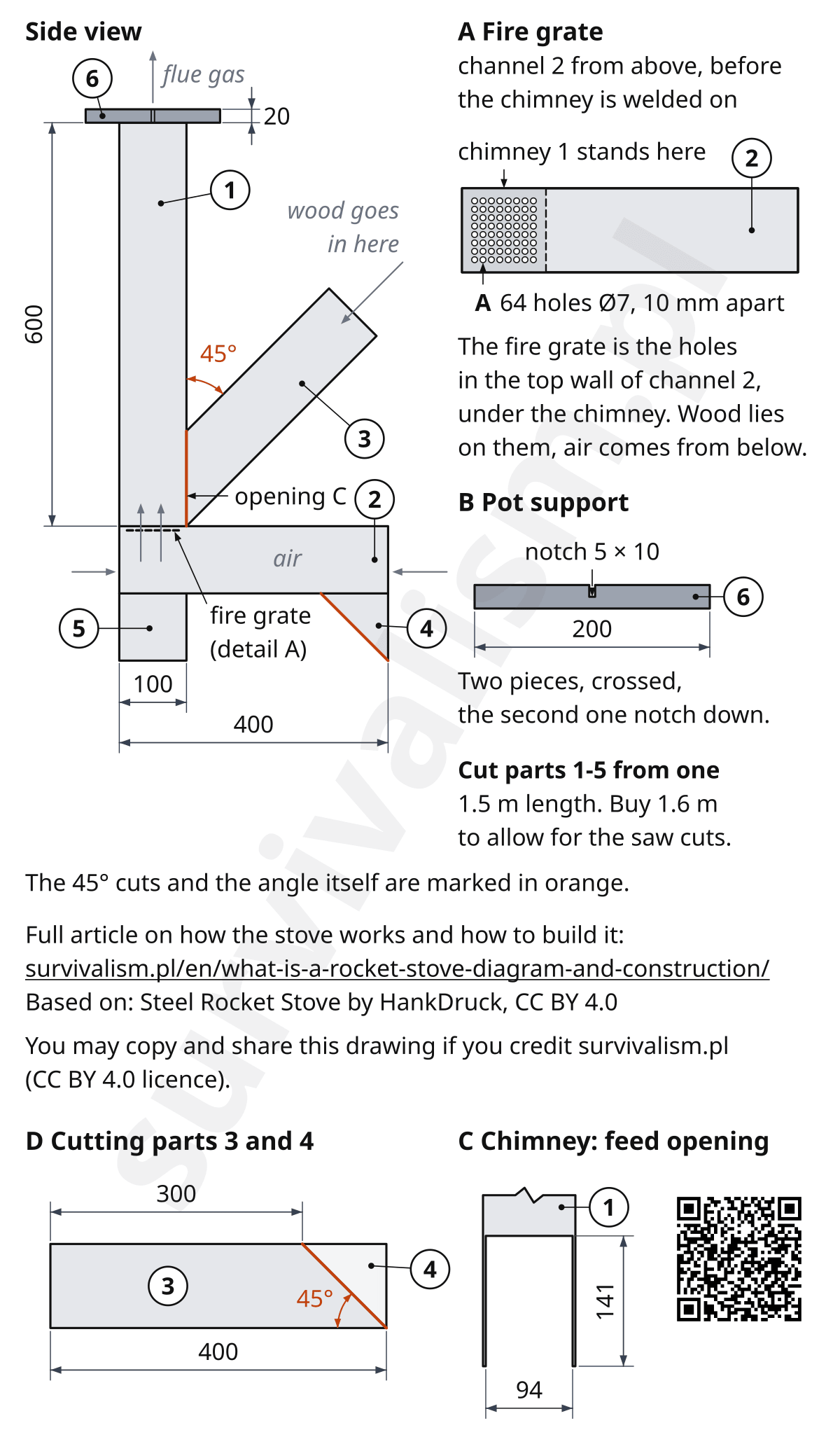
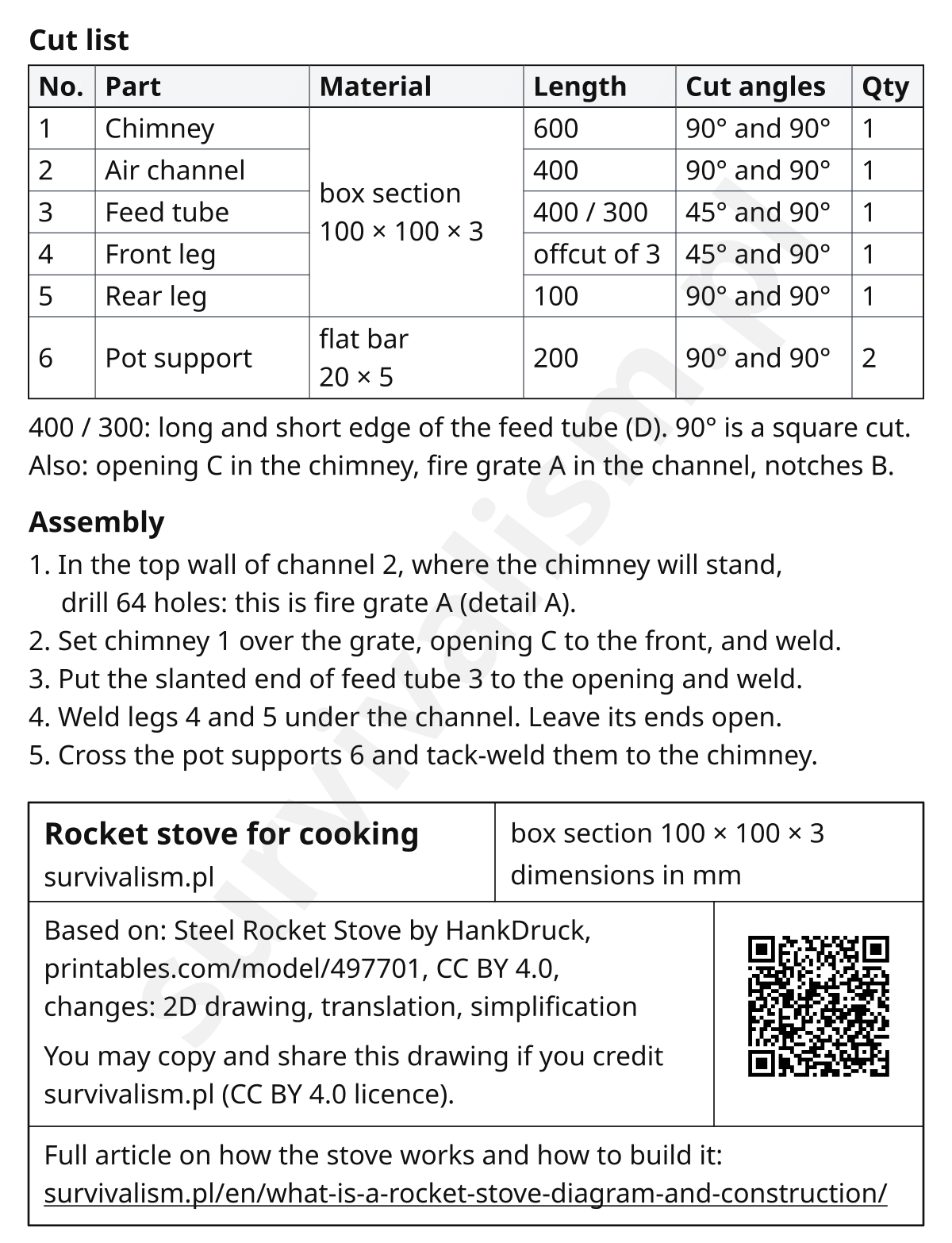
Using a different box section? Scale the lengths in the cut list to the inside width of your section. 100 x 100 x 3 mm box section is 94 mm wide inside, so multiply each length by the inside width of yours and divide by 94. In 80 x 80 x 3 mm, which is 74 mm inside, the chimney comes out at about 47 cm instead of 60. The 45° angle and the 20 mm gap between the chimney and the pot stay the same. This only scales this one design up or down; it is not a rule from the sources. The only rule the sources give is for the chimney, which should be roughly two to three times2 or about three times3 as tall as it is wide, and the chimney on this drawing is taller than that because that is how the model’s author designed it.
Rocket stove: dimensioned diagram to print (PDF)
The drawing fits on two A4 pages: the dimensioned views on the first, the cut list and assembly on the second. Download the drawing as a PDF, print it and take it to the workshop.
The drawing is based on the 3D model “Steel Rocket Stove” by HankDruck, licensed under CC BY 4.0. It was turned into a flat drawing, translated and simplified: no extension on the side of the chimney, a grate drilled straight into the channel and a simpler pot support. The model’s description says it is a beta: the stove has not been built yet and there is no guarantee that every part fits perfectly. This drawing has not been tested on a built stove either, so dry-fit the parts before you weld.
A second, different design is the technical drawing of a simple rocket stove that I managed to dig up in the depths of the internet on GrabCAD. Although the text is in Turkish, the construction details are simple and easy to follow. It has a lower chimney and a shorter feed tube than the drawing above, so do not mix dimensions from the two.
Rocket stove efficiency and temperature
On Polish websites a rocket stove is credited with “up to 90% efficiency”, “70-90%” or “75-95% combustion of the gases”. It sounds great, except that I could not find a study these figures come from, and on top of that they mix up two different things.
Combustion efficiency vs thermal efficiency
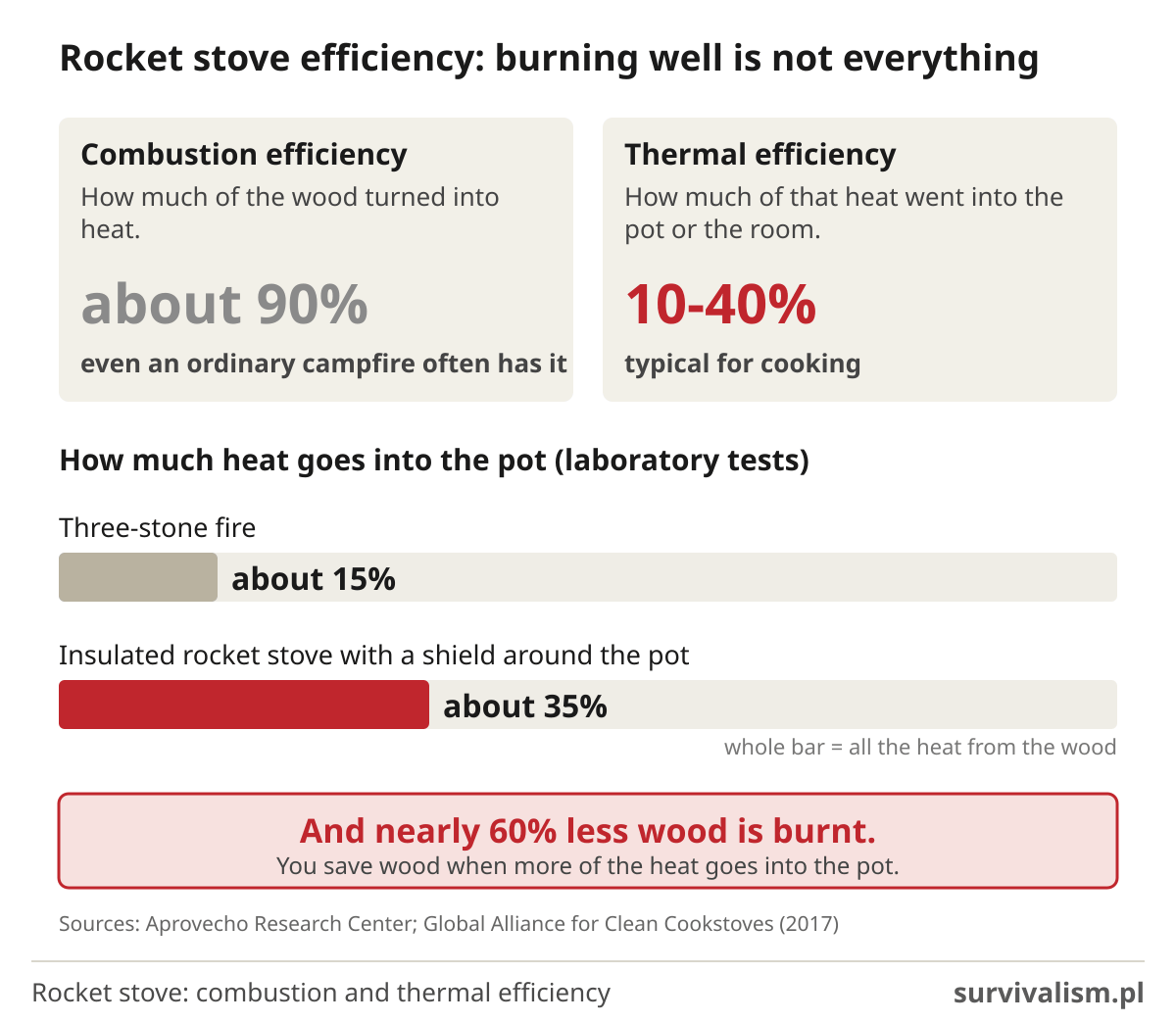
Combustion efficiency tells you how much of the wood has turned into heat, and here even an ordinary campfire often reaches about 90%. Thermal efficiency tells you how much of that heat went where you need it, that is, into the pot or into the room. For cooking it is usually between 10 and 40%3, so better combustion on its own saves little. You save wood when more of the heat goes into the pot, not into the air.
In laboratory tests a three-stone fire passed about 15% of its heat into the pot, and an insulated rocket stove with a shield around the pot about 35%. The difference looks modest, but wood use drops by nearly 60%4. In real kitchens in India the savings were smaller, as I mentioned under the advantages.
For a large mass heater there is simply no reliable measurement of heating efficiency. Instead, Ianto Evans gives a comparison from his own life: in his cottage in Oregon he burns about two thirds of a cord of wood a year (an American cord is about 3.6 m³ of stacked wood), while his neighbours burn 3 to 5 cords5. It is an account, not a measurement, but it gives you an idea of the scale.
Temperature in a rocket stove
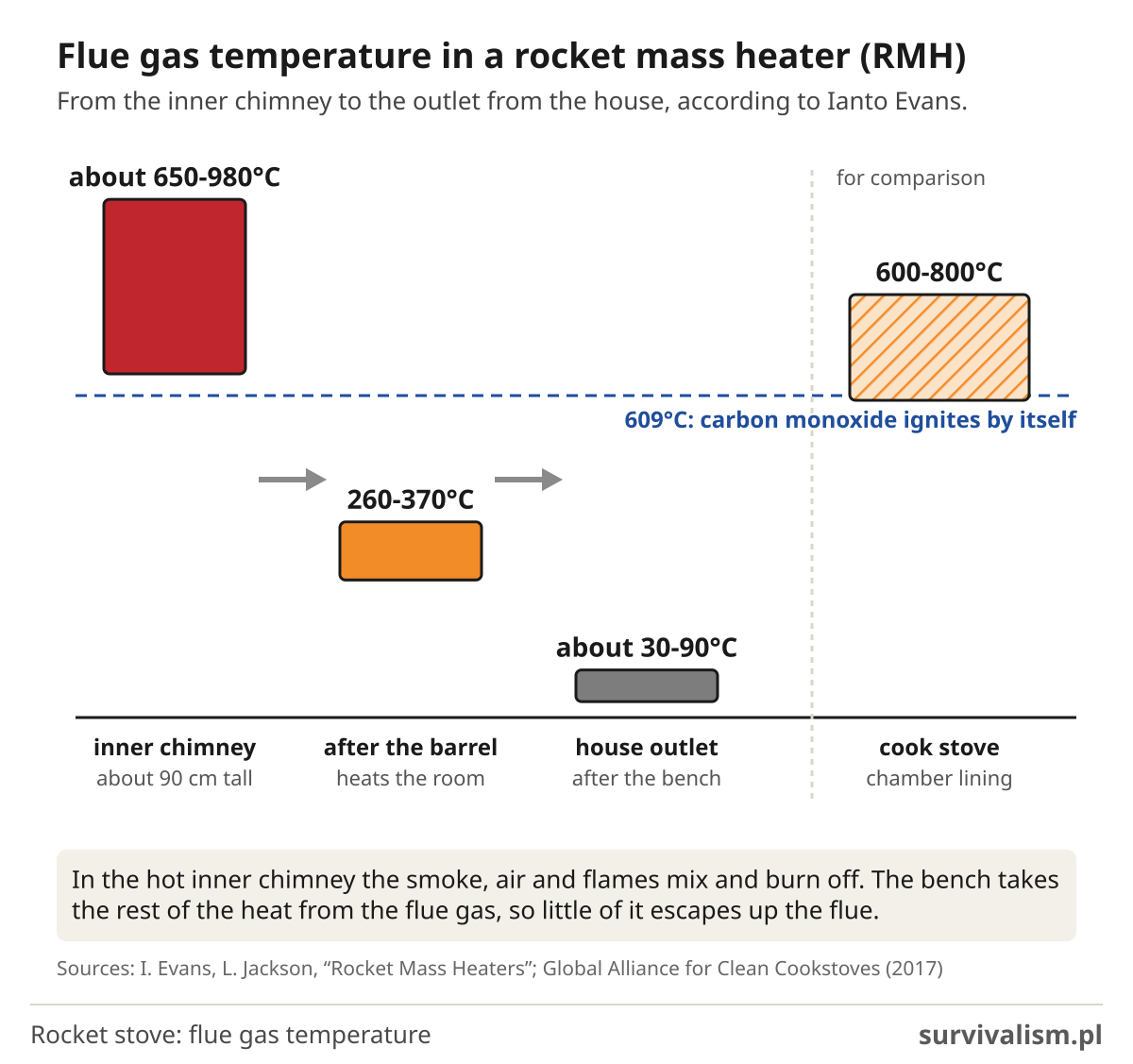
In Evans’s mass heater the inner chimney is about 90 cm tall and runs at between about 650 and about 980°C. After the steel barrel the flue gas is still at 260-370°C, and after passing through the clay and stone bench it leaves the house at about 30-90°C5. That is exactly why so little heat escapes up the flue.
By comparison, the combustion chamber lining in ordinary natural-draught wood-burning cook stoves runs at 600-800°C, and carbon monoxide ignites by itself at 609°C4. So a hot, well-insulated inner chimney gives the smoke, air and flames a place where they can mix and burn off3, and that is where the clean burning of a rocket stove comes from.
A rocket stove for your home: tips for beginners
Deciding to install a rocket stove at home can seem a bit overwhelming, especially if you are new to this. To make life easier for you, I have put together a few key tips to help you understand what to look out for when choosing and installing a stove like this.
- Work out what you need: Before you start looking for the perfect rocket stove, think about exactly what you need. Are you planning to use it mainly for cooking? Or perhaps to heat a small room? Once you know what you need, you will be able to tailor your choice better.
- Consider the location: Where are you planning to install your stove? Make sure the location is suitable in terms of ventilation ducts, and that the stove will not be a danger to the materials around it. (Use a camping or garden stove only outdoors, never in a garage, summer house or tent, because of the risk of carbon monoxide poisoning. A stove indoors must be connected to a working chimney, and there should be a carbon monoxide detector Amazon store, affiliate link, opens in a new tab in that room.)
- Choose the right materials: A rocket stove can be made from various materials. Although many people choose a masonry stove, you can even make one from a barrel or from a pipe, so it is worth looking into the different options available. Materials such as stainless steel or cast iron may last longer, but they may also be more expensive.
- Understand how it works: Before you start using the stove, it is important to understand how a rocket stove works. This is the key to optimising its performance and getting the most out of it.
- Consider extra features: Some rocket stoves have extra features, such as a water jacket or a heating coil, which can increase their efficiency and usefulness. It is worth considering whether add-ons like these would benefit you.
- Budget: Last but not least, set a budget. Rocket stoves come in a wide price range, from simple, inexpensive models to advanced systems with lots of features. If you choose a stove that meets your needs and fits your budget, you will be happy with your purchase. Remember that a rocket stove is an investment that will save you a good deal of money in the long run.
Buying and installing a rocket stove at home can be a fascinating experience. With the right knowledge and preparation, you can enjoy all the benefits this innovative system has to offer. And above all, do not forget to enjoy using your rocket stove, whether you are cooking on it or relaxing in the warmth of the flames.
What is a rocket stove good for?
In short, for cooking outdoors and for heating a house that someone lives in all the time. Everything else involves compromises.
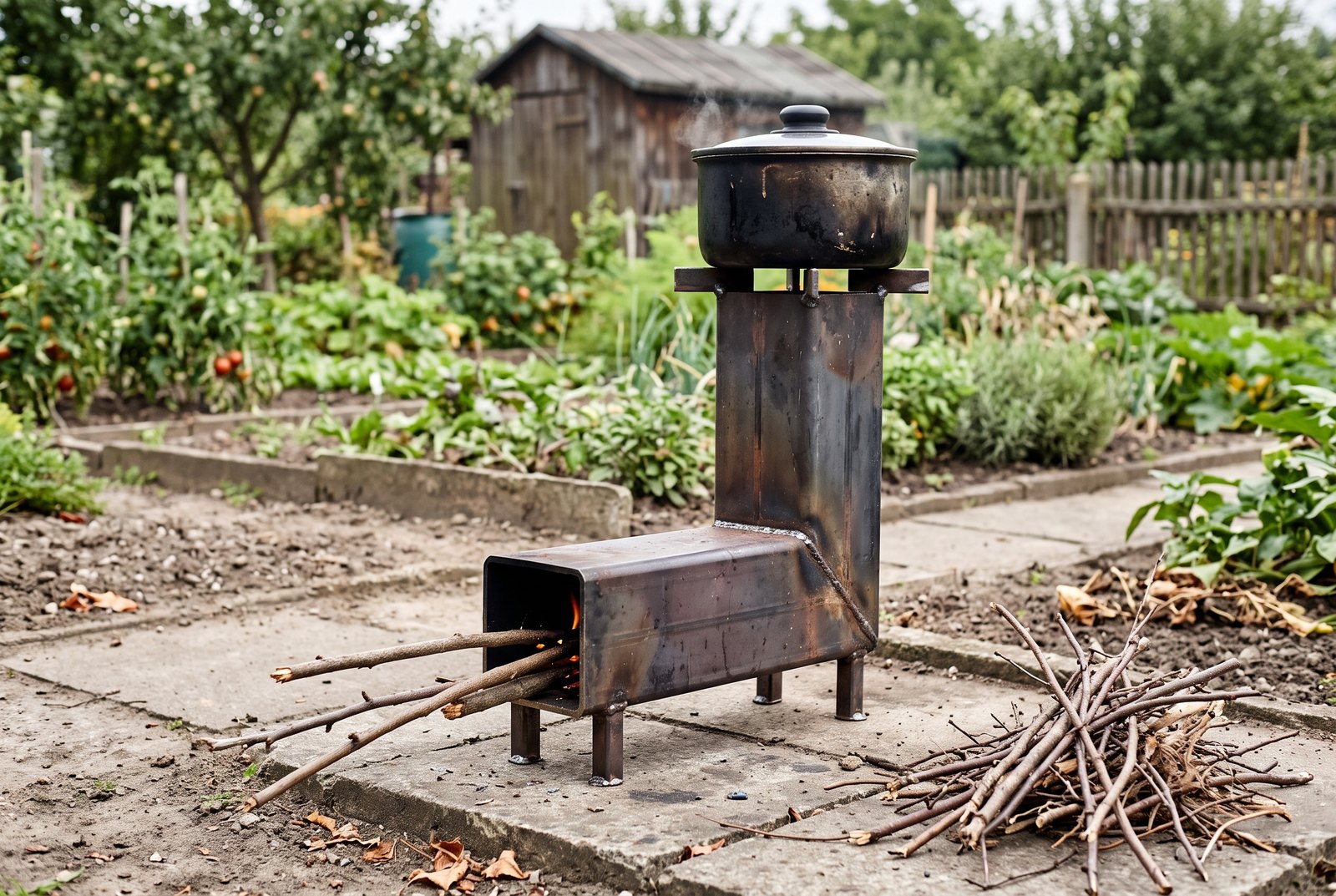
Field kitchen. That is what the rocket stove was invented for, because Larry Winiarski designed it for kitchens in countries where people cook on wood. Set up in front of the house, on an allotment or at a campsite you drive to, it will cook dinner on a handful of sticks, even when there is no electricity or gas for a long time. If that scenario interests you, in another article I write more about how to survive a blackout.
Heating a house. This is a job for a mass heater (RMH), not for a cook stove. The heavy bench stores the heat and keeps giving it off for many hours, even up to a day after the fire has gone out1, so it works best in a house where someone lives and lights the fire every day. Ianto Evans has heated his house solely with a stove like this (well, and the sun) since the late 1980s5. In a cottage you only visit at weekends, the cold mass takes too long to warm up for it to make sense. You can get hot water from a stove like this through a water jacket or a coil, which I wrote about above.
Garage and workshop. Here I would think twice. If you only use your workshop now and then, a mass heater will not have warmed up before you finish work, and the authors of the RMH book themselves recommend an ordinary stove, which heats straight away, for places like that. If you spend whole days there, an RMH makes sense, just as in a house, that is, with the flue gas led into a chimney. A camping stove is no good for a garage, for the reason I gave in the tips for beginners.
Greenhouse. The flue pipes are run under the beds or under the floor, and the bed stores heat much as the bench does in a house. A greenhouse is damp, so the ducts have to withstand corrosion (brick, stainless steel), and the flue gas is led outside, not into the greenhouse.
Building a rocket stove step by step
Building your own rocket stove may seem complicated at first, but with the right approach and the right materials it is a job you can successfully do yourself. There are a great many stove designs, which differ in the materials they are built from, their size and their construction details.
Below I will give you a brief plan for building a simple rocket stove in the strict sense, that is, one you can cook on. It will be a model made from welded pipes and box sections, but there are also masonry models, which need a somewhat different set of materials and skills.
Here we will use the dimensioned drawing above. You can cut the whole stove from one 1.5 m length of 100 x 100 x 3 mm box section (buy 1.6 m, as some of it goes on saw cuts), and the pot support from 40 cm of 20 x 5 mm flat bar.
If you prefer the Turkish drawing I linked to earlier, the main materials are about 1 metre of 100 x 100 x 3 mm box section and about 1.4 metres of 20 x 20 x 2 mm box section Amazon store, affiliate link, opens in a new tab. On top of that, a few pieces of sheet metal Amazon store, affiliate link, opens in a new tab for the burner base, the base of the legs and, if you want one, a flap for the feed opening. Of course, you will also need the right tools (and common sense when using them: use plain black steel, not galvanised, because zinc gives off fumes when welded and in a fire, and breathing them can give you what is called zinc fume fever; protect your eyes, airways and hands when cutting, grinding and welding, ideally with leather welding gloves Amazon store, affiliate link, opens in a new tab, and do the first firing outdoors).
In this video a chap shows how to go about it, although I must admit his choice of cutting tool size is rather controversial:

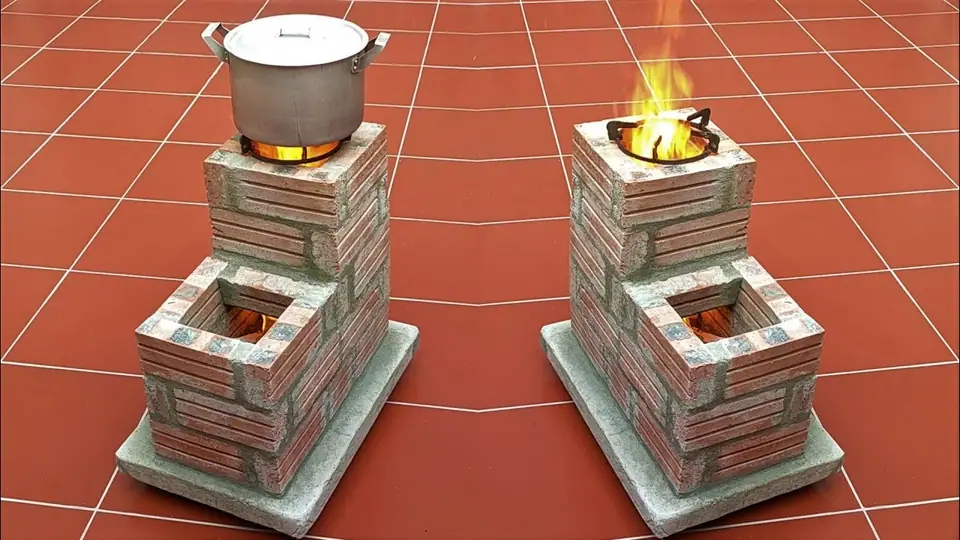
If, on the other hand, we are interested in a masonry rocket stove, we will need firebricks and fireclay mortar Amazon store, affiliate link, opens in a new tab, or the much easier to use high-temperature fireclay silicone. This is a very simple L-shaped stove:
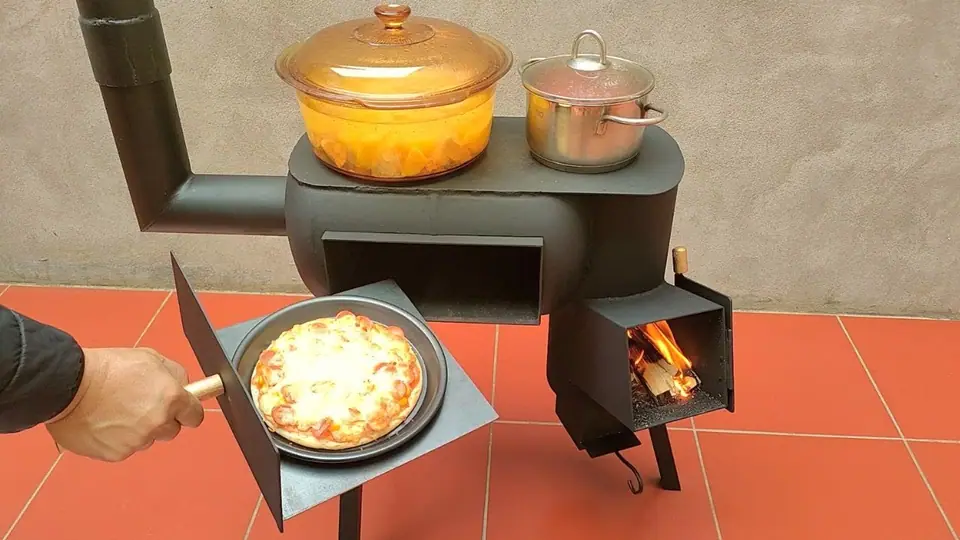
Here, in turn, we have a simple rocket stove built from an old gas bottle (if you want to make something similar, remember that even an “empty” bottle can contain leftover gas, which forms an explosive mixture with air, so it must be completely purged of gas before you cut it):
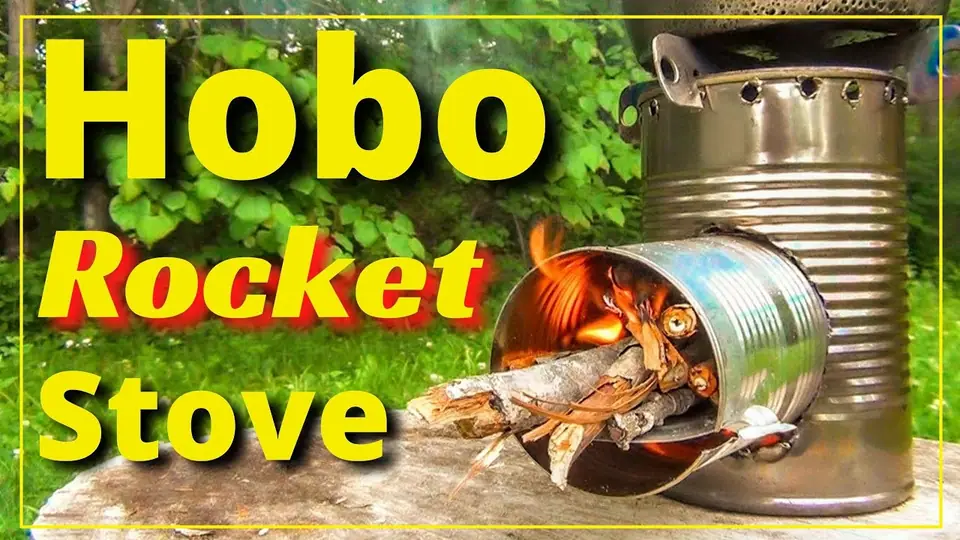
As proof that you can make a rocket stove out of almost anything, here is a video in which the author shows how to make a small, working rocket stove for cooking using tin snips Amazon store, affiliate link, opens in a new tab and 3 tin cans.
The masonry version in brief
You can put up the brick stove from the video above in a few steps.
- Stand it on a level, non-flammable base, such as a concrete slab or a layer of ordinary bricks.
- Lay out an L or J shape from firebricks, that is, a horizontal channel for the fire and a vertical chimney above its end. The channel should have the same cross-section along its whole length, and you join the bricks with a thin layer of fireclay mortar.
- Take the chimney up to a height 2-3 times the width of the channel.
- Insulate the chimney and the horizontal channel. The simplest way is to put a casing of sheet metal or ordinary bricks around them and pour perlite or vermiculite into the gap.
- On top of the chimney, set the pot supports so that the flue gas has as much room under the bottom of the pot as in the channel (a quarter of the channel width, so with a 10 cm channel a gap of 2.5 cm).
In a mass heater (RMH) the steps are similar, except that everything is bigger and you add a barrel and a bench. Evans and Jackson advise making the combustion tunnel shorter than half the height of the inner chimney, with 5-7.5 cm of light insulation under the tunnel (perlite, vermiculite or pumice mixed with thin clay slip). They treat the brick lying just above the tunnel as a part you will replace one day1.
Where to buy a rocket stove?
- You can buy a rocket stove in online shops, for example on amazon.pl. One example is the folding Fox Outdoor rocket stove Amazon store, affiliate link, opens in a new tab, measuring 21 x 14 x 14 cm. It weighs 950 g, though, so I would not put it in a rucksack, but in the boot of a car or on an allotment those grams do not matter.
- Another option is to try to find a company that makes stoves, or at least similar products, and have it make a stove for you from the technical drawing you will find in this article.
- You can also try looking on classified ad sites such as OLX (a popular Polish classifieds site), where various small craftsmen offer their products.
- The last option is to make the stove yourself, or buy a ready-made stove of another type, for example an ordinary pot-bellied stove, and then convert it into a rocket stove.
Alternative fuels: oil and pellet rocket stoves
When we think of traditional rocket stoves, we often picture fuel in the form of dry branches or wood. However, a rocket stove can burn more than just wood, although any other fuel requires changes to its design.
Oil as fuel in a rocket stove
A suitably rebuilt rocket stove (the basic one is designed for thin, dry wood) can also run on other fuels, including various kinds of oil. Here, though, I have some moral doubts - even oil that is burnt properly and “cleanly” produces a fair amount of harmful substances. Anyone burning it would probably be poisoning not only themselves but also their neighbours, so I decided not to publish any information on how to build one. Of course, it is possible to make a stove that would burn oil cleanly enough, but I suspect it would be expensive and complicated to build.
Pellets - a compact and efficient fuel
Wood pellets are small, compressed granules made from wood waste. They are becoming more and more popular as a fuel for rocket stoves, for several reasons:
- High energy value: Pellets have a fairly high energy content for their volume, which makes them an efficient fuel. As a result, they give more heat than the same volume of firewood.
- Uniform, consistent size: Pellets have a consistent shape and size, which makes them easy to feed into stoves in measured amounts. As a result, the firebox can work more efficiently, and you stay fully in control of how much fuel you use.
- Less risk of contamination: Pellets are made in a process that keeps unwanted impurities to a minimum. As a result, they leave fewer deposits and less dirt in the heating system, which means lower maintenance and cleaning costs.
- Storage and transport: Because they are compact and uniform, pellets are easy to store. They take up less space than firewood and are easy to transport, but they need a dry store, because they swell and fall apart when damp.
As with oil, there are some challenges in using pellets, such as needing a hopper and a suitably matched burner. Even so, the benefits of using them outweigh the difficulties.
And here I managed to find a real gem: a video in which the author explains in detail how a rocket stove with a water jacket works, and then converts an old top-burning stove into a pellet-fed rocket stove.
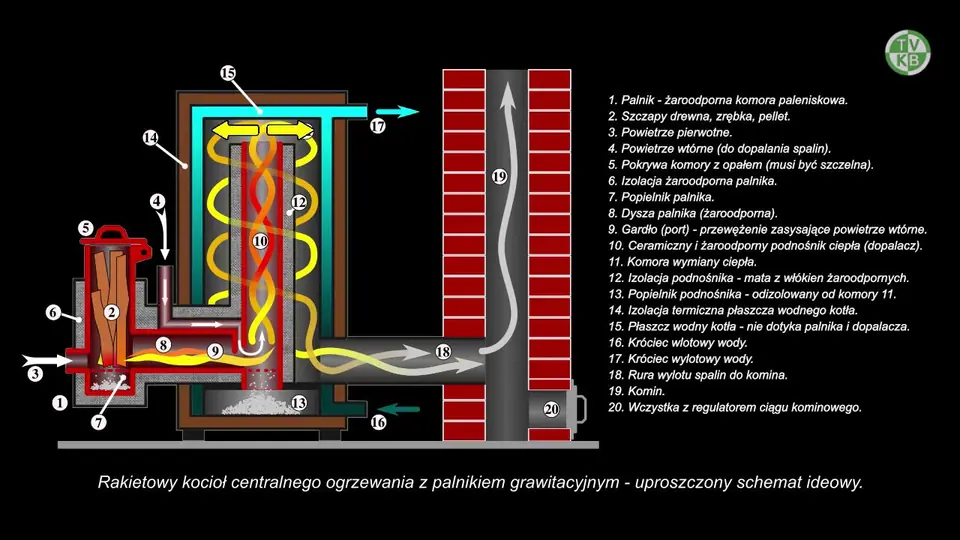
The author of the video has also shared a PDF file with a detailed plan for building a rocket stove for 6 mm pellets, made from 50 x 50 mm square box section.
As well as a detailed description and technical drawings, the file contains plenty of useful links for anyone who would like to dig deeper into the subject.
Common questions about rocket stoves
Does a rocket stove need a chimney?
A cook stove used outdoors does not, because its short, hot inner chimney provides the draught. A stove indoors always needs one. When you read somewhere that a rocket stove “does not need a chimney”, it means that it does not need a tall chimney for the draught, because the hot channel inside the stove takes its place5. The flue gas, and the carbon monoxide with it, still has to be led outside through a sealed flue, and the Aprovecho team, where the story of the rocket stove began, recommends a chimney for every wood-burning stove, cook stoves included3.
Can a rocket stove heat a house?
A cook stove cannot, but a mass heater (RMH) can, because that is exactly what it is for. It works best in a house where someone lives and lights the fire every day. I write more about this in the section What is a rocket stove good for?
How efficient is a rocket stove?
A rocket cook stove passes about 35% of the heat into the pot and a campfire about 15%, and the rocket stove uses nearly 60% less wood4. Nobody has reliably measured the heating efficiency of a large mass heater, and the “90%” you see online is at best combustion efficiency, which an ordinary campfire has too (explained above).
How hot does a rocket stove get?
In the inner chimney, from about 650 to about 980°C. After the steel barrel of a mass heater the flue gas is at 260-370°C, and after passing through the bench it leaves the house at about 30-90°C5.
Does a rocket stove smoke?
A little while you are lighting it, because a cold stove does not yet burn off the gases. In tests of cleaner wood-burning stoves about 25% of all the particulate matter came out in the first two minutes of operation4. Once the stove is hot and burning dry wood, it gives off very little smoke.
How much do the materials for a rocket stove cost?
It depends on the version. A stove made from three tins costs as much as a pair of tin snips, and Ianto Evans built his home stove in a day from salvaged parts for less than 50 dollars5. Ready-made welded rocket stoves made in Poland cost about PLN 450-6006. A large mass heater with a rocket firebox built by a stove fitter costs, for example, PLN 5-10 thousand for the materials alone, plus labour7.
Summary and the future of rocket stove technology
The heating market has been evolving for years. Lately it is the rocket stove that has become one of the most fascinating topics among fans of efficient, low-cost heating. Simple as it is to build, this technology brings its users many benefits and lets them save a good deal of money.
So far, designs like this are not particularly popular with stove manufacturers, at least in Poland. It is very hard to find, for example, a company that makes rocket stoves meant specifically for heating, that is, with a water jacket or a coil. So it looks as though, to start using a stove like this at home, you have to make it yourself or have a company or a craftsman make it for you. Luckily it is not a terribly difficult job, as I hope I have shown in this article.
I encourage you to keep exploring the subject and experimenting with this technology. In this article I have tried to include everything I have managed to learn about rocket stoves, and I have done my best to make it as accurate as possible. But if you spot a mistake or think something is missing, let me know in the comments.
Some of the information comes from the English Wikipedia articles Rocket mass heater and Rocket stove (authors: Wikipedia contributors), licensed under CC BY-SA 4.0. The description of the RMH types is my adaptation of that material, and I share the adapted passages under the same licence.
Sources
- Ianto Evans, Leslie Jackson, “Rocket Mass Heaters: Superefficient Woodstoves YOU Can Build”: books.google.com
- Larry Winiarski (Aprovecho Research Center), “Rocket Stove Principles”: bioenergylists.org
- Aprovecho Research Center, “Design Principles for Wood Burning Cook Stoves”: bioenergylists.org (PDF)
- Global Alliance for Clean Cookstoves, “Handbook for Biomass Cookstove Research, Design, and Development” (2017): cleancooking.org (PDF)
- Ianto Evans, Leslie Jackson, “Rocket Mass Heaters”, pp. 12 and 14 (excerpt published by the authors): rocketstoves.com (PDF)
- AJRO, rocket stoves, catalogue prices (in Polish, accessed 2 October 2026): ajro.info.pl
- Piece Artura, “Price list of stove-fitting services” (in Polish): pieceartura.pl
Leave a comment