
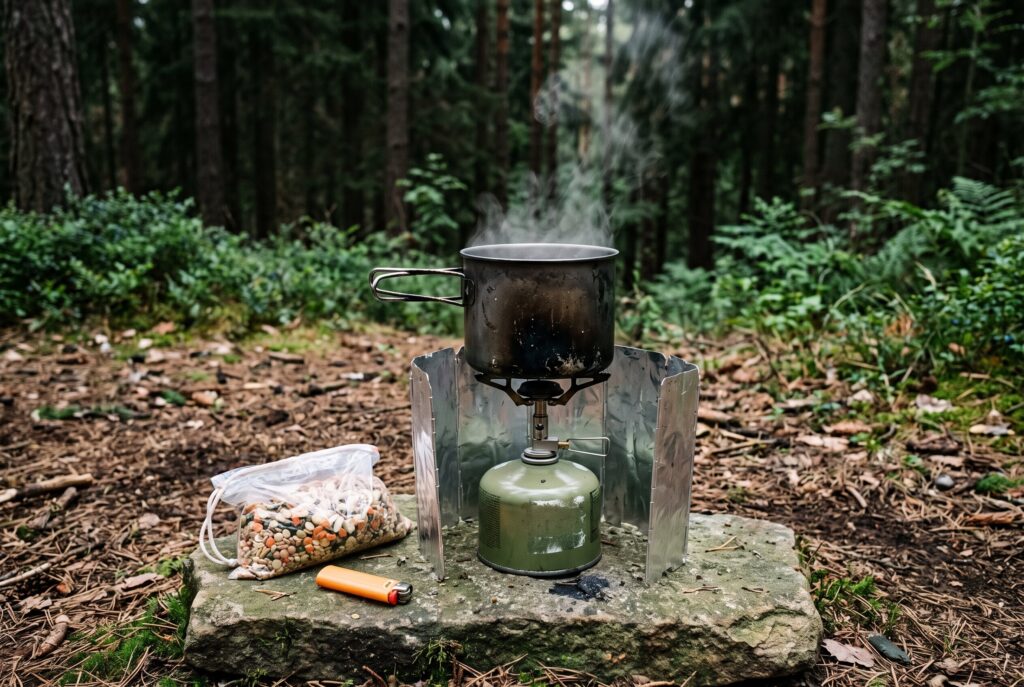
If you have already packed a bug-out bag using my list, you probably stopped at some point at the item “a mini gas stove that takes replaceable canisters”. You walk into an outdoor shop and there are gas burners, petrol stoves, spirit stoves, tablet stoves, stoves that burn sticks and whole sets with a pot included. Which camping stove will be best? And do you even need one?
In the article on how to pack a bug-out bag, I wrote: “Choosing the right gear in this category is a hugely complex subject in itself, and I will try to cover it in a separate article in future.” It took a while, but a promise is a promise 😉
Below I go through all the popular types of stove one by one, and at the end I say what I would put in my own bug-out bag.
Why do you need a stove when there is a campfire?
The truth is that you will survive 72 hours without cooking. Bars, tinned food, dried fruit and nuts can all be eaten straight from the packet. But a mug of hot tea on a cold, wet night does more than you might think at first glance, and it is not really about the temperature, more about morale and how you feel, which is very important, maybe even the most important thing, in any crisis.
Then there is water. Water from an uncertain source is best boiled after filtering as well, and water from a stream or from melted snow has to be boiled either way (I wrote about how long in the article about your first night in the woods). Without fire you are stuck.
A campfire? You can’t light one everywhere or every time. Sometimes it is too wet, there is no dry wood, and sometimes you simply don’t want anyone far away to see your smoke. A stove lights in moments, in the rain, on a rock or on tarmac.
What should you look for when choosing a stove?
Ask yourself the same questions about every stove. How much does it weigh together with fuel for three days? How quickly will it boil a litre of water? Will it work at a few degrees below freezing and in the wind? Where will you get fuel when the shops are closed and the petrol stations grind to a halt without power? And what happens if something goes wrong?
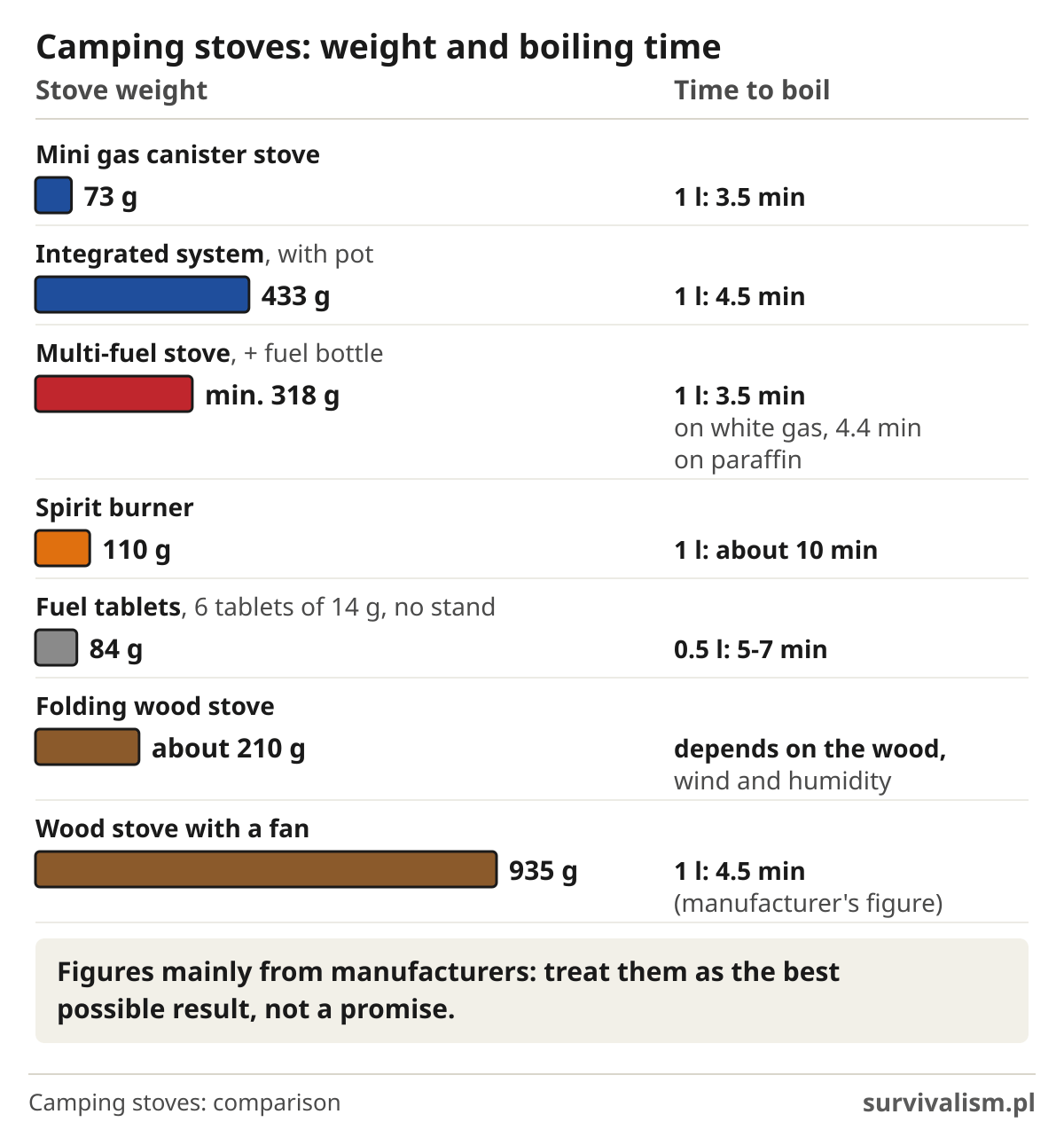
The figures I give below come mainly from the manufacturers. Treat them as the best possible result, not a promise. Out in the field, wind, frost and ice-cold water in the pot will take their toll.
Mini gas canister stove
This is exactly the kind of burner I recommended in the bug-out bag article, and I still think it is the most sensible choice for 72 hours. You screw it onto the canister, open the valve, light it and cook. There is nothing to spill or pump.
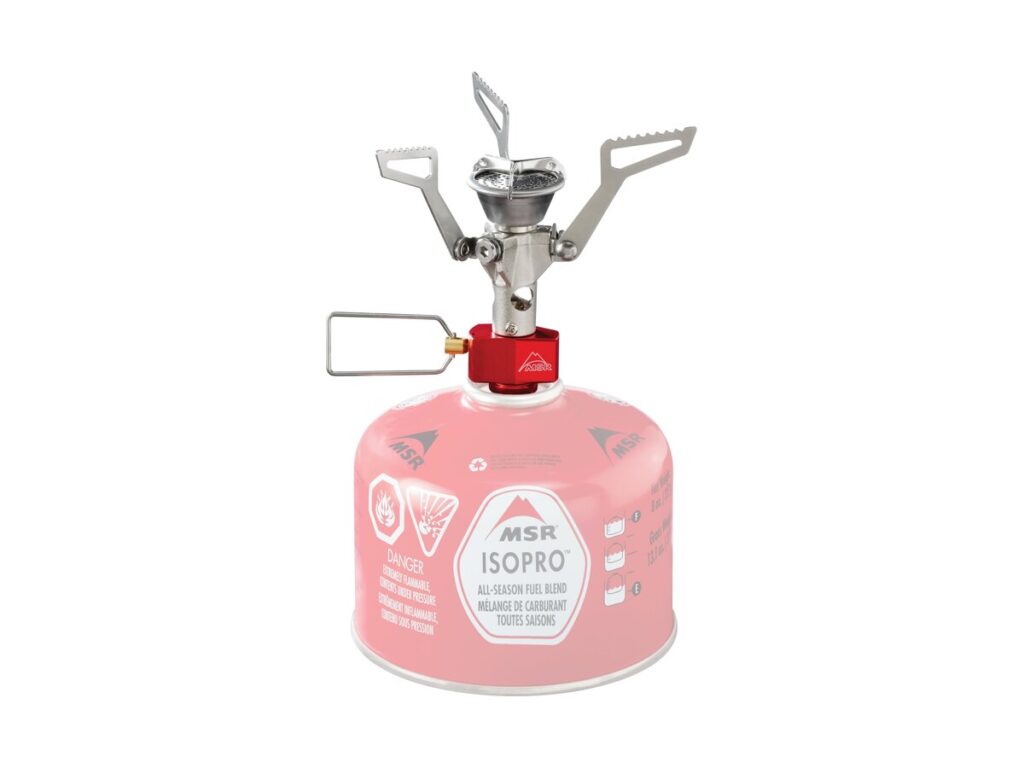
For example, the MSR PocketRocket 2 Amazon store, affiliate link, opens in a new tab weighs 73 g, boils a litre of water in 3.5 minutes, and a 227 g canister will boil about 16 litres of water, running at full power for roughly an hour1. Another manufacturer gives an hour and a half at full power for a 230 g canister2.
Canisters vary: threaded, pierceable, long ones for briefcase-style stoves. Before you buy a stock of them, check that a given canister fits your burner. In a crisis there will be nowhere left to swap it.
 Amazon store, affiliate link, opens in a new tab
Gas below freezing
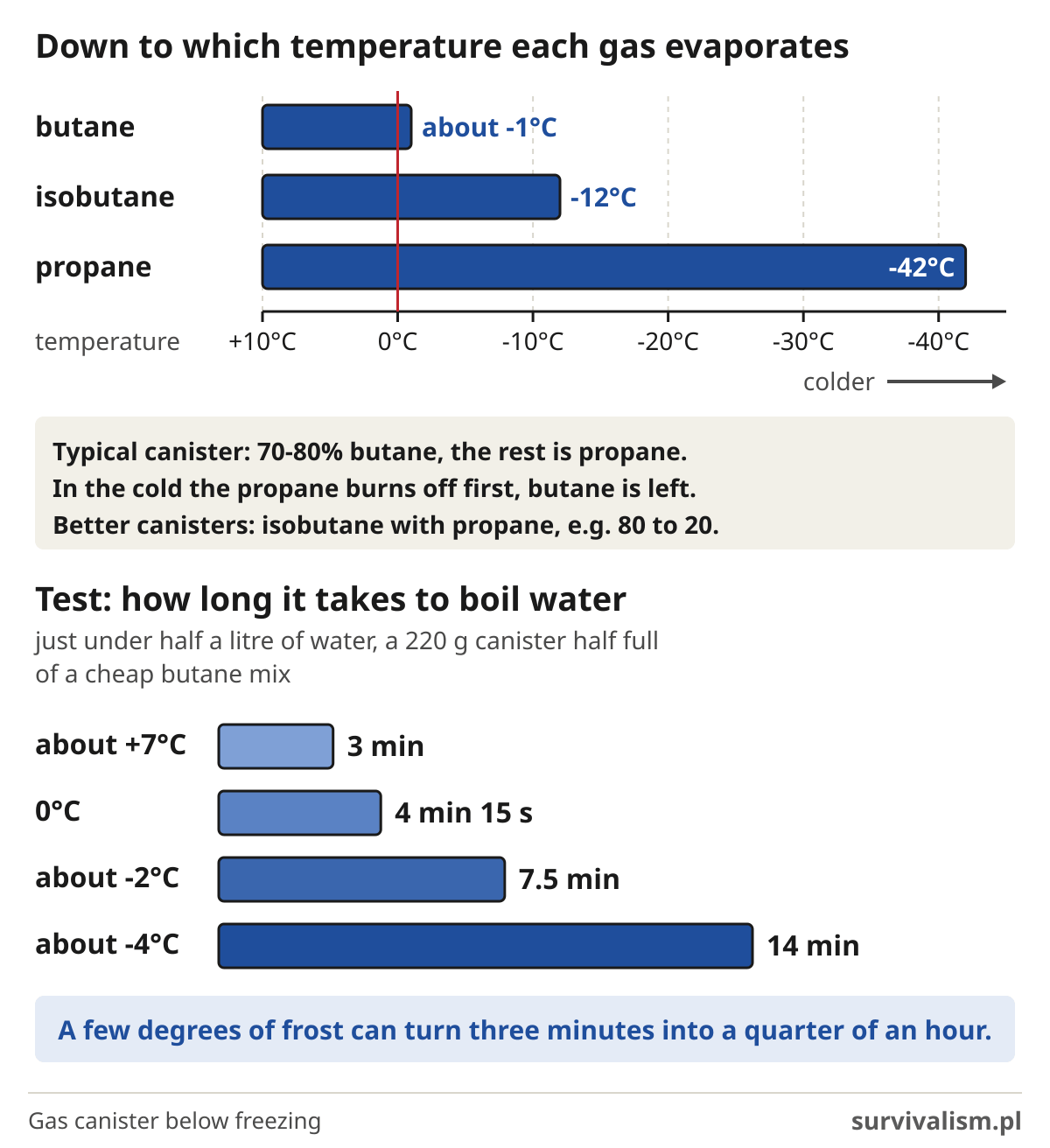
This is where things get tricky. The gas sits in the canister as a liquid, and for the burner to work it has to evaporate. Butane stops evaporating at about -1°C, isobutane at -12°C and propane only at -42°C, which is why better canisters contain a mix of isobutane and propane, for example in an 80 to 20 ratio3. On top of that, fuel that evaporates cools itself down, so the canister gets colder and colder as you cook.
In a typical canister butane makes up 70-80% of the mix and the rest is propane4. In the cold the propane burns off first, so towards the end more and more butane is left in the canister, and butane no longer wants to evaporate.
What does that look like in practice? In one test with a 220 g canister half full of a cheap butane mix, just under half a litre of water came to the boil in 3 minutes at about +7°C5. At 0°C it took 4 minutes 15 seconds, at about -2°C 7.5 minutes, and at about -4°C as much as 14 minutes. At +7°C the canister cooled by about 4°C during a single boil. A few degrees of frost can turn three minutes into a quarter of an hour.
How can you help a canister in the cold?
Buy canisters with an isobutane and propane mix, not the cheapest butane. Keep the canister in your jacket, close to your body, and put it in your sleeping bag at night. While cooking you can stand it in a shallow bowl with a little water, which will keep it above zero4.
Just don’t overdo it the other way. Don’t warm the canister over a fire or over the burner. If it is so warm that you can’t comfortably hold it in your hand (above about 40°C), cool it down straight away6, because an overheated canister can explode.
Wind and integrated systems
The second enemy of a small burner is wind, which blows the heat away from under the pot. The simplest fix is to set the burner up somewhere out of the wind, behind some natural shelter or one you put together on the spot.
To deal with wind, manufacturers came up with integrated systems, popularly known as Jetboil-type stoves: a burner hidden behind a shield and a pot that clips onto it. For example, the MSR WindBurner Amazon store, affiliate link, opens in a new tab weighs 433 g, boils a litre of water in 4.5 minutes and will boil 18 litres from a 227 g canister7. The manufacturer also says that the shielded burner keeps its performance in wind and cold.
Compare that with a burner weighing 73 g and its 16 litres (although those 433 g already include a pot). On a calm day you pay in weight for a small gain in fuel. The advantage of a system like this starts in the wind, when the most you can shield an open burner with is a rock.
Multi-fuel stove, or petrol in reserve
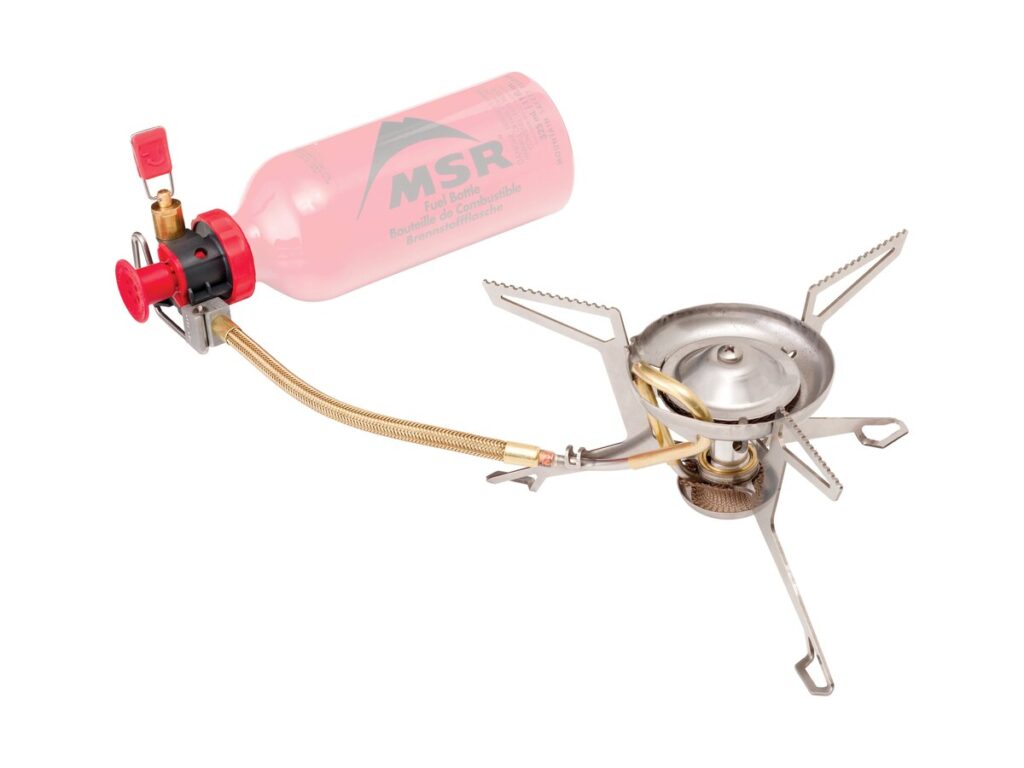
A liquid fuel stove has a separate bottle with a pump, and the fuel runs from it through a hose to the burner. You build up the pressure in the bottle yourself with the pump, and in a real winter a stove like this does better than a canister4.
For example, the MSR WhisperLite International Amazon store, affiliate link, opens in a new tab weighs at least 318 g (plus the fuel bottle), boils a litre of water in 3.5 minutes on refined camping fuel (white gas) and in 4.4 minutes on paraffin (kerosene), and if need be it will also burn ordinary unleaded petrol from the pump8. Ordinary petrol works, but the additives in it damage the pump seals and clog the fuel line and the jet, while paraffin is cheap and easy to get, but it is dirty, smelly and harder to light9.
And where do you get fuel in a crisis? Without power you can’t even fill up your car. But if you keep a jerrycan in the garage or the shed, a multi-fuel stove will use the same supply.
On the other hand, it is heavier and more complicated, and it takes practice and jet cleaning. This is a stove for someone who likes tinkering with gear, not for someone who just wants to boil some water.
 Amazon store, affiliate link, opens in a new tab
Trangia-style spirit stove
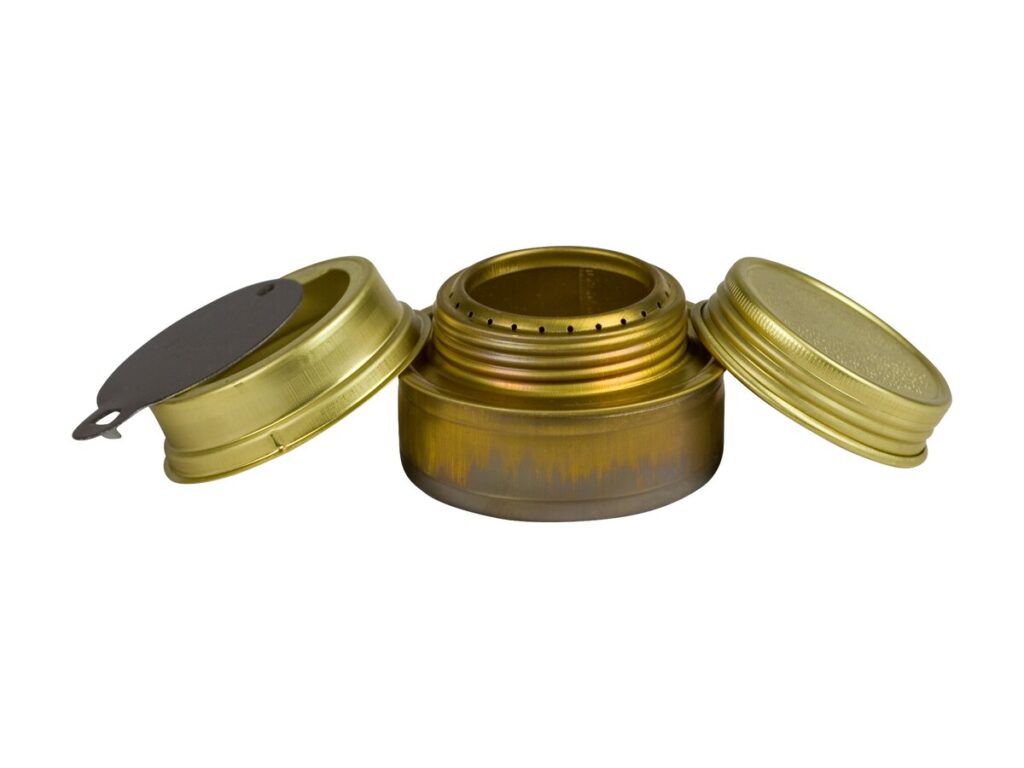
The simplest of them all. A small metal cup that you pour spirit into and light. There is no pump, valve or seal here, so there is nothing to break.
The classic Trangia spirit burner Amazon store, affiliate link, opens in a new tab weighs 110 g and has an output of 1150 W. It will boil a litre of water in about 10 minutes, depending on the weather and the quality of the fuel, and one filling (about 100 ml, no more than 2/3 of its capacity) burns for roughly 25 minutes2. As you can easily work out, one filling will boil about 2.5 litres of water in good conditions. The lightest burners you can buy weigh about 30 g, but they usually boil at least twice as slowly as gas10.
The fuel is alcohol of at least 70%, preferably ethanol, even 96% spirit11. Avoid methanol, because it gives off poisonous fumes. In Poland the easiest thing to get hold of is denaturat (denatured alcohol), which you can buy wherever paint and thinners are sold, and which is mostly ethanol, although the exact make-up depends on the manufacturer (Orlen’s is over 92%)12. Vodka from the drinks cabinet won’t do, it’s too weak 😉
 Amazon store, affiliate link, opens in a new tab
Spirit below freezing
Below freezing, spirit gets noticeably weaker and doesn’t really work in winter10. The manufacturer of the classic burner recommends a winter attachment with a preheater from about +5°C11. If your bag also has to be ready for January, spirit shouldn’t be your only fuel.
The invisible flame
In daylight a spirit flame is almost invisible, which makes it easy to burn yourself10. Spilt spirit burns in exactly the same way, so you may not notice that the fire has spread across the table or the grass. Never top up the fuel until the burner has gone out completely and cooled down, and never pour petrol into it2.
Esbit-style fuel tablets
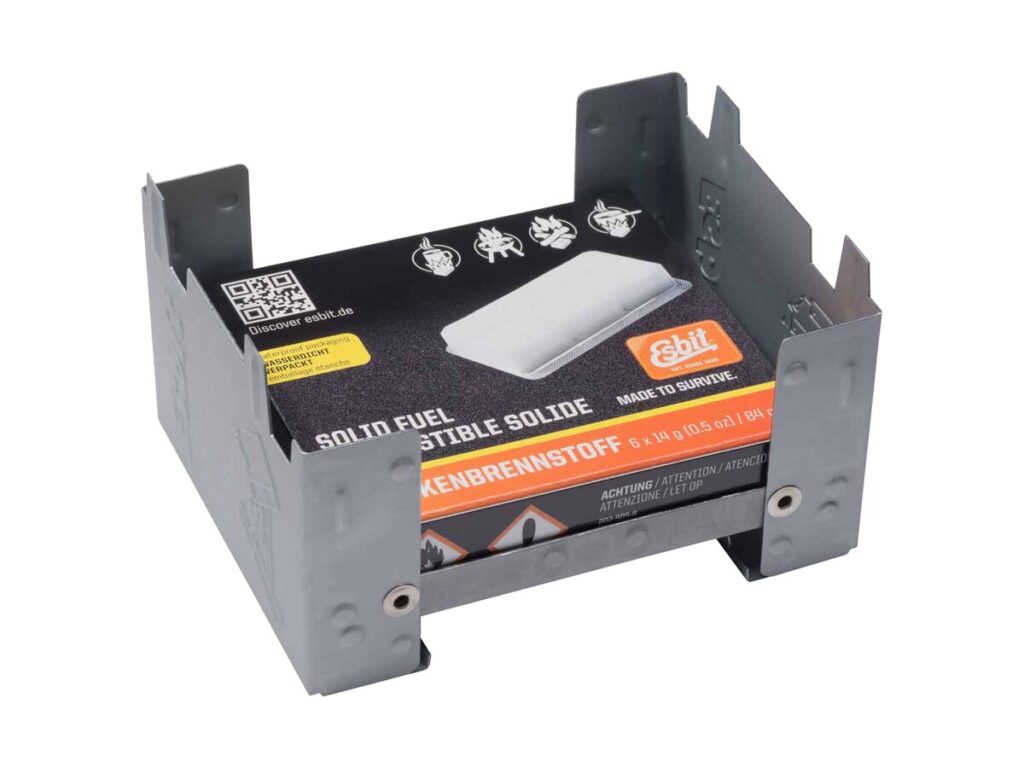
The lightest stove there is comes down to a folding metal stand and a pack of solid fuel tablets Amazon store, affiliate link, opens in a new tab. A 4 g tablet burns for 5 minutes, a 14 g one for 12 minutes and a 27 g one for 15 minutes13. They will boil half a litre of water in 5-7 minutes, depending on the pot and the wind. Six 14 g tablets come to 84 g and 72 minutes of flame.
The biggest advantage? Kept somewhere dry, the tablets last for many years and have no use-by date. They won’t leak, they don’t need pumping, and when the wood is damp you can use a tablet to light your kindling too.
The drawbacks? You can’t adjust the flame, so they are more of an emergency reserve for a mug of water than a stove for cooking dinner.
 Amazon store, affiliate link, opens in a new tab
Wood-burning stove
The fuel for it lies at your feet: sticks, pine cones, bits of bark. The simplest folding wood stove is a few steel panels that you fold into a small chimney and stand your pot on. For example, the Vargo Hexagon Amazon store, affiliate link, opens in a new tab weighs about 210 g14.
Some wood stoves have a battery-powered fan that blows into the firebox and improves combustion. A stove like this, for example the BioLite CampStove 2+ Amazon store, affiliate link, opens in a new tab, weighs 935 g and, according to the manufacturer, boils a litre of water in 4.5 minutes15. In one test of another wood stove a litre of water took about 10 minutes to boil, and the testers stress that the time depends on the type of wood, the wind and the humidity16.
You don’t have to carry or buy fuel, but you do have to keep feeding it, wet wood smokes and barely burns, and your pot will be black with soot. In a town or city a stove like this makes little sense, because dry sticks are hard to come by there.
In practice a wood stove is a small campfire on legs. If you like making things yourself, a rocket stove works on a similar principle and you can build one on your own, although you’re unlikely to pack it in your rucksack.
The campfire as a benchmark
A campfire “weighs nothing”, and the fuel for it lies in the forest for free. What it does take is skill, time and dry wood.
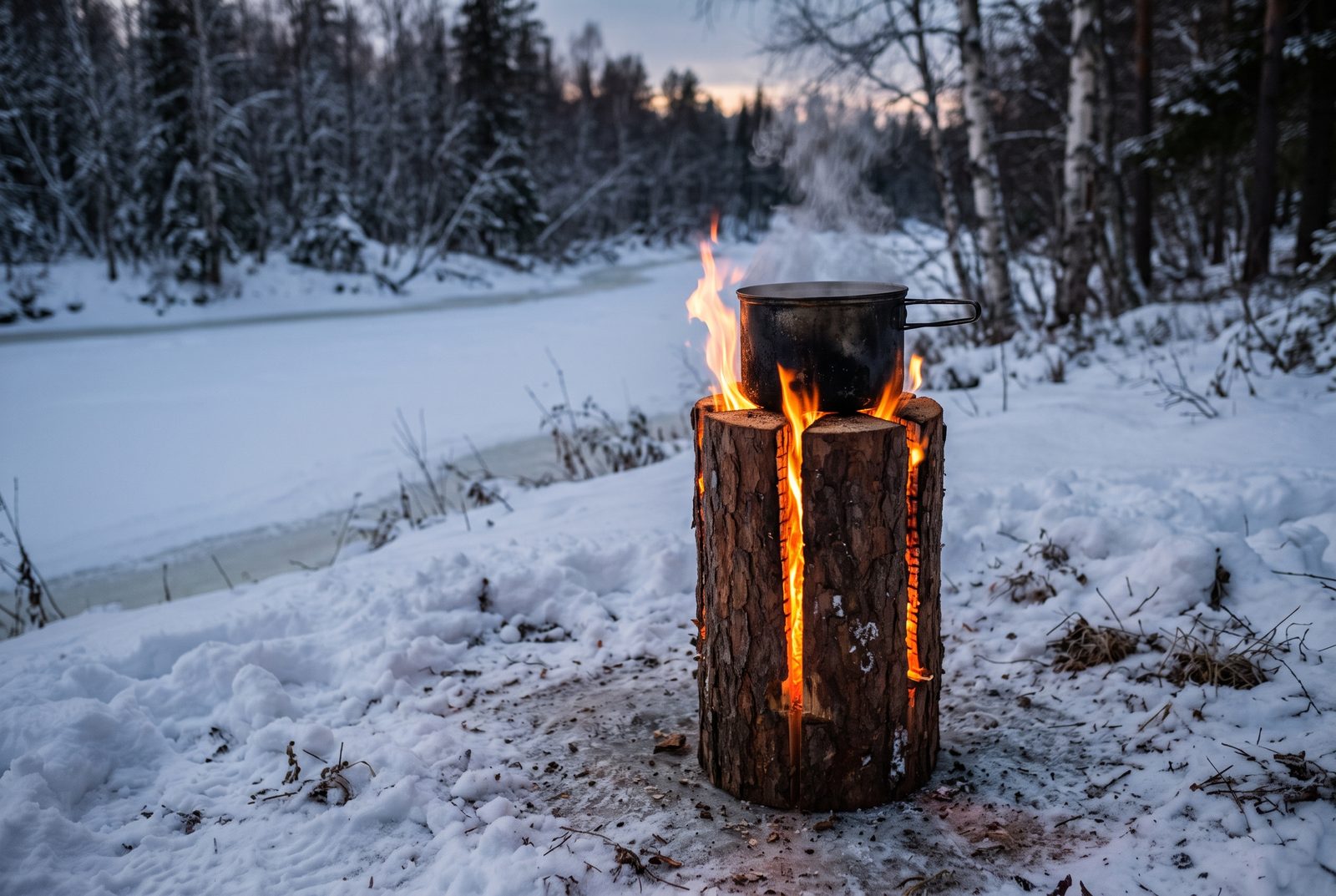
Not every campfire is good for cooking. You probably won’t stand a pot on a tipi fire, but a Swedish fire has a flat top that you can put pots on. And sometimes you don’t need a pot at all. Now and then I wrap a single potato with butter, onion and salt in aluminium foil, drop it straight into the embers, and after 30-60 minutes I have a delicious, steaming potato.
If you have flour, you can knead it into a dough, wrap it round a stick and stand the stick next to the fire. That way the dough bakes without any extra cookware.
A campfire has its price, though. Fire can get out of control faster than you think. I once saw for myself how a tiny flame set a whole, fairly large hill covered in dry grass alight literally within moments. One moment it was a small campfire, and 30 seconds later it had turned into an unstoppable blaze that nobody had any control over any more. A stove set down in dry grass can do exactly the same.
Carbon monoxide and fire in a tent
Don’t cook or warm yourself with a stove inside a tent. It makes no difference whether it is gas, spirit, petrol, tablets or wood. Carbon monoxide is colourless and odourless, and it is produced, among other things, by incomplete combustion of butane and propane, which is exactly what you have in your canister17.
In March 1999, in the US state of Georgia, a man and three children were found dead in a zipped-up tent, with a propane stove still burning inside18. Opening the door or the vents of the tent a little is not enough to stop carbon monoxide from a stove like that building up.
It is the same in a flat during a blackout. You light an ordinary camping canister stove outside, like a barbecue.
If you get a headache or start to feel sick near a stove, turn it off and get out into the fresh air straight away. Take anyone who feels unwell outside, loosen their clothing and call for help19.
How much fuel for 72 hours?
Let’s do the maths. For 72 hours you need at least 9 l of water per person (3 l a day). Let’s assume the worst case: you have to boil all of that water.
On gas, a 227 g canister will boil about 16 l of water1, so a litre takes roughly 14 g of gas (227 : 16). For 9 l that is about 130 g. One canister with plenty to spare, right? Except that this is the result in good conditions. In the test I described above, at about -4°C the same boil took almost five times longer than at +7°C5.
On spirit, one filling of about 100 ml burns for about 25 minutes, and a litre of water takes about 10 minutes to boil2, so a litre needs about 40 ml. For 9 l that is about 360 ml of spirit, more than a third of a litre, and that is in good conditions.
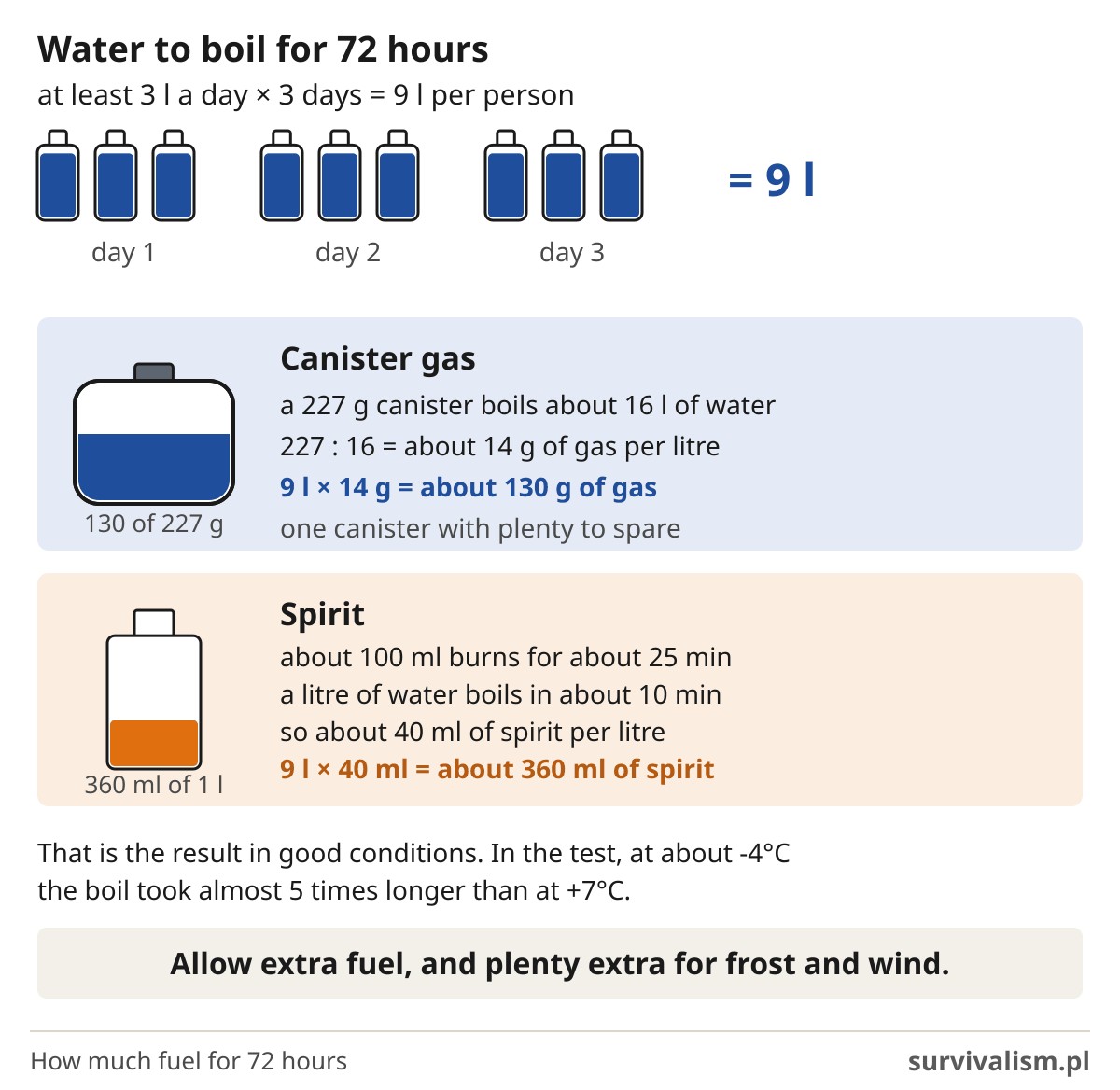
If the tin of beans says to heat it for half an hour and you only have fuel for 15 minutes, you will have to make do with undercooked food or go hungry. Allow extra fuel, and plenty extra for frost and wind.
What would I put in my bug-out bag?
In my view, for a 72-hour bag the winner is what I recommended from the start, a mini gas canister stove like the PocketRocket 2 Amazon store, affiliate link, opens in a new tab. It is light, it boils quickly, there is nothing to pump or keep feeding, and you can light it in the rain. It does have one serious drawback, though. You depend on canisters, which you won’t be able to buy more of in a crisis, and gas weakens in the cold.
That is why, along with the burner and a canister with an isobutane and propane mix Amazon store, affiliate link, opens in a new tab, I would pack a folding stand and a few solid fuel tablets Amazon store, affiliate link, opens in a new tab. Six of these tablets weigh less than 100 g, they sit in the bag for years without coming to any harm, and they don’t care whether the canister has caught the frost. When the gas lets you down, you can still boil a mug of water. Add matches and a lighter, each in a waterproof bag. On my hikes I usually have at least one of each on me, because when one fails I can use the other. A spare source of fire weighs less than a spare stove.
It is a compromise between weight and independence from fuel. A multi-fuel stove gives you more freedom, because it burns what you keep in the garage, but it weighs more and takes practice. A wood stove frees you from carrying fuel, but it is slower, temperamental in the rain and not much use in a town or city. If you live in the countryside or near a forest and plan to stay out for longer, a wood stove makes sense. But a bug-out bag is meant to get you through 72 hours, not through a winter in the Bieszczady mountains 😉
One more thing. Try your stove out before you need it. Boil some water on it on a frosty morning at your allotment or on a camping trip, and check how long it takes and how much gas has gone from the canister. Better to find out now than in the forest, in the rain and on an empty stomach.
If I had to sum it all up in one sentence: a light gas burner for everyday use, tablets and matches for a rainy day, and a campfire when you have the time and dry wood. I’m not saying it is the only right choice. Your bag, your back, your life 🙂
And what do you cook on in the field? Do you have a stove that has seen you through frost or a downpour, or perhaps one that let you down at the worst possible moment? Let me know in the comments. I read all the comments and reply to most of them.
See you on the trail!
Sources
- MSR (Cascade Designs), “PocketRocket 2 Stove”: cascadedesigns.com/products/pocketrocket-2-stove
- Trangia, “The Handbook 2021” (PDF): trangia.se/wp-content/uploads/2021/09/The_Handbook_2021.pdf
- MSR (Cascade Designs), “The Ins and Outs of Canister Fuels”: cascadedesigns.com/blogs/msr-gear-guides/ins-outs-canister-fuels
- Appalachian Mountain Club, “Why Does My Canister Stove Fail in Cold Weather?”: outdoors.org/resources/amc-outdoors/outdoor-resources/why-does-my-canister-stove-fail-in-cold-weather
- Backpacking Light, Jerry Adams, “Evaporative Heat Loss in Upright Canister Stoves” (2017): backpackinglight.com/evaporative-heat-loss-in-upright-canister-stoves
- Backpacking Light, “Canister Stove Fuel Warming Techniques”: backpackinglight.com/canister-stove-fuel-warming-techniques
- MSR (Cascade Designs), “WindBurner Personal Stove System”: cascadedesigns.com/products/windburner-personal-stove-system
- MSR (Cascade Designs), “WhisperLite International Stove”: cascadedesigns.com/products/whisperlite-international-stove
- MSR (Cascade Designs), “Liquid Fuel Stoves 101: Choosing the Right Fuel for Your Liquid Fuel Stove”: cascadedesigns.com/blogs/msr-gear-guides/liquid-fuel-stoves-101-choosing-the-right-fuel-for-your-liquid-fuel-stove
- Appalachian Mountain Club, “Pros and Cons of Alcohol Stoves”: outdoors.org/resources/amc-outdoors/outdoor-resources/pros-and-cons-of-alcohol-stoves
- Trangia, “Guide - Spirit burner”: trangia.se/en/support/guides/all-about-our-burners/guide-spirit-burner
- ORLEN OIL, „Karta charakterystyki: Denaturat 92% obj.” (safety data sheet, in Polish, PDF): orlen.pl/…/PDS_denaturat.pdf
- Esbit, “Solid fuel”: esbit.de/en/pages/solid-fuel
- Vargo Outdoors, “Hexagon Backpacking Wood Stove”: vargooutdoors.com/collections/stoves/products/hexagon-backpacking-wood-stove
- BioLite, “CampStove 2+”: bioliteenergy.com/products/campstove-2-plus
- CleverHiker, Brett Kretzer, “Solo Stove Lite Review” (2024): cleverhiker.com/camping/solo-stove-lite-review
- MSWiA (Polish Ministry of the Interior and Administration), „Zatrucie czadem” (in Polish): gov.pl/web/mswia/zatrucie-czadem
- CDC, MMWR, “Carbon Monoxide Poisoning Deaths Associated with Camping - Georgia, March 1999”: cdc.gov/mmwr/preview/mmwrhtml/mm4832a1.htm
- Regional Headquarters of the State Fire Service (PSP) in Gdansk, „Tlenek węgla (czad)” (in Polish): gov.pl/web/kwpsp-gdansk/tlenek-wegla-czad
Leave a comment