
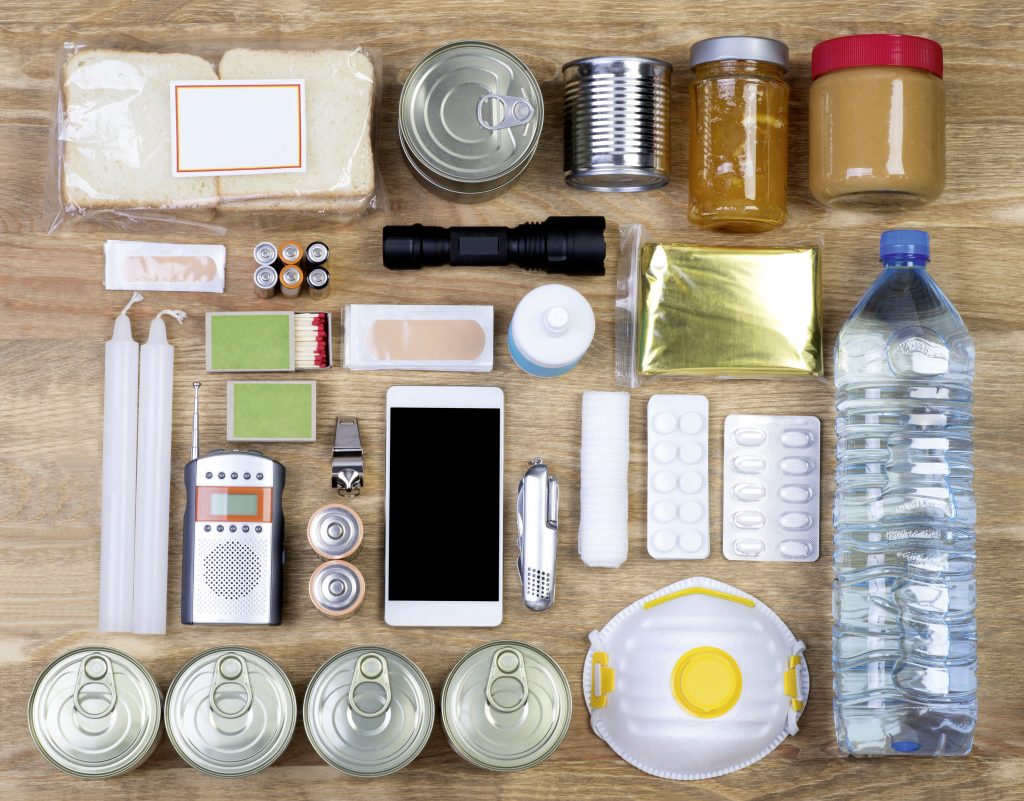
[UPDATE 2026] I wrote the first version of this article at the beginning of 2022, and the introduction below dates from that time. Since then, a blackout has stopped being something out of a film: on 28 April 2025 the power went out across the whole of mainland Spain and Portugal, and on 4 July 2025 around a million supply points in Czechia, including Prague, were left without electricity (I write about both cases below). In August 2025 the Polish government published the „Poradnik bezpieczeństwa” (Safety Guide) (there is also a downloadable PDF version) with a separate chapter on long power outages. Wherever the Guide says something specific, I have added it in the right place in this article, and at the end you’ll find a printable checklist.
A lot has happened over the last 2 years, and a lot is still happening. The unrest and problems around the covid-19 epidemic have taken their toll on every one of us. Inflation is starting to reach levels we haven’t seen for decades. More and more companies are running out of cash. On top of that, a war has broken out just beyond our eastern border, one that has the potential to “spill over” into neighbouring countries.
Unfortunately, it looks like that isn’t the end of our troubles. Another danger is looming on the horizon: blackouts.
Blackout - what is it?
It is another word whose meaning many of us didn’t know until recently, just as it was with the word “lockdown”. The word “blackout” is turning up in the media more and more often, and serious people and serious institutions, including government ones, are starting to use it. So what is a blackout, and what does it actually mean?
A blackout (literally, going dark) is a situation in which the electricity supply to an area is restricted or stopped completely. It can last anywhere from a few hours to as long as several weeks.
A prolonged blackout is a very dangerous situation, because most of the achievements of our technical civilisation, to which we have entrusted our safety, our health and often even our lives, are devices that run on electricity. Can a modern person survive without electricity at all?
We have got so used to devices that need electricity to work that we don’t even notice it is there. In a sense, electricity has become invisible to us, like the air we breathe. But if you stop and think about it for a moment, it turns out that practically everything we regard as the material backbone of our existence relies on electricity.
It is a system built on top of a system. When one element fails, everything fails.
Without electricity there is no internet. There is no water in the taps, because the pumps need electricity to run. There is no heating, because boilers need electricity too. The banking system won’t work: we won’t withdraw money from a cash machine, and we won’t pay by card in a shop. The only things you will be able to pay with are cash or substitute means of payment (more on those later). We won’t even be able to fill up the car.
What emerges is an Armageddon scenario, comparable in its consequences to military action by a hostile army.
Causes of blackouts
So what lies behind this state of affairs? There are at least a few causes.
Firstly, we are dealing with the planned and deliberate actions of the Russian Federation. It is no secret that Russia uses natural gas supplies to Europe as a tool of political and economic pressure. At the end of December 2021, Russia turned down the tap on the Yamal pipeline1, which was one of the main pipelines carrying gas from Russia to Europe.
[UPDATE] It didn’t stop at turning down the tap. On the morning of 27 April 2022, Gazprom completely halted gas deliveries to Poland under the Yamal contract2.
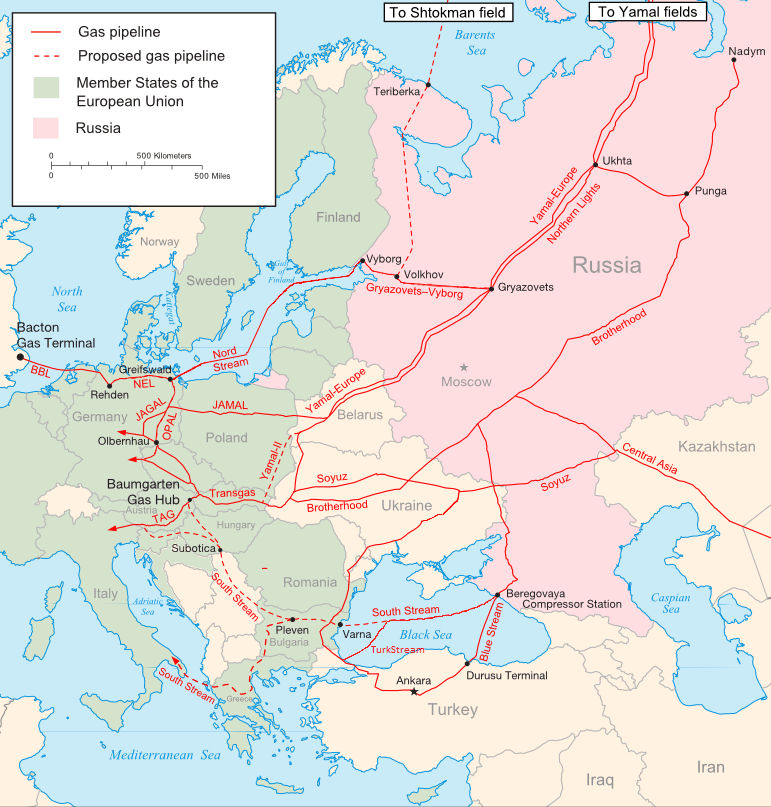
This caused a sharp rise in natural gas prices on world markets. That, in turn, caused a lot of turbulence on the energy markets and pushed electricity prices up considerably. As a result, several energy suppliers in Germany went bankrupt3. But that is only the beginning of the problems.
The second cause is placing too much trust in so-called green energy sources. Unlike traditional fossil fuels, renewable energy sources depend far more on the weather.
For example, a frosty, windless winter can, on the one hand, cause significant drops in the output of wind farms and, on the other, push demand for electricity above normal, for instance to heat homes. That is why Germany, usually so green, has recently been going back to “dirty” energy from coal4.
At the end of December 2021, the Swedes were forced to import electricity from Poland for the second time. It was a repeat of what happened in February5, when the closure of the Ringhals 1 nuclear reactor, combined with a frosty winter, led to an electricity shortage on the Swedish market.
In reality, the European energy market is a set of interconnected vessels. Sometimes we buy energy from abroad, sometimes we are the ones selling it. In 2021 Poland was exporting more and more electricity, but over the year as a whole it was still a net importer.
Despite the obvious problems that so-called green energy sources create, the European Union is pressing Poland and forcing it to close mines and shut down “dirty” power stations, which could deepen the energy crisis even further.
The third cause can be infrastructure failures. Here is an example from 2021. On Monday 17 May, at 16:34, there was an emergency shutdown of the Rogowiec substation run by PSE, the Polish transmission system operator6, which took the power from 10 of the 11 generating units of the Bełchatów power station. This caused a sudden drop in power in the Polish grid, by as much as 16%. Numerous emergency procedures were launched, including drawing the necessary reserve capacity from many small conventional units kept as an emergency reserve. Power was also brought in from several European countries. The effects of the failure were felt across the whole interconnected power system, from North Africa to Turkey.
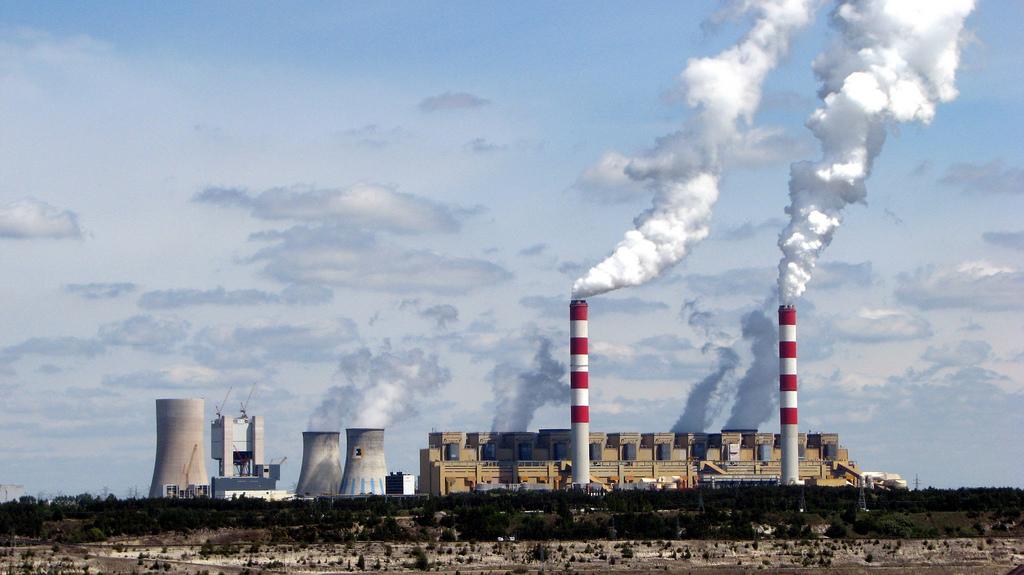
Source: fotopolska.eu
Although this situation fortunately did not end in disaster (even though it actually came very close), it gives us a foretaste of what can happen when several unfavourable circumstances coincide: bad weather, the failure of large generating units and aggressive actions by the Russian Federation.
Frost is not the only thing that can cause problems with the power supply. Drought can have a similar effect, as we saw in Poland in August 2015. The heat and low river levels caused cooling problems at the Połaniec and Kozienice power stations. As a result, the power stations cut the power they sent to the grid, which in turn led to so-called power supply levels, the Polish system of rationing electricity, being introduced across the whole country (more on that later in the article).
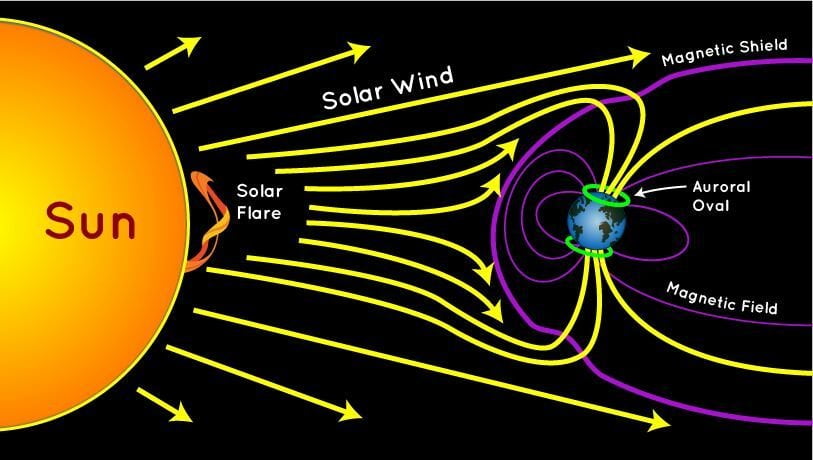
The fourth cause could be a so-called coronal mass ejection (CME). This has already happened in the past, in 1859, but fortunately at a time when electricity did not yet matter to people as much as it does today. A strong geomagnetic storm triggered by a CME can overload and damage transformers and cut the power over a very large area, as happened in Quebec, Canada, in 1989. You can read more about it here: A solar EMP caused global atmospheric anomalies.
The fifth cause could be a terrorist or military attack on infrastructure. It doesn’t have to be a physical attack - it is enough for someone to break into the IT system that controls a power station or several power stations7. In the extreme case, a hacker could take full control of a power station. This scenario is probably clear enough that I don’t need to spell it out - everyone can fill in the rest for themselves.
[UPDATE] The outbreak of the war in Ukraine has made us take more and more seriously a scenario in which foreign troops knock out parts of our energy infrastructure by attacking it with conventional or nuclear weapons. In my opinion, all it would take is for the enemy to hit 3-4 key power stations in our country, and we would all be back in the Stone Age, at least until the grid is working again - and nobody knows how long that could take.
[UPDATE 2026] The following years of war showed what this looks like in practice. In the first winter of the war, Ukraine lost (to occupation, destruction or damage) roughly half of its generating capacity, roughly half of its large substations were damaged as well, and in spring 2024 another 9 GW was lost. Even so, the grid did not fall apart. Instead of one huge blackout came rolling outages: in the worst-hit regions there was power for only a few hours a day, lifts stopped, there were problems with water, and on 26 August 2024 around 8 million households were cut off without warning8. So what turned out to be more realistic than the “Stone Age” was a scenario of long, repeated power cuts.
As I mentioned earlier, the whole European energy system is a set of interconnected vessels, and while in the past we have coped with individual problems in supplying and generating electricity, several unfavourable factors coming together could lead to a real disaster.
Could a lack of electricity plunge Poland into disaster?
Although Polish grid operators reassure us9 that Poland is not at risk of blackouts, their assurances rely largely on the possibility of importing energy from neighbouring countries, mainly Germany, Sweden, Lithuania and Ukraine.
Unfortunately, many of the neighbours we would “borrow” electricity from have their own capacity shortages. In theory, the operators say we are prepared for that situation too, but personally I don’t entirely trust those assurances.
One hint may be a post on Twitter from the Government Centre for Security (RCB, the Polish government’s crisis management centre), which explains rather tersely how to prepare for power cuts ([UPDATE] since August 2025 the government’s guidance has had a separate chapter on long power outages10):
Back then the German and Austrian governments were also already warning about blackouts. Germany’s Federal Office of Civil Protection and Disaster Assistance (BBK) runs a dedicated page on how to prepare for a power cut, and the Austrian Ministry of Defence published a guide called “Blackout - what next?”.
The Austrian defence minister officially warned of Europe-wide power cuts. The Austrian government takes the potential threat seriously enough to have even launched a public education campaign to help people prepare for power cuts.
Here is a short instructional video made by the Austrian government. It shows the scenario of a possible blackout and goes through ways to survive it. The video was uploaded to YouTube in October 2021.
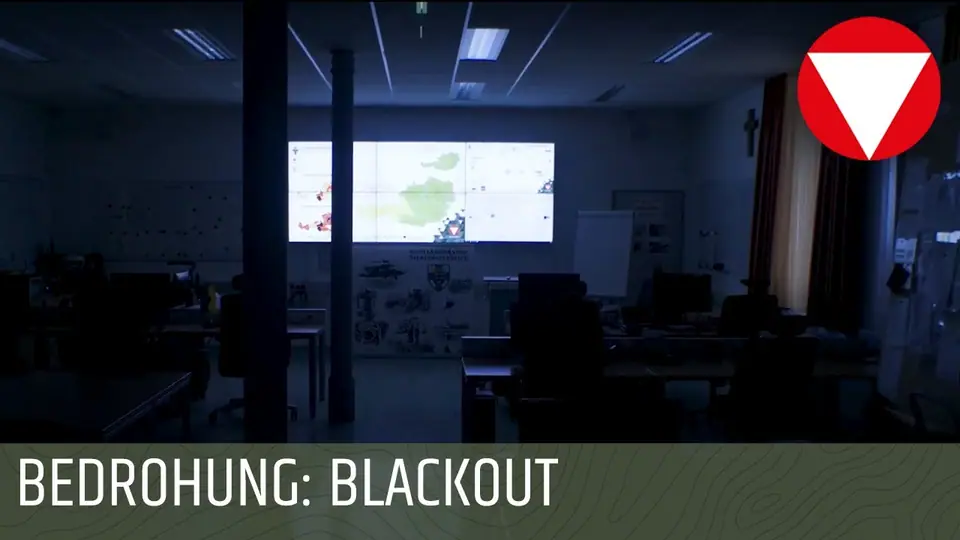
Interestingly, the Austrians recommend keeping food supplies at home for at least 2 weeks, so the scenario they describe is a crisis that could last at least a dozen days or so.
The governments of Spain and Switzerland have also warned that blackouts could happen11.
[UPDATE 2026] 28 April 2025 showed that these are not idle fears. At 12:33 the power went out across the whole of mainland Spain and Portugal. Trains, metros and lifts stopped12, and the Spanish prime minister appealed to people to keep phone calls short so as not to overload the network. Restoring the system took all night: in Portugal the power was back everywhere just after midnight, and in Spain at around 4 in the morning on 29 April. The transmission system operators called it the most serious blackout in over 20 years13, and in their final report of March 2026 they did not point to a single cause but to a combination of several: oscillations in the grid, gaps in voltage control and a cascade of power stations disconnecting one after another.
The official version has plenty of critics, though. At the moment of the failure, solar power was supplying 59% of Spain’s electricity, wind almost 12%, and nuclear and gas plants together about 16%14. From the very first days the Spanish government insisted that renewables were not to blame, but many experts and commentators believe it was precisely their dominance that robbed the grid of its safety margin. Unlike the huge turbines in coal, gas and nuclear power stations, solar panels don’t give the grid inertia, which damps sudden fluctuations. Even the final report noted that some large renewable plants were running in a mode that did not let them respond to voltage surges, and disconnected earlier than they should have (the report also blames conventional power stations for the lack of voltage control, as they did not deliver as much power as the operator requested). And according to reports from the Spanish Senate’s investigative committee, grid operators were already talking about “photovoltaic oscillations” on recordings 20 minutes before the failure15. Who to believe is your call. For us the conclusion is simple: the more the grid depends on the weather, the more it pays to have your own plan for a power cut.
You don’t even have to look as far as the Iberian Peninsula. On 4 July 2025, around midday, the power went out in 6 of Czechia’s 14 regions, including Prague and three regions bordering Poland. Around a million supply points were left without power, roughly one in six in the country. Most of them got their power back within about 6 hours, and the last faults were fixed after 10 hours. The cause was not an attack (a cyberattack was ruled out) but a broken phase conductor on a line in the Ústí nad Labem region16.
Taking all these facts into account, we have to admit that the threat of a blackout is real and cannot be ignored.
How do you survive without electricity?
However seriously you take the threats that blackouts bring, it is always worth being prepared for the worst. You need to realise that a prolonged power cut will mean - at least for a while - the practical collapse of civilisation and growing anarchy.
The longer it lasts, the worse it will get. While power cuts of a few hours can sometimes pass almost unnoticed, blackouts lasting several days, let alone several weeks, will pose a very serious danger to our health and lives.
In the rest of this article you’ll find out what you can do right now to prepare to survive in a world without electricity.
If you don’t have time to read it all, here are the most important points in a nutshell:
- Before you buy anything, work out your water: at least 3 litres per person per day (water without electricity).
- First you eat what is in the fridge, then the supplies that need no cooking (fridge and freezer, food).
- In winter you heat one room, and every heater has a carbon monoxide alarm next to it (freezing weather without power).
- Insulin and electrically powered medical equipment need a plan before the lights go out (medicines and medical equipment).
- A battery radio, a power bank, cash in various denominations and a meeting place agreed with your family (communication).
- A generator only ever goes outside (generator).
- At the end there is a printable checklist.
A possible scenario for Poland in a prolonged power outage
In Poland, in the event of an electricity shortage, there are procedures ready for introducing various power supply levels, from 11 to 20. In practice, these levels apply mainly to businesses with a contracted capacity of at least 300 kW ([UPDATE] the rules are now set out in the regulation of 8 November 2021 issued by the Council of Ministers, the Polish cabinet, which replaced the rules from 2007). The power supply level restrictions do not apply to households. Nor do they apply to:
- hospitals and other emergency medical facilities;
- facilities that broadcast national radio and television programmes;
- facilities serving air, rail and public transport;
- military and energy facilities, and fuel mines;
- facilities important for protecting the environment, including sewage treatment plants;
- critical infrastructure facilities.
If these restrictions don’t have the expected effect, the next step may be cutting off larger or smaller areas of the country. Nobody knows in what order the operators would disconnect customers, but in my opinion the first to go will be villages and small towns, or even whole districts, in the less strategically important and more remote parts of Poland. Next in line will be medium-sized towns, then large cities, and finally the capital itself.
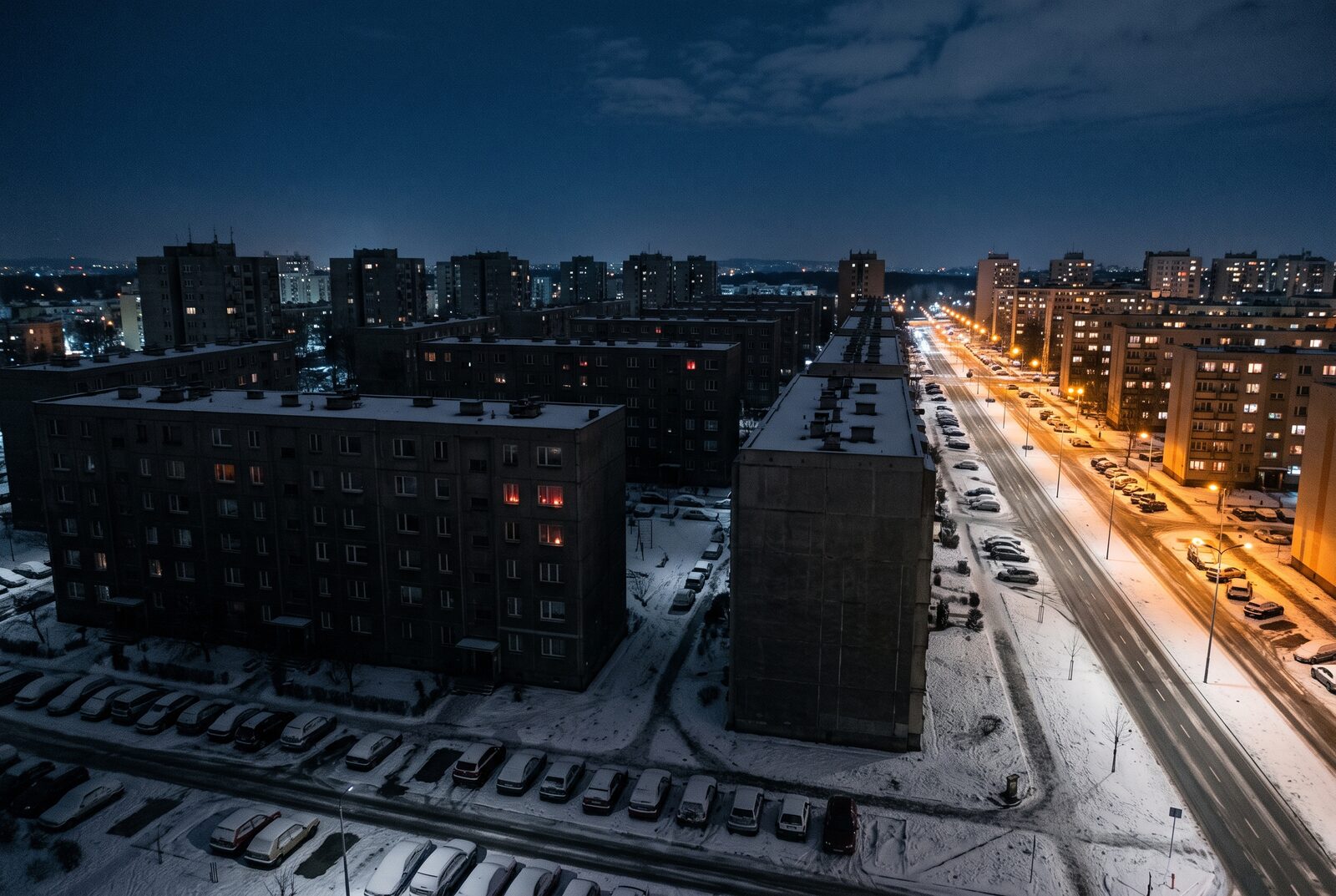
Of course, strategic infrastructure will have absolute priority, which means the power in your flat will be switched off first, and only later at the nearby army base or hospital.
When a power cut is like a war - how to prepare?
In the rest of the article I will now and then quote the account of a Bosnian man who lived through the hell of war in the Balkans in 1992 - 1995 and survived a year in a city cut off from the world - without electricity or civilisation. The situation he describes resembles, in very many ways, a possible scenario of a prolonged blackout (he wrote under the pseudonym Selco on the SurvivalistBoards forum in 2011, and the authenticity of his account cannot be confirmed today).
I will also draw on the advice of an anonymous GRU officer going by the pseudonym Szop, Polish for “raccoon” (this text cannot be verified - it has been circulating on the Polish internet since at least 2015, so treat it more as a curiosity than as expert knowledge). The translation is a bit clunky, but clear enough.
In the first hours of a blackout, people will assume it is a temporary problem, that “someone will fix it” any minute and everything will go back to normal. Great if that happens. But if it doesn’t, it is worth heading to the shop for some emergency shopping - the sooner, the better:
It makes sense to buy food on the first day, while they are still selling; later the shops will close and all the staff will start stealing everything.
Of course, card terminals won’t work, so even if you have millions in your bank account, you won’t be able to buy so much as a loaf of bread with them. For a situation like that, it is worth having, somewhere safe, some cash.
As Marek rightly pointed out in a comment, when the power is out most cash registers won’t work either, unless the shop has its own backup power or a mobile till. I think quite a lot of shops do have backup power for their tills, and besides, if there is a bigger “ruckus”, shopkeepers will probably pay less attention to sticking strictly to the rules. So cash will definitely come in handy, at least at the beginning.
Bear in mind too that - because of inflation (which at the beginning of 2022 was running wild) - keeping cash “under the mattress” like this doesn’t really pay. For example, if inflation is 10% a year and you put away PLN 500, then after a year of keeping your money like this, your PLN 500 will have a real purchasing power of about PLN 455.
Even so, I think PLN 500 (at least at the beginning of 2022) is a sensible amount “per head”. That is, if there are 4 people in your family altogether, then - in my opinion - it makes sense to keep PLN 2,000 in cash this way. In this case you simply have to accept the losses to inflation. What is more, in a long blackout money will lose its value very quickly, so it doesn’t pay to keep large amounts in cash.
How do you cope with freezing weather without electricity?
If a power failure happens during a freezing winter, we have another problem: no heating. Many boilers need electricity to run, and gas boilers usually need it too. The building will “hold” its heat for a while, so it will be warmer inside than outside, but the longer this goes on, the colder it will get indoors.
While temperatures down to about 0 °C can still be put up with somehow just by dressing warmly (a healthy adult can manage that; older people, small children and the sick lose heat much faster, so look after them first), frosts of -20 °C and below, without heating, will be deadly for you in the long run. If you live in a block of flats, your options are limited - lighting a fire in the living room is possible in theory, but where and how will you let the smoke out? Will you open the windows and chill the place down even more? What about fuel? How long will the kitchen table and chairs last? (But seriously: a fire in a flat without a chimney is a straight road to carbon monoxide poisoning or setting the whole block on fire, so don’t even try.)
The truth is that your options are most limited when you live in a block of flats in a big city. The events in Ukraine in 2022 prove beyond doubt that big cities are often death traps for civilians, so if you possibly can, get out of the city - the sooner, the better (and so that leaving doesn’t turn into a panic, pack a bug-out bag in advance).
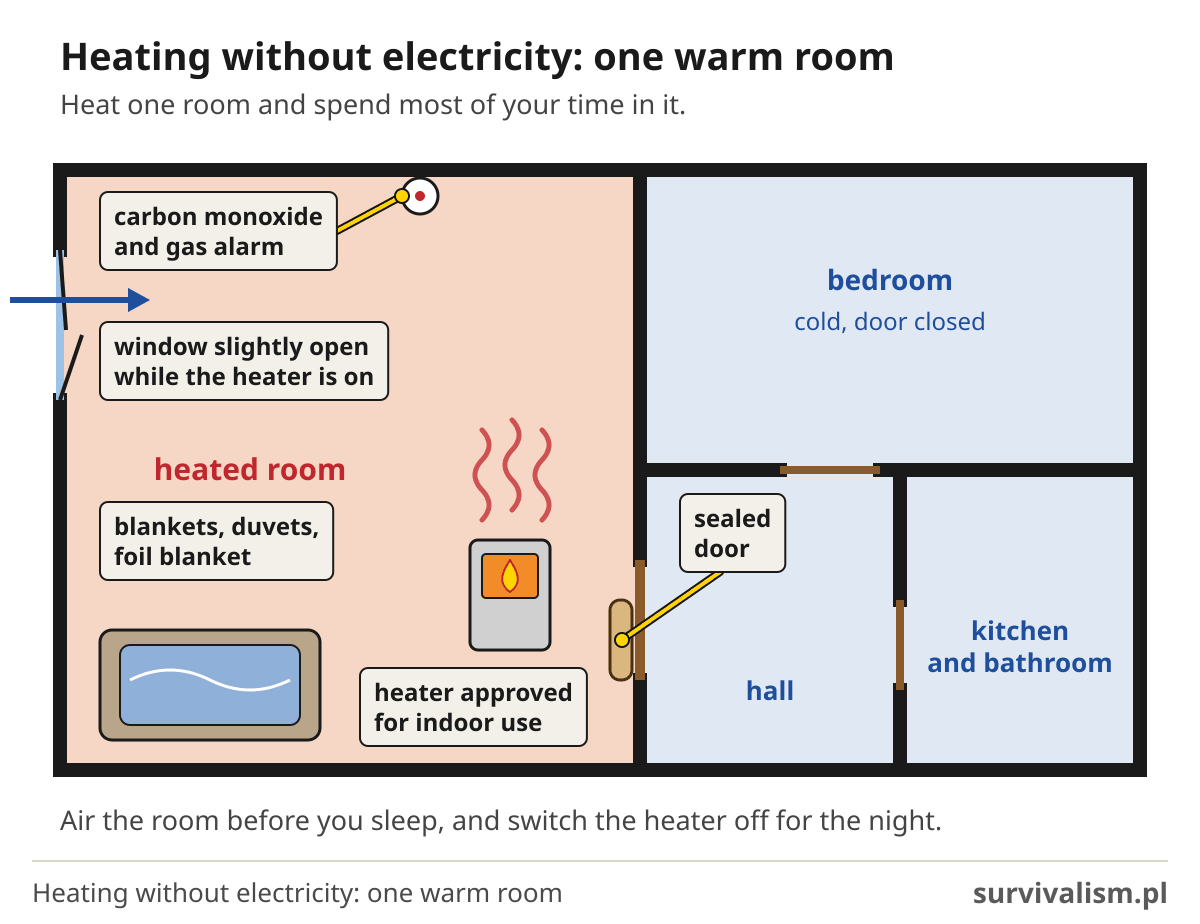
If you decide to stay in the city, practically the only sensible way to solve the problem of heating without electricity is to buy, in advance, a small heater that runs on gas cartridges or a model that connects to a gas cylinder.
I managed to find a heater Amazon store, affiliate link, opens in a new tab like that. Not only does it heat, you can also cook meals on it; it runs on cartridges and can also be connected to a gas cylinder (if you buy the right valve). However, a heater like this has a small output and can only heat small rooms effectively. To keep heat loss to a minimum, pick one room that you will heat and where you will spend most of your time. Seal the doors and windows with whatever you can, so that as little heat as possible escapes (but while the heater is burning, leave a window slightly open - the heater burns oxygen, and in an airtight room carbon monoxide poisoning can happen easily).
Important: the room where you use a heater like this must be aired regularly. It is best to do it at least right before you go to sleep (and switch the heater off for the night - never sleep with it on). Be sure to get a carbon monoxide and gas alarm too - with a heater like this it is a must, not an option. Only use a heater that the manufacturer approves for indoor use, and follow the instructions (headache, dizziness, nausea and drowsiness are symptoms of carbon monoxide poisoning - if you notice them, open the windows at once, get out into the fresh air and call 112).
And don’t heat your flat with an ordinary gas hob or the oven either, because that is a straight road to carbon monoxide poisoning and fire17.
Of course, you need to “raid” your wardrobe and dress warmly. If you have to, put on 3 jackets and 5 jumpers, and top it all off with your wedding suit. Wrap yourself in a duvet, a blanket and anything else that gives you better insulation. This is where a foil emergency blanket will come in very handy, so it is worth getting one in advance. It is very cheap and very good at stopping you from losing precious heat.
The German Federal Office of Civil Protection and Disaster Assistance even suggests this trick with candles and a flowerpot (be careful with it: it gives off hardly more heat than the candles on their own, and German fire brigades and chimney sweeps warn that the wax under a hot flowerpot can burst into a large flame):
You have to do everything in your power to get through hard times, but it is better to prepare for them in advance.
A block of flats without power: the lift and water on the upper floors
In a block of flats you will feel the lack of power sooner than in a house. The first thing is the lifts: without power they stop (that is what happened in Spain in April 2025). If the power has already gone off once or outages have been announced, take the stairs, and help elderly neighbours on the upper floors carry up their water and shopping.
The second thing is water. In tall blocks, water is often pushed up to the higher floors by a booster pump, which is part of the building’s own plumbing18. Without power the pump doesn’t work, so on the upper floors the taps may run dry sooner than on the ground floor. So if you live high up, a supply of bottled water matters even more for you.
Water without electricity
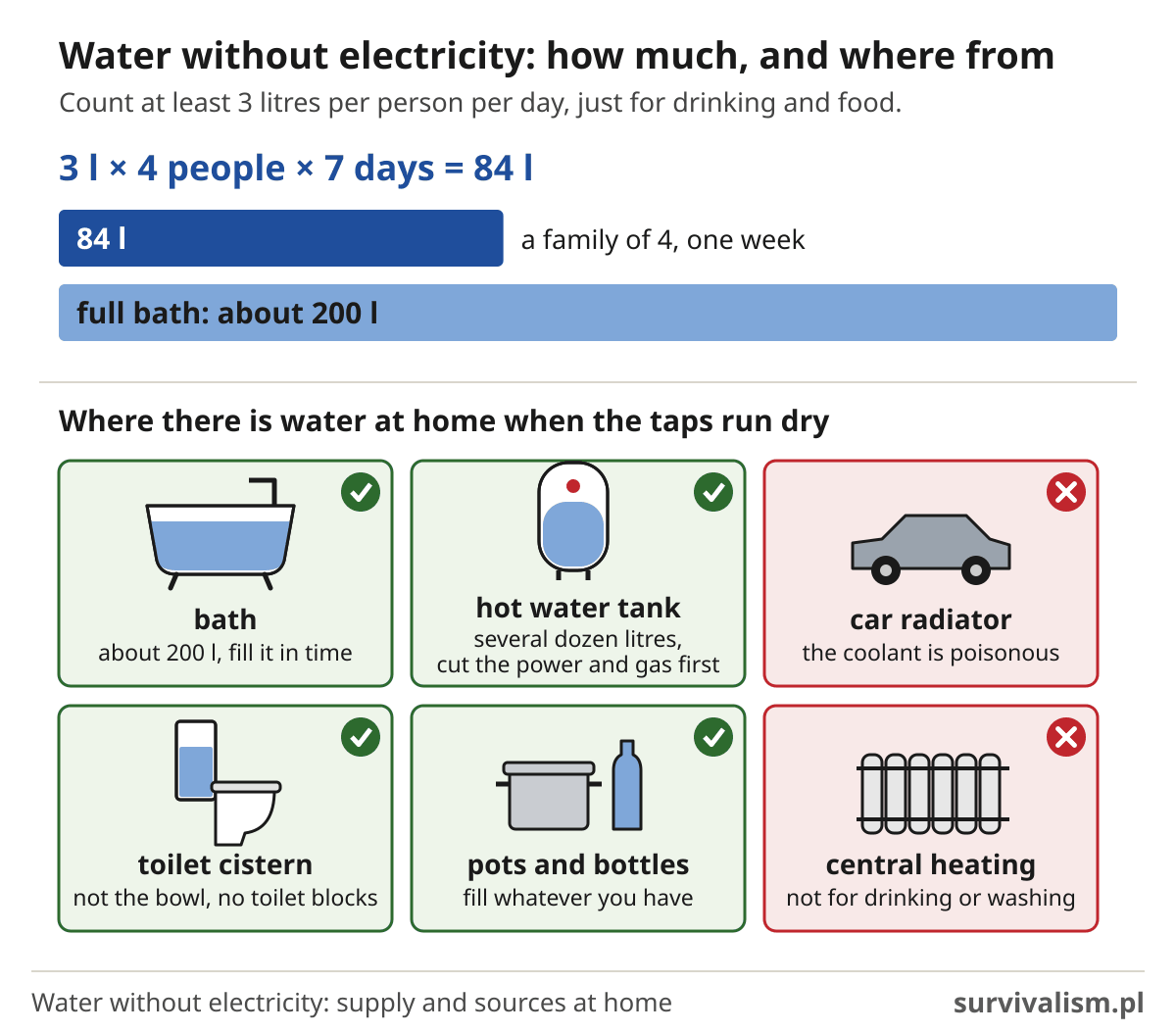
Those of us who don’t have our own independent source of drinking water will have another serious problem. A person can survive without water for a few days at most, and without electricity there will be no water in the taps. An adult needs about 2-3 litres of this precious liquid a day, and it is worth planning your supply at no less than 3 litres per person per day10. So it is easy to work out that, just for drinking and food, a family of four will need at least 84 litres of water for a week. That is quite a lot.
Drinking water needs careful planning and thought. A lot depends on your circumstances and where you live. If you live in the countryside, you will probably be better off than someone in a city. In many cases you will have access to a well or to containers that collect rainwater.
Rivers and streams in the countryside are also generally less polluted than rivers in cities. In most cases you can drink water from such a source - as long as there are no harmful chemicals in it - fairly safely once it has been boiled (boiling won’t remove chemicals or fuel, though, so avoid rivers that flow through farmland or below factories, and choose springs and streams above any buildings).
Even so, I recommend filtering such water before you boil it as well. You can build a filter yourself or buy a ready-made one. There are many models of outdoor water filters on the market in various configurations, but even the simplest one filters water very effectively, removing sediment, bacteria and protozoa.
With the right filter you can drink water even from a puddle (as long as it is not contaminated with harmful chemicals; most filters don’t remove viruses either, so be careful) or from melted snow (remember: never eat yellow snow ;).
An alternative or addition to a water filter is water purification tablets Amazon store, affiliate link, opens in a new tab. They make the water taste pretty grim (like very heavily chlorinated tap water), but water treated this way is reasonably safe to drink.
If you live in a city, find out whether there are any “wild” springs, water intakes or wells nearby. You’ll be able to “fill up” there if you need to. Just remember that a queue of people who have had the same idea as you will soon form there. Wherever you live, keeping some water stored at home is also a good option.
Got an allotment? Start collecting rainwater there now. In summer you’ll have something to water the plants with, and if the worst comes to the worst, you’ll have a supply of drinking water.
Don’t, however, reach for water from your car radiator or from the radiators and boiler of your central heating: a car radiator almost always contains coolant, which is poisonous even in small amounts, and water from a central heating system is not fit for drinking, cooking or even washing19. Do you use a hot water tank to heat water at home? Then you have several dozen litres of drinking water (before you drain it, cut the tank’s power and turn off the gas supply). You can also take water from the toilet cistern (not the bowl!). That water is no different from what comes out of your tap, as long as you don’t put toilet blocks or cleaning tablets in the cistern (boil it to be on the safe side).
If you have a bath and there is still time to prepare (for example, a longer blackout has been announced in the media), fill it to the brim as quickly as you can. A bath holds about 200 litres of water, so you will have your own supply for the duration of the blackout. If you don’t have a bath, fill pots, bottles and any other containers you have at home.
We usually collected rainwater in 4 big barrels and then boiled it. There was a small river nearby, but it quickly turned into a sewer. You need lots of water containers: barrels and tanks.
Important: water whose origin and cleanliness you are not sure of should only be drunk as a last resort. Drinking contaminated water can cause far bigger problems than thirst itself. You can get diarrhoea and become even more dehydrated. You can fall ill, which, with no electricity, civilisation, hospitals or medicines, will be very dangerous. Any water from an uncertain source must at least be boiled before you drink it.
The fridge and freezer without electricity
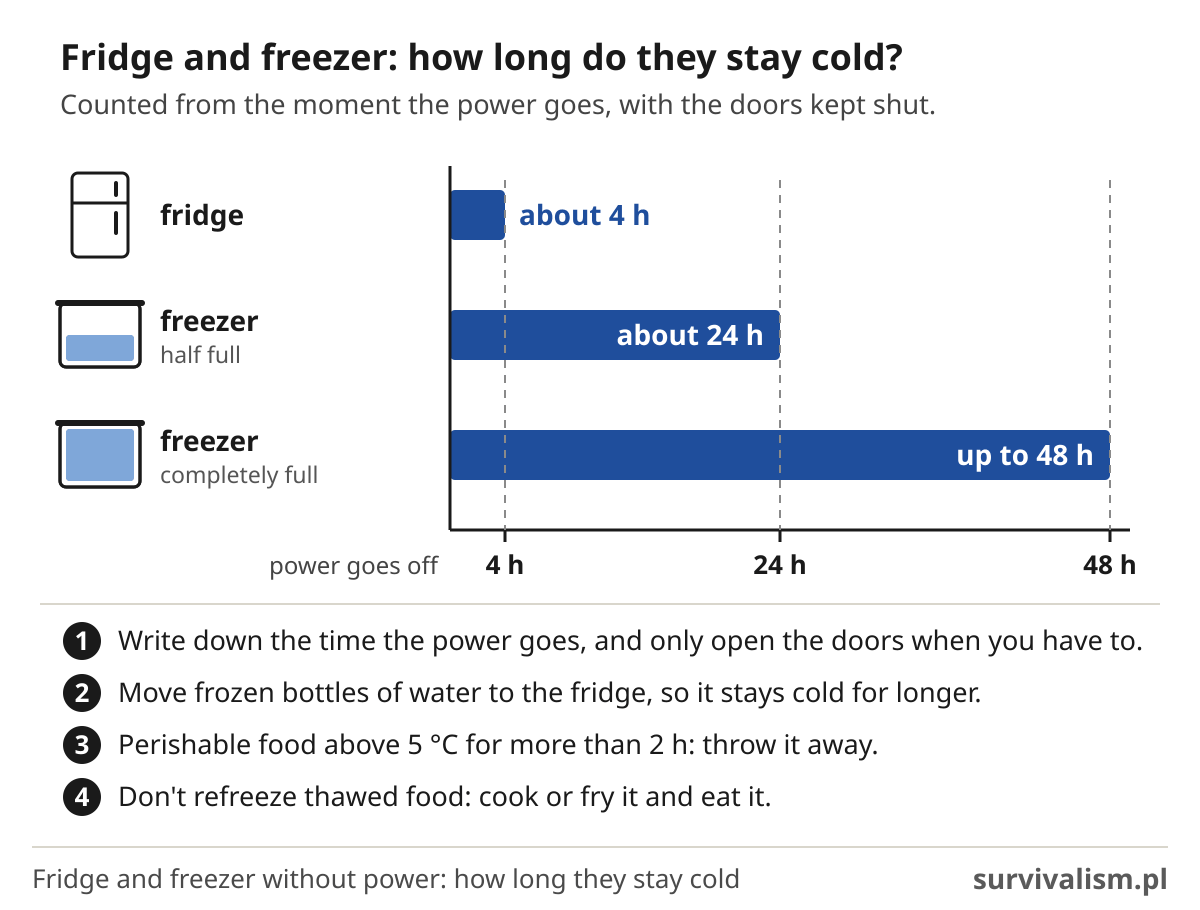
Before you reach for the supplies in the cupboard, eat what is in the fridge. This is how much time you have20:
- a closed fridge keeps a safe temperature for about 4 hours;
- a completely full freezer stays cold for up to 48 hours, a half-full one for about 24 hours;
- throw away perishable food that has been above 5 °C for more than 2 hours;
- don’t refreeze thawed food; cook or fry it straight away and eat it.
So only open the fridge and freezer when you have to10, and when the power goes, write down the time. If you have room, keep a few plastic bottles of water in the freezer. During an outage, move some of them to the fridge so that it stays cold for longer.
For the first few days, food you can eat without cooking will also come in handy. It is the same kind of thing you take to the mountains, which I wrote about in my article on food in the mountains.
Food during a blackout
Another important thing to take care of is food. Stock up for yourself and your family for at least a week, ideally two. Anything that keeps for a long time will do here, so:
- Flour, rice, pasta, groats, semolina, oats (carbohydrates)
- Beans, broad beans, peas, nuts (plant protein)
- Tinned fish and meat, powdered milk (animal protein)
- Peanut butter, oil (fats)
- Sugar, honey, chocolate, snack bars (energy)
- Dried fruit, raisins, candied fruit, preserves (a source of vitamins)
From my own experience: the popular “Snickers” bars are very nourishing. 6 double Snickers - that’s a man’s daily calorie ration[…] The Snickers idea is stolen from the Chechens. They fight on them. You can eat them on the move, a very good thing: sugar, glucose, it lifts your mood (assuming you’ll be in a terrible state, mentally and physically - glucose is very useful).
It is worth stocking the things your household actually “gets through” every day. That way, in normal times, you can eat the ones nearing their best-before date and keep replacing them with fresh ones as you go.
When you store dry goods for a long time, you may run into a problem with pests; the main culprits here are the Indian meal moth and the Mediterranean flour moth, commonly known as pantry moths.
Fighting them isn’t easy, but there are ways to minimise the chance of an infestation. Dry goods such as flour, semolina or oats should be kept in airtight glass containers.
In addition, put each filled jar in the oven at about 100 °C for a quarter of an hour or so and/or in the freezer for about 2 weeks. That should kill all the eggs, larvae and adult insects. After this treatment, you can store your food safely.
You can also get special moth traps and put them in strategic places.
Storing food only partly solves the problem of hunger. What good is flour if we have nothing to cook a meal from it on? Eating raw flour can be very dangerous to our health21. So sort out a suitable gas cartridge stove in advance, one you can not only cook on but also use for heating. A standard 220 g cartridge lasts for 1-3 hours of burner use, depending on its power, which is quite a lot.
Just remember that an ordinary camping stove that runs on cartridges and is not approved for indoor use is lit outside, just like a barbecue (keep both at least 6 metres from windows, because they give off carbon monoxide17). If you have a garden or an allotment, you can also cook over a campfire (how to light a fire in almost any conditions) or on a small rocket stove that you can build yourself.
Another option is to buy a gas cylinder, which can be refilled at a dedicated outlet for relatively little money. In some parts of Poland, for example Upper Silesia, cylinders like these are standard in many kitchens.
It may turn out that the power stays off not for hours or days, but for whole weeks. Especially in the cities, this will certainly lead to great hunger. People will fight for food like animals; there may be scenes straight out of Dante’s Inferno. Even the best-stocked larder will run empty one day. What then?
Well, then you have to eat whatever you can get your hands on: pigeons and rats, worms, stray cats (the meat of such animals can carry diseases, so always boil or fry it thoroughly). Scary? Impossible? Disgusting? You’ll be surprised how quickly, faced with hunger, people lose all their inhibitions and their morals slide back to the Stone Age.
Have you ever been really hungry? I mean really hungry?
I don’t mean skipping dinner, but going without food for a long time. I once did a week-long fast during which I drank nothing but water. It will probably come as no surprise that after just a few dozen hours my thoughts revolved almost entirely around food.
Food was also the main subject of my dreams and of my conversations with the friend who was fasting with me. I guarantee you that hunger is one of the most powerful forces that act on a human being.
To get food, you can fish (if you have somewhere to do it, something to do it with and know how). You can also hunt. I don’t mean hunting wild boar, but rats, starlings and pigeons. In a big city - at least for a while - there will be no shortage of them. For this, it is a good idea to get yourself an airgun.
Pellets are very effective for hunting birds. I own 2 kinds of airgun myself: one is a classic break-barrel air rifle that fires lead pellets. It is a simple, reliable weapon with surprisingly high hitting power (bottles and jars shatter even when hit from several dozen metres). The other is a pistol that takes CO2 cartridges and shoots small balls, a so-called BB gun. A handgun is handier and doesn’t draw unnecessary attention to itself, especially in a city.

Hygiene and health when there is no power
Hygiene and health are another thing you mustn’t neglect, especially in the extreme situations we are talking about here.
A lot of people died because of hygiene problems. You need simple things in huge quantities. Bin bags and toilet paper, for example. Disposable cups and plates. Loads of them. I know because I didn’t have any.
For me, a supply of hygiene products is probably more important than food. You can shoot a pigeon. You can find a plant to eat. You can’t find or shoot hygiene products.
Make sure you have a good supply of the essential hygiene items: disinfectants, detergents, bleach, soap, gloves.
How did you go to the toilet? We used shovels and holes in the ground. Sounds disgusting? It was. We washed in rainwater or in the river, but the river was often too dangerous. We had no toilet paper. Even if we had, I would have traded it. It was a “dirty” business.
Think about where you will go to the toilet. If you live on a housing estate, you have a problem. After all, the toilets stop working from the first day of a blackout - there is no more water to flush them. How many days will pass before the bowl fills to the brim and the stench in your home becomes unbearable, not to mention the risk of bacteria?
Of course, you can go outside to a secluded spot to relieve yourself, but that “secluded spot” will probably very soon be secluded in name only. Other people have exactly the same problem as you, after all, and they will be looking for a “secluded spot” too. In heavily built-up areas there aren’t all that many of them.
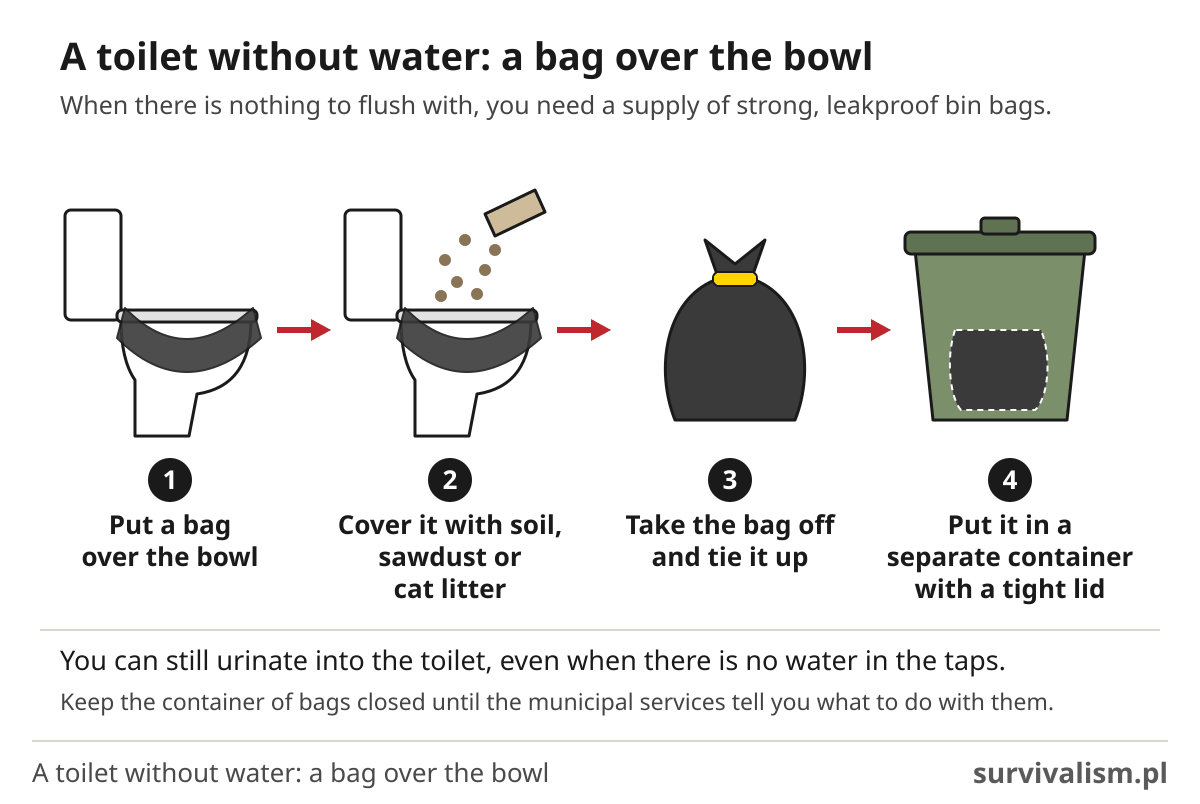
A good solution here may be a large supply of strong, leakproof bin bags. When you need to do a number two, put one of these bags over the toilet bowl, sit down and do your business into the bag. Then take the bag off, tie it up and take it out of the flat (it is best to cover the contents first with soil, sawdust or cat litter, and to put the bag into a separate container with a tight lid - left on the staircase, it will become a breeding ground for germs for the whole block).
Number one is a bit easier, at least for men. All you need is a large container, ideally one that closes tightly, which you can carry outside and empty once it is full. To make things easier, you can get an adult potty - there are versions for men and for women. First you do your number one into the potty, then pour it into the larger container, which you carry out and empty outside once it is full.
There is one thing that is easy to forget: even when there is no water in the taps, you can still urinate into the toilet. Keep the bags of faeces in a separate container with a tight lid until the municipal services tell you what to do with them10.
First aid kit and medicines
People often died for trivial reasons. Without medicines, and with a limited amount of water, ordinary diarrhoea will kill you in a few days.
In a stressful situation like this one, and when our standard of hygiene is lower than usual, an ordinary cut can end in death if it gets infected and we don’t get to a doctor in time.
Every wound, even a small one, needs to be cleaned well, rinsed and protected from getting wet and dirty. For that you will need dressings, plasters and bandages. On top of that, to minimise the chance of the wound getting infected, it is worth getting an antibiotic ointment, which in Poland you can buy without a prescription (it is for small wounds, grazes and burns; a deep wound or a puncture wound is a job for a doctor, and while you are at it, check that your tetanus vaccination is up to date). I have tested it, and it works brilliantly. Wounds heal quickly and without “festering”.
Your first aid kit should also contain packs of painkillers. Another important item in it is medicinal charcoal (activated). It will stop diarrhoea effectively, which can come on out of nowhere, caused either by food poisoning or by stress (with diarrhoea, though, the most important thing is to drink, so add oral rehydration solutions to your kit, and take the charcoal separately from other medicines, because it weakens their effect).
Remember that medicines have expiry dates, so every now and then you need to replace the ones that are out of date.
Medicines kept in the fridge and electrically powered medical equipment
If someone in your home takes medicines that have to be kept in the fridge, or uses medical equipment that runs on electricity, prepare a separate plan for them before the power goes. Keep a supply of the medicines they take regularly and batteries for assistive devices, such as a hearing aid or a blood sugar sensor10, and also a plan B for keeping medicines cool and powering medical equipment17. It is best to agree it with a doctor.
The most common case is insulin. Insulin in the manufacturer’s vials and cartridges, opened or unopened, can be kept out of the fridge at 15 to 30 °C for up to 28 days and still works22 (some products for longer, the details are in the leaflet). Keep it in the coolest place you can, out of the sun, and if you cool it with ice, make sure it doesn’t freeze: insulin that has frozen even once must not be used.
Lighting
For light over a short period, candles will do. But if the blackout drags on, they may not be enough in the long run. So tuck a torch and spare batteries away in a drawer somewhere. Modern LED torches are very energy-efficient and give a bright, even light.
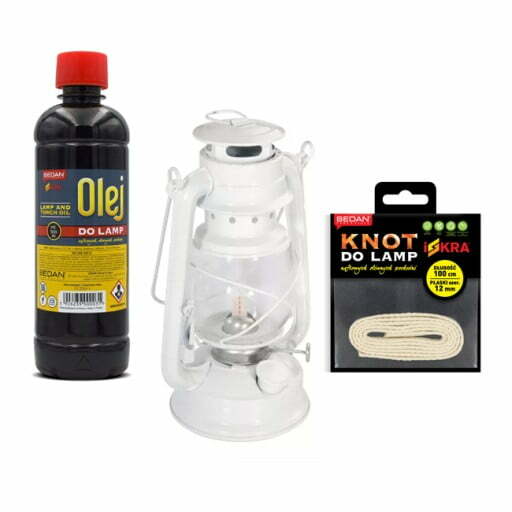
You could also think about buying a paraffin lamp and some extra fuel for it. It is also worth having a good supply of lighters and/or matches to hand. If the blackout went on for several weeks, they would make a good currency for bartering. The same goes for batteries.
Back to candles - large shops sometimes have offers on refills for grave candles. In most cases, though, they will be useless for our purposes, because they are made to burn outdoors. If we use them in a closed room, we can be poisoned.
Radio, communication and other electronics
Get yourself a battery radio Amazon store, affiliate link, opens in a new tab, or even better, a good wind-up radio with a solar panel. The radio will be your window on the world. It is how you will hear about help on its way (or the lack of it) and listen to the weather forecast. A radio also does a lot to lift morale, which matters too.
You can also buy a set of walkie-talkies, so that you can stay in touch if you have to split up from your loved ones. Just make sure you choose a model that takes replaceable batteries, because in a blackout you won’t be able to use a charger. Batteries come up quite often, so once again I remind you to stock up on enough of them. On Amazon you can buy whole packs of 40 Amazon store, affiliate link, opens in a new tab, so per battery it doesn’t cost a fortune.
Get a high-capacity power bank too. You can use it to charge your smartphone in an emergency, and perhaps other devices with built-in batteries as well. Although in a longer power cut there will most likely be no mobile signal, and so no internet (base stations only have backup power for a while; before they go down, send text messages instead of calling, so as not to overload the network), you can still use your smartphone to find your way (offline maps, compass) if you need to, or as a torch as a last resort.
To make your smartphone battery last longer, switch off all the functions you don’t need, such as Wi-Fi or Bluetooth. Turn the screen brightness right down too, because the screen uses the most power. It is best to switch the smartphone on only when you really need it.
The simplest way to save battery is to switch on your phone’s power-saving mode10. Install the free Regionalny System Ostrzegania (RSO) app, the Polish Regional Warning System, in advance, and remember that RCB Alerts, the warnings from the Government Centre for Security, are sent to mobile phones. While the network is still working, don’t make calls unless you have to; send text messages instead, so as not to overload the lines.
Also agree with your loved ones what you will do if you can’t get through to each other: where and when you meet (near home and outside the town) and who picks the children up from school. The government Guide has ready-made sections to fill in for this, and I wrote about it in my article on the bug-out bag. And look in on your neighbours, especially the elderly and those who live alone, and check who around you needs help.
When the power goes, unplug the TV, the computer and other devices. Power can come back with voltage surges that damage equipment.
A generator: outdoors only
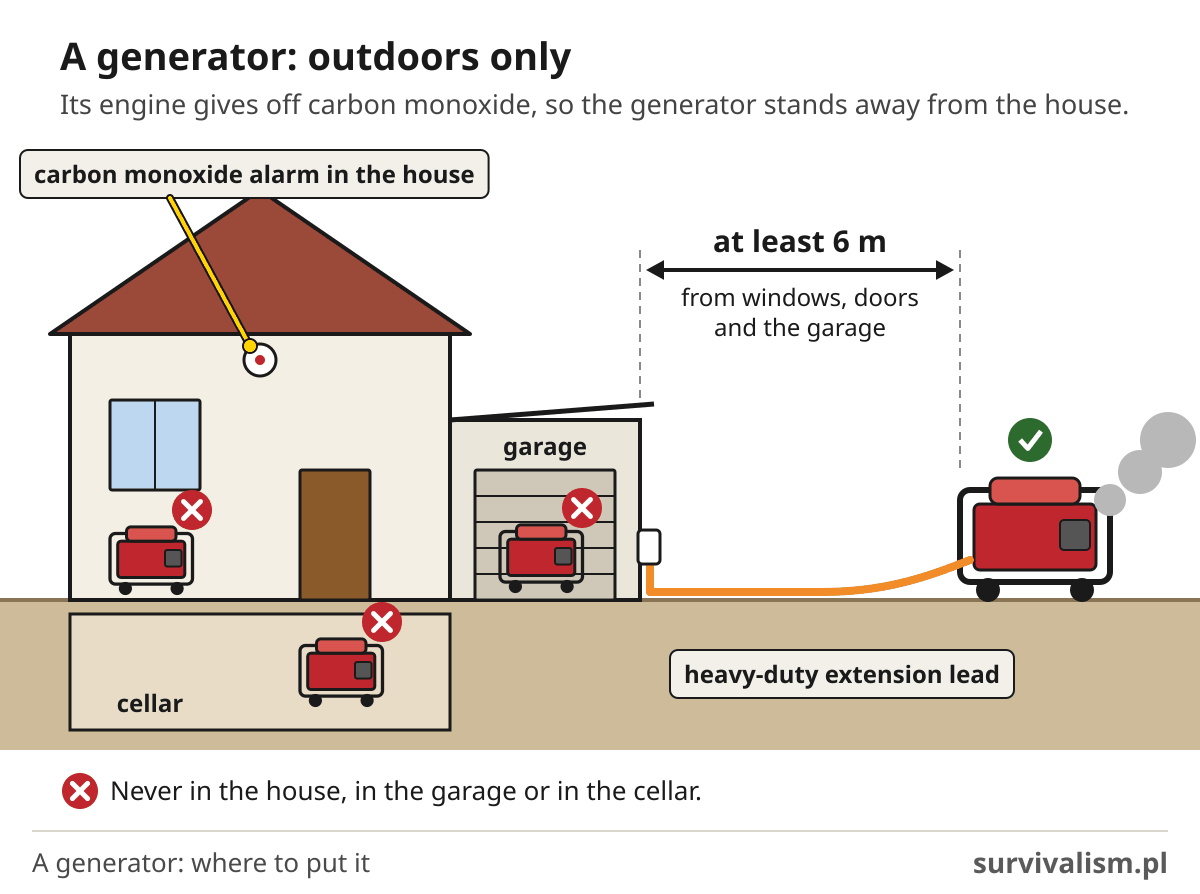
It is also worth considering buying a generator10. With a generator you will get through a longer outage much more comfortably (the fridge, charging phones, light), but it is a combustion engine that gives off carbon monoxide. So only ever put it outside, at least 6 metres from windows, doors and an attached garage, never in the house, in the garage or in the cellar17. Connect devices to it with heavy-duty extension leads designed for this kind of use, and before you top up the fuel, switch it off and wait for it to cool down, because fuel spilled on a hot engine can catch fire. Have a working carbon monoxide alarm in the house. Leave connecting the generator to your home wiring to an electrician. I explain how to store fuel further down.
When help doesn’t come - substitute means of payment
This part describes an extreme scenario: a blackout that lasts for weeks, for example during a war. I base it mainly on Selco’s account from a besieged city in Bosnia, so treat it as a picture of the worst case, not of what you can expect from an ordinary failure.
When a blackout lasts more than a dozen days or so, things will start to get ugly.
The most important thing is to survive the first 72 hours - it is worth having home supplies for at least 3 days, because that is roughly how long you need to be able to cope on your own before help is organised10. After that, you’ll manage somehow. People have an incredible ability to adapt; they can get used to unbelievably hard conditions. But not everyone can. Without help, the weakest will die, and within the first few days. After that comes the fight for survival among those who are left.
Money soon became worthless. We went back to bartering. For a tin of tushonka (tinned stewed meat) you could have a woman. (It is hard to talk about, but it is true.) Most of the women who sold themselves were desperate mothers.
Crisis situations bring out people’s worst instincts. In the long run, only the strongest and/or the best organised will survive. To be among those lucky ones, you need to prepare properly. Some of us still remember the communist era, when the shop shelves were empty and food was rationed with coupons. Even so, people somehow got by. The goods with the best trading value were these:
- Coffee and tea
- Alcohol and cigarettes
- Sugar and chocolate
These goods went from hand to hand as a substitute for cash. They are easy to store and in demand.
Was salt expensive? Yes, but coffee and cigarettes were even more expensive. I had a lot of alcohol and sold it all straight away. People drank 10 times more than in peacetime.
Lighters, batteries and antibiotics will also make a good substitute for money (if you have access to them; only take them yourself if a doctor knows about it), as will anything else that is in demand at the time.

I would like to stress this: learn to repair things, shoes or people. My neighbour knew how to make kerosene for oil lamps. He was never hungry.
It is also worth buying a few, or a dozen or so, silver coins. They don’t take up much space and they hold their value well (you will lose quite a lot on them at the start, because since 2025 you pay the full 23% VAT on silver in Poland, plus the dealer’s margin, but there you go). Gold and jewellery will of course be valuable too.
Another commodity that will become valuable very quickly is fuel: diesel and petrol. Don’t keep it in the house (harmful fumes and the risk of fire). Keep it in a sealed jerry can in a garage or in a shed away from the house.
Power cut checklist
Below is a list of things worth having at home in case of a long power cut. I have gathered here what I write about in this article and what the Polish government’s Safety Guide recommends. Print it out and every few months check that everything is in place and that nothing is past its expiry date (if you are just starting out, also have a look at my article Who is a prepper).
| What | Notes | Checked (date) |
|---|---|---|
| Water | at least 3 l per person per day, for at least 3 days; a bath to fill when a longer outage is announced | |
| Food you can eat without cooking | for at least 3 days, better a week or two; check the dates | |
| Cartridge stove and spare cartridges | a camping stove is only ever lit outside | |
| Heating without electricity | a heater approved for indoor use, foil emergency blanket, blankets, warm clothes | |
| Carbon monoxide (and smoke) alarm | with spare batteries | |
| Torches and batteries | candles for household use only, not grave candles | |
| Battery or wind-up radio | ||
| Power bank | charged; power-saving mode and the RSO app on your phone | |
| Cash | in various denominations | |
| First aid kit and regular medicines | insulin and electrically powered medical equipment: a plan for a power cut | |
| Hygiene | strong bags, a bucket with a lid, sawdust or cat litter, disinfectants, toilet paper | |
| Family plan | meeting place, phone numbers written down on paper | |
| Neighbours | which of your neighbours may need help | |
| Generator fuel | only in a garage or a shed away from the house, in a sealed jerry can |
Final thoughts
Weapons, ammunition, candles, lighters, antibiotics, fuel, batteries and food. We fought over these things like animals. In a situation like that, everything changes. People turn into monsters. It was disgusting.
My aim in writing this article was not to scare anyone, but to draw your attention to a few important aspects of surviving in a world without electricity, so that you can prepare well for a situation like that.
I have done my best to make the text as accurate and complete as possible, but I may have missed something, or some piece of information may be imprecise. If you have spotted something like that, or would like to share your thoughts, please do so in the comments below the article. I read all the comments that appear on my blog and reply to most of them.
To wrap up, if I had to sum everything up somehow, I would put it like this: in my opinion, surviving in a city without electricity is much harder than in the countryside, so if you can, and if you have somewhere to go, you should get out of the city as quickly as possible when a blackout hits.
While power cuts lasting a few days shouldn’t turn into a disaster, prolonged blackouts will be very dangerous for everyone. Many of us will be counting on help from the army and the Territorial Defence Force (Poland’s part-time volunteer soldiers) organised by the government, but personally I wouldn’t put unlimited trust in the government on this.
Things could go in all sorts of directions: some enemy army may want to take advantage of a blackout and the chaos it causes, and then the chance of help from the government will be close to zero.
Yes, I realise that a scenario like that is unlikely, but that is probably just what the Ukrainians thought before the “little green men” attacked them in 2014.
Sources
- Business Insider Polska, „Rosja wstrzymała dostawy gazu przez Polskę. Ceny wystrzeliły” (Russia has halted gas supplies through Poland. Prices have shot up): businessinsider.com.pl (in Polish)
- Rzeczpospolita, „Rano Gazprom wstrzymał dostawy gazu do Polski” (Gazprom halted gas supplies to Poland this morning): energia.rp.pl (in Polish)
- WNP.pl, „Dostawcy energii bankrutują jeden za drugim” (Energy suppliers are going bankrupt one after another): wnp.pl (in Polish)
- WNP.pl, „Niemcy wracają do węgla” (Germany is going back to coal): wnp.pl (in Polish)
- Business Insider Polska, „Blackout w Europie? W mroźną zimę zaczyna brakować prądu nawet we Francji” (A blackout in Europe? In a frosty winter even France is starting to run short of electricity): businessinsider.com.pl (in Polish)
- WysokieNapiecie.pl, „Awaria odłączyła od sieci niemal całą Elektrownię Bełchatów” (A failure disconnected almost the whole Bełchatów power station from the grid): wysokienapiecie.pl (in Polish)
- Business Insider Polska, „Hakerzy zaatakowali elektrownie atomowe w USA” (Hackers attacked nuclear power stations in the USA): businessinsider.com.pl (in Polish)
- International Energy Agency (IEA), “Ukraine’s energy system under attack”: iea.org
- WysokieNapiecie.pl, „Czy grozi nam blackout? Operatorzy uspokajają, ale…” (Are we facing a blackout? The operators reassure us, but…): wysokienapiecie.pl (in Polish)
- „Poradnik bezpieczeństwa” (Safety Guide) (2025), chapter „Długotrwały brak prądu (blackout)” (Long power outage (blackout)): gov.pl/web/poradnikbezpieczenstwa/dlugotrwaly-brak-pradu-blackout (in Polish)
- Polsat News, „Możliwe długotrwałe wyłączenia prądu zimą. Rządy ostrzegają przed blackoutem” (Long power cuts possible in winter. Governments warn of a blackout): polsatnews.pl (in Polish)
- WysokieNapiecie.pl, „Blackout w Hiszpanii: to był potężny Apagón” (Blackout in Spain: it was a mighty Apagón): wysokienapiecie.pl (in Polish)
- ENTSO-E, “28 April 2025 Blackout” (with the final report of March 2026): entsoe.eu
- Carbon Brief, “Q&A: What we do - and do not - know about the blackout in Spain and Portugal”: carbonbrief.org
- Brussels Signal, “Truth is out: Operators immediately linked mega blackout to renewables, Spanish Senate hears” (March 2026): brusselssignal.eu
- Centre for Eastern Studies (Ośrodek Studiów Wschodnich, OSW), „Czechy bez prądu: wnioski z blackoutu” (Czechia without power: lessons from the blackout) (9 July 2025): osw.waw.pl (in Polish)
- Ready.gov (FEMA, the US Federal Emergency Management Agency), “Power Outages”: ready.gov/power-outages
- ZWiK Szczecin (the Szczecin water and sewerage company), low water pressure or no water: zwik.szczecin.pl (in Polish)
- CDC, “How to Find Clean Water in an Emergency”: cdc.gov
- Chief Sanitary Inspectorate (Główny Inspektorat Sanitarny, GIS), „Przerwa w dostawie prądu? Pamiętaj o bezpieczeństwie żywności” (A power cut? Remember food safety): gov.pl (in Polish)
- Gotujmy.pl, „Koniec z podjadaniem surowego ciasta! Surowa mąka może zawierać groźne bakterie” (No more nibbling raw dough! Raw flour can contain dangerous bacteria): gotujmy.pl (in Polish)
- FDA, “Information Regarding Insulin Storage and Switching Between Products in an Emergency”: fda.gov
Leave a comment