
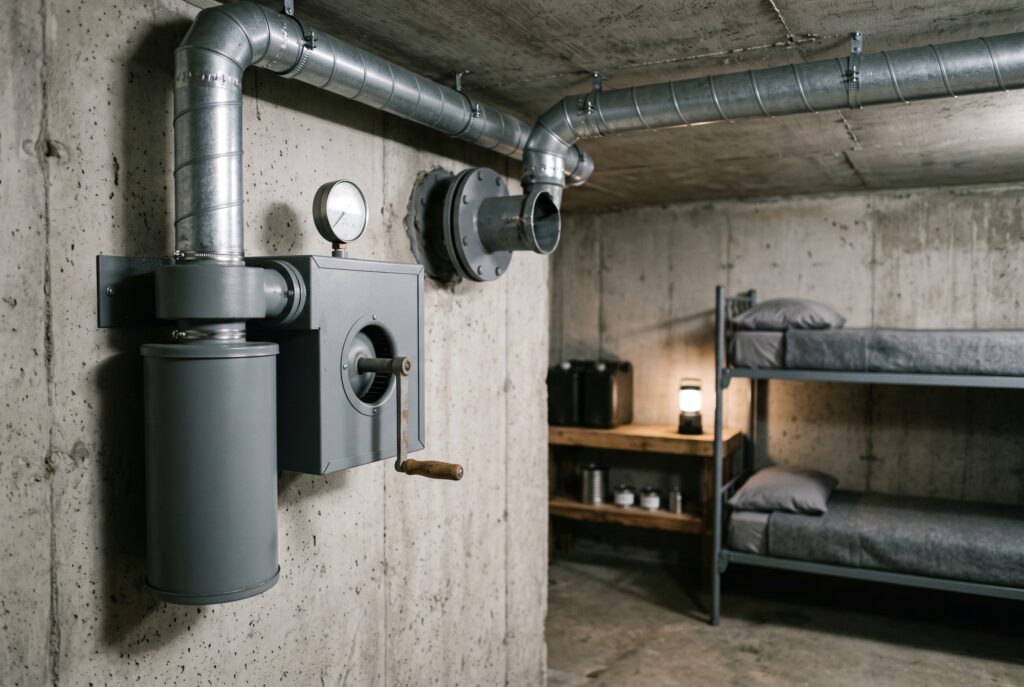
You have a basement. Concrete, dry, under the whole house. Reading the news, you have probably thought more than once that if it came to it, the whole family would go down there. That’s a good instinct, because concrete and earth overhead really do their job. But what will you all breathe down there for a day or two, while dust you can’t see is settling outside?
The answer to that question is filtered ventilation, or shelter air filtration. On the Polish internet you will mostly find sellers’ offers and vague talk of “NBC filters”, with no numbers and not a word about what such a filter can’t do. So I’m taking it apart here. How much air a person needs in a closed room, what the filter protects against and what it doesn’t, what the units available to a private buyer cost, and how to check whether a manufacturer’s claim means anything at all. I’ve gathered the legal matters and public money in one section near the end.
What filtered ventilation is and why a heat recovery unit is not the same thing
Filtered ventilation is a system that draws in air from outside, passes it through a particle filter and a gas absorber, and then pushes it into a sealed room so that there is a slight overpressure inside. In the Polish technical requirements for shelters it is mandatory equipment. The ventilation has to be mechanical, with filtered ventilation, with backup power or a manual drive, and with the option of an immediate hermetic shut-off.1 Throughout this text I treat these requirements as a model to follow, not as a definite obligation for your basement. I explain why in the legal section.
Ordinary ventilation and heat recovery have a different job. They exchange the air in the house, and their filters aren’t designed for contamination. A shelter filter has to stop at least 99.95% of particles (class H13), have carbon with a specified capacity to absorb chemical warfare agents, a sealed housing that withstands a pressure of 10 kPa from outside, and a tamper seal. Before you decide that a heat recovery unit or an air purifier “filters too, after all”, look for these parameters on its data sheet. If they aren’t there, the device isn’t made for this.
There’s one more difference that hardly anyone writes about. A filter protects nothing if air can get around it through a gap in the door. That’s why filtered ventilation always goes hand in hand with a sealed room and overpressure, which I’ll come to in a moment.
How filtered ventilation works, step by step
Components in the order the air flows through them
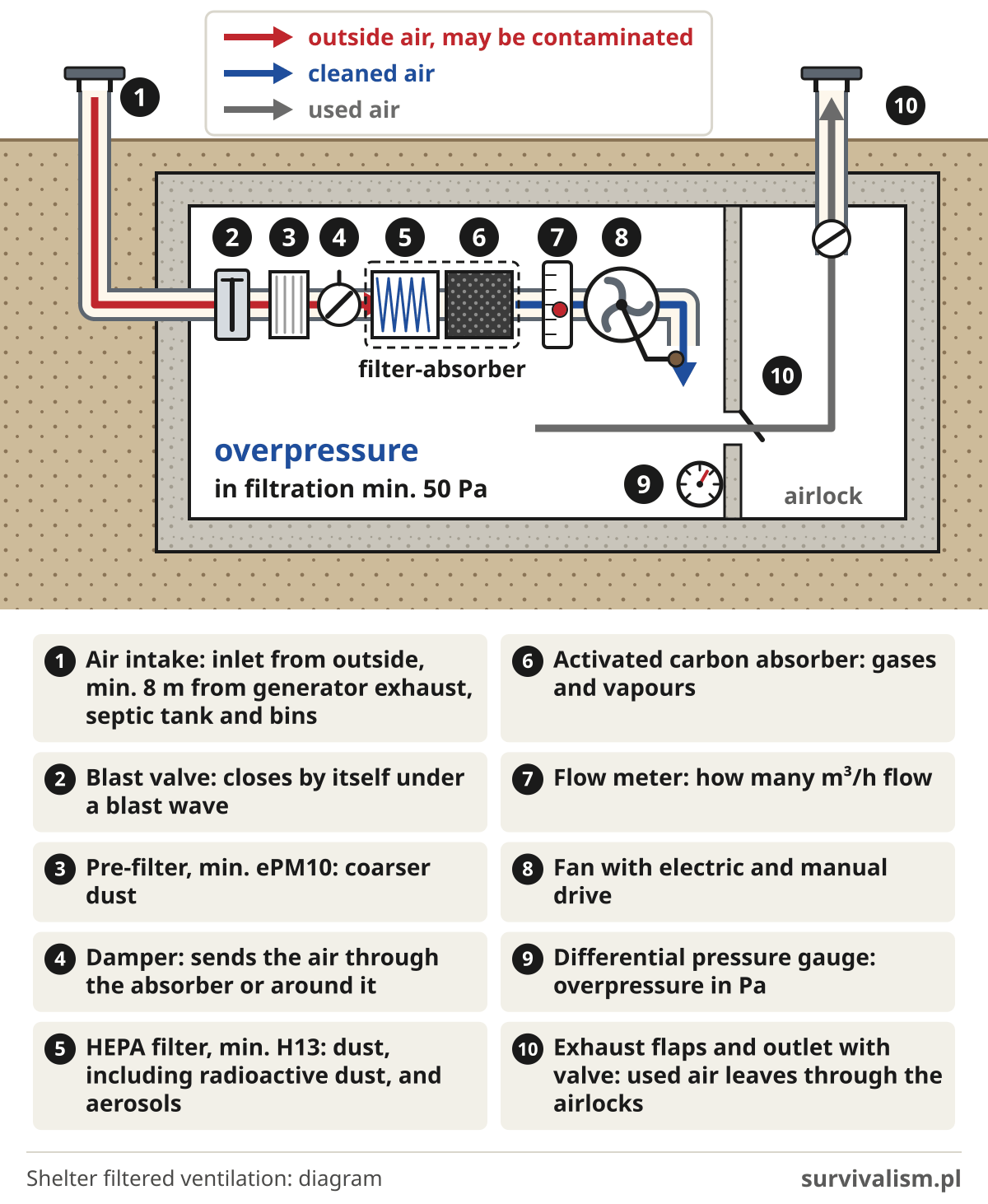
The order is similar in the Polish requirements and in the Swiss shelter operating handbook.12 The air passes through the following components:
- the air intake, meaning the inlet from outside, placed at least 8 m from the generator exhaust outlet, bins, septic tank and sewer vents, and 4 m from any parts of the building that aren’t non-combustible, so that it doesn’t draw in smoke;
- a blast valve, which closes by itself under a blast wave;
- a pre-filter (at least class ePM10), which catches coarser dust and protects the filters further along;
- a damper, which sends the air through the absorber or around it;
- a HEPA particle filter (at least H13), which stops dust, including radioactive dust, and aerosols;
- an absorber with impregnated activated carbon, which stops gases and vapours;
- a flow meter, which shows how many cubic metres per hour are actually flowing;
- a fan with an electric and a manual drive;
- a differential pressure gauge, which shows the overpressure in the room in pascals;
- exhaust flaps and an outlet with a valve, through which the used air leaves via the airlocks.
In Polish terminology the HEPA filter and the carbon sit in one sealed housing, called a filter-absorber. The whole filtered ventilation unit has to be able to run for at least 48 hours, and at least twice as long as the design protection time.
Three operating modes
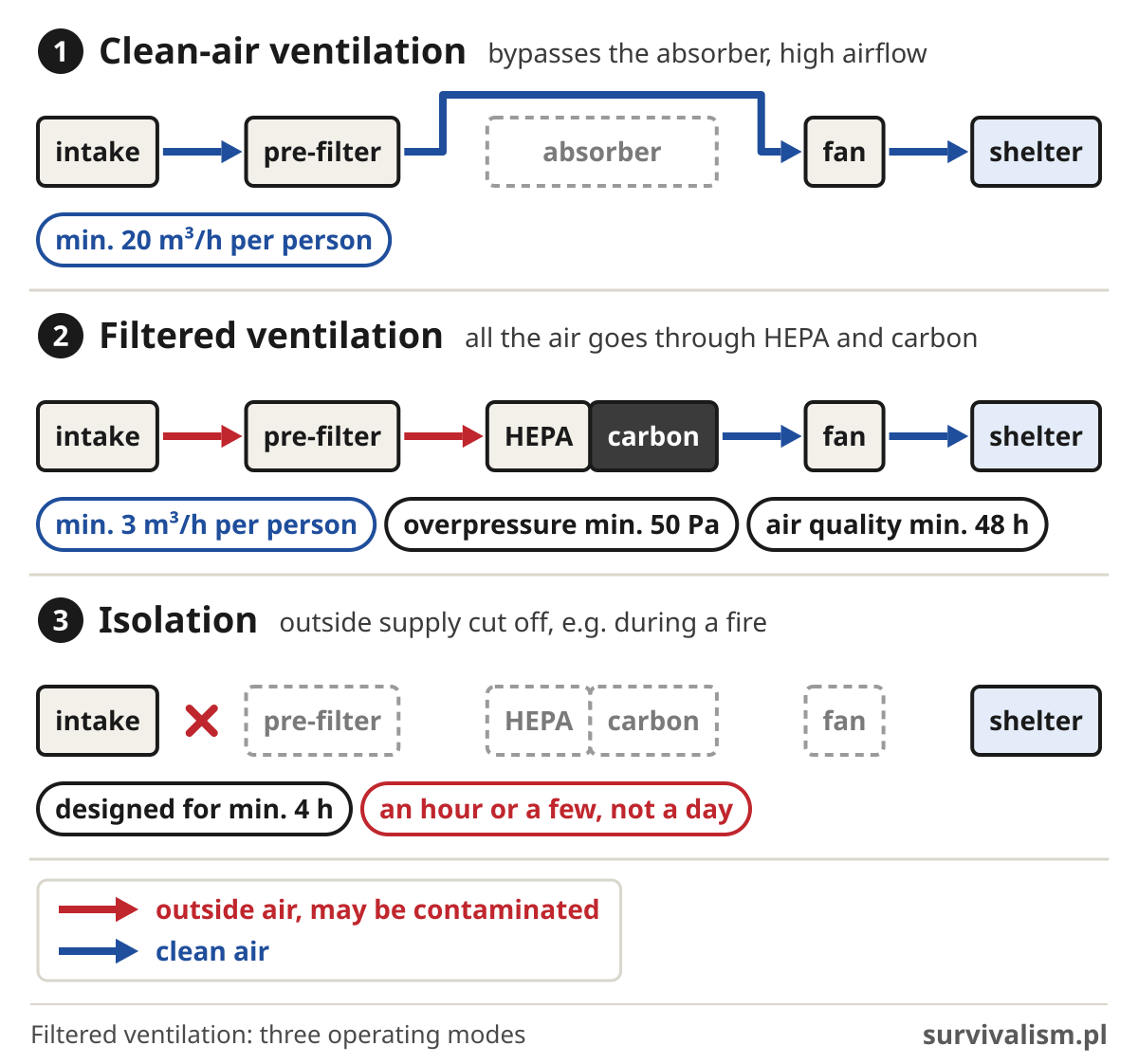
Filtered ventilation doesn’t work the same way all the time. The Polish requirements distinguish three periods.1 In clean-air ventilation the air bypasses the absorber and a lot of it flows, at least 20 m3/h per person. In filtered ventilation all the air goes through the HEPA filter and the carbon, the room has to be kept at an overpressure of at least 50 Pa, and the right air composition has to be maintained for at least 48 hours. In isolation the supply from outside is cut off, for example during a fire, and this period is designed for at least 4 hours.
The Swiss also have internal recirculation. When there is smoke outside, the ventilation has to be switched off or switched to recirculation, but not for long. When there are people in the shelter, fresh air should come back in after an hour at the latest, and in large facilities after four hours at the latest.2 The conclusion is simple. Isolation is a way to sit out an hour or a few hours, not a whole day.
Why overpressure
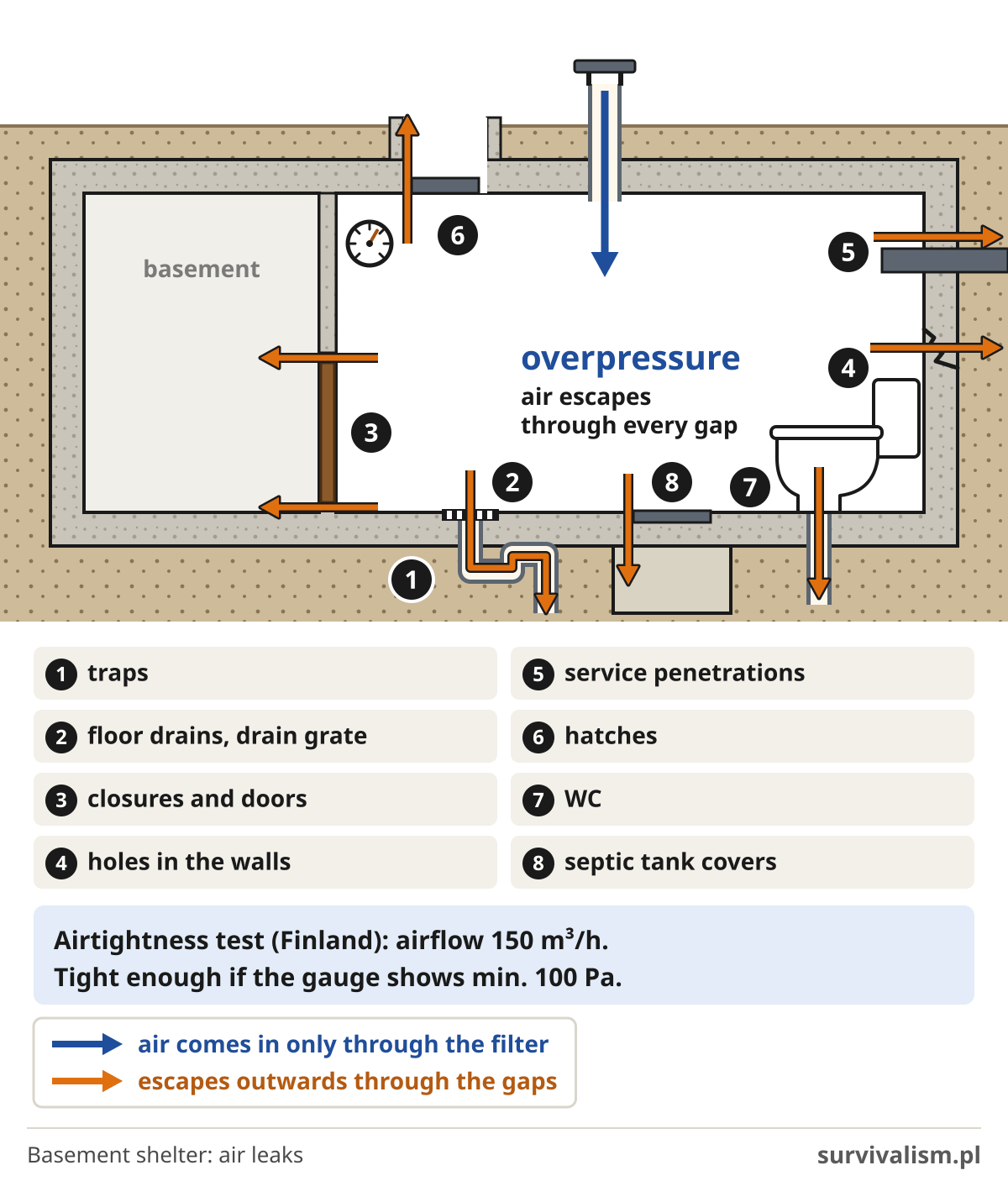
The fan pushes more air into the room than escapes through the gaps. Air then flows outwards through every leak, and comes in only through the filter. Poland and Switzerland both set at least 50 Pa in filtration mode, and the Finnish guide requires that a shelter be able to hold at least 50 Pa.13 The Swiss handbook gives a range of 50 to 250 Pa for fresh-air mode and adds that with too much overpressure people start to feel unwell, and then you need to check whether the used air has a way to escape.2
The American FEMA sets the bar lower, at 0.1 inches of water column, which is about 25 Pa. It does, however, point out something more important. A room with a filter but without overpressure doesn’t keep out contaminated air seeping in through the gaps.4 In other words, a filter without a sealed room and without overpressure is largely money wasted.
How much air per person and how to work out the capacity you need
The standards in numbers
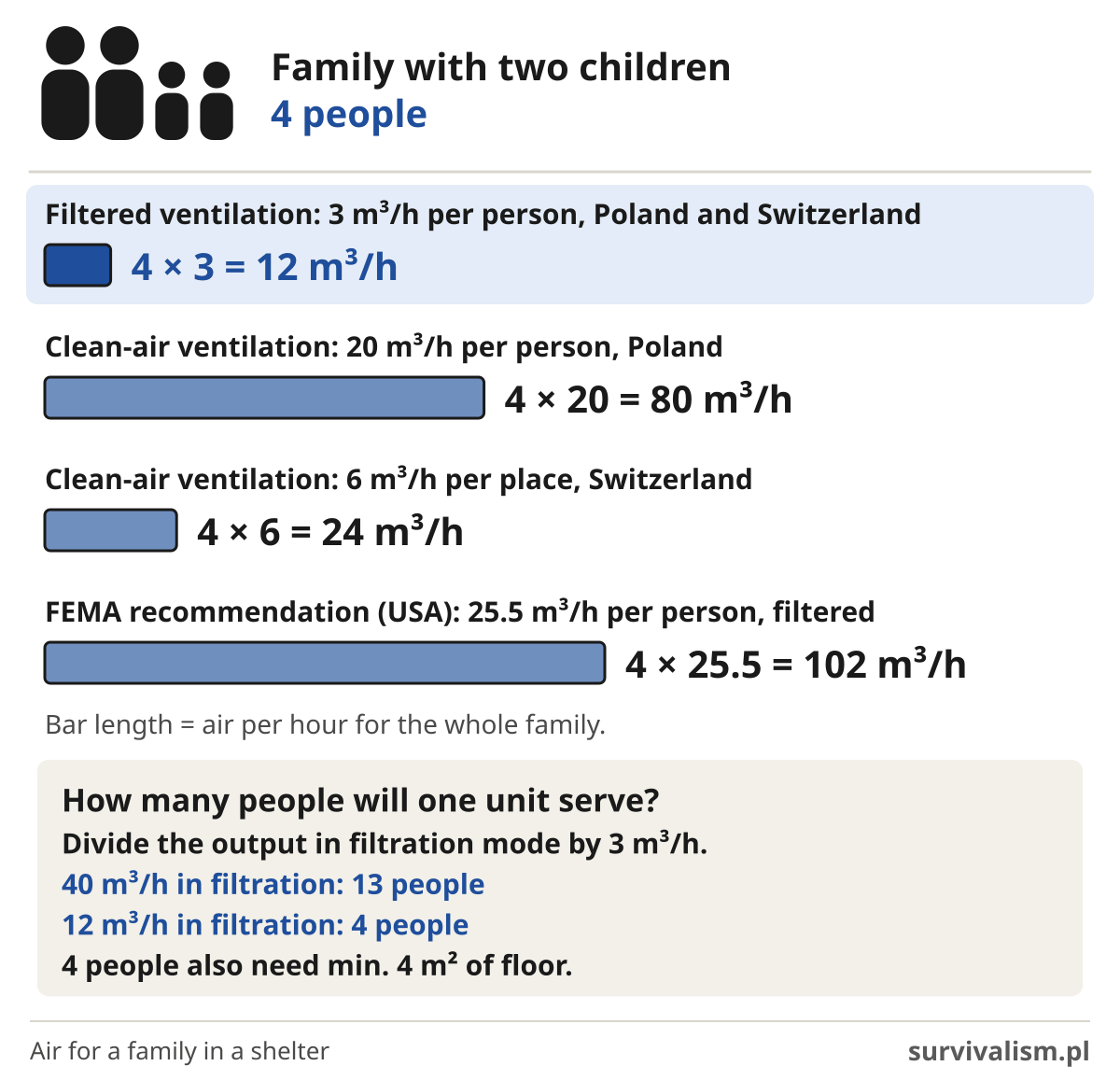
Here’s a number worth remembering. In filtration mode the Polish requirements assume at least 3 m3/h per person, and in clean-air ventilation at least 20 m3/h.1 The Swiss assume the same 3 m3/h in filtration, but only 6 m3/h per place in fresh-air mode.5 FEMA considers 15 cubic feet per minute per person desirable and 5 the minimum, which works out at roughly 8.5 to 25.5 m3/h.4 The Finnish manufacturer Temet gives 144 m3/h in filtration for its unit for 60 people in a shelter of 45 m2, which comes to 2.4 m3/h per person.6
None of these sources explains why the differences are so large. One thing is clear, though. Three cubic metres per hour in filtration is the figure on which the Poles and the Swiss agree, and the Finns go even a little lower.
The sums for a family
Let’s work it out for a family with two children. In filtration that’s 4 x 3 = 12 m3/h. In clean-air ventilation, by the Polish standard 4 x 20 = 80 m3/h, and by the Swiss one 4 x 6 = 24 m3/h. If you want to meet the value FEMA recommends, you need 4 x 25.5 = 102 m3/h of filtered air.
In my view the most sensible way to work it out is this. Take the unit’s output in filtration mode (not in clean-air ventilation!) and divide it by 3. The result is the number of people the unit will serve by the Polish and Swiss standard. The Swiss VA-40 delivers 40 m3/h in filtration, and 40 / 3 is just over 13, and a German shop sells it as a unit for exactly 13 people.78
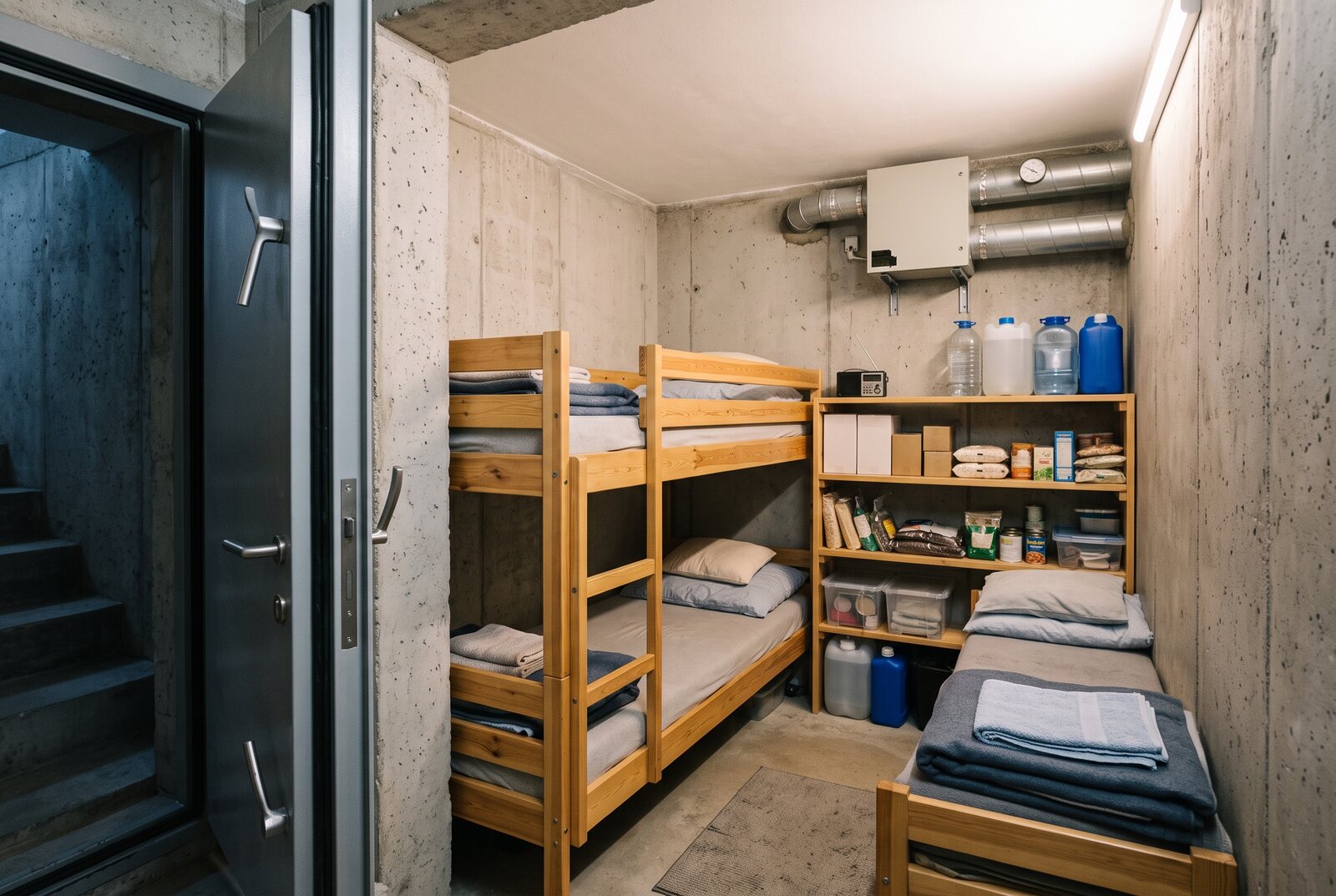
While you’re at it, work out the space too. The Polish requirements assume at least 1 m2 of floor area per person, and the air in the shelter has to stay within at least 18% oxygen and at most 2% carbon dioxide.1 So four people means at least 4 m2 and a unit that gives them 12 m3/h through the filter.
What the filter protects against, and what it doesn’t
Radioactive dust is not the same as radiation
A HEPA filter stops particles, and so also the dust that radioactive isotopes have settled on. A good HEPA filter removes all toxic aerosols, including very fine biological agents.4 But the filter does not stop gamma radiation from dust lying outside. What protects you from that is mass and geometry, meaning earth, concrete and bends in the passages. The Polish requirements for hiding places (the non-hermetic kind of protective structure) provide for double bends in the ducts precisely as shielding against radiation from fallout.1
Radioactive iodine is a gas, so only the carbon stops it. The Polish requirements set the bar high here, because the filter-absorber has to stop 99.999% of methyl iodide on dry carbon and 95% on wet carbon. Remember this difference, because it comes back below, where I write about storing filters.
There’s also something the filter won’t stop at all. Designers of filtration systems for nuclear power plant control rooms state plainly that ordinary systems with HEPA filters and iodine absorbers don’t adequately stop the noble gases released in a severe reactor accident.9 That takes special carbon filters designed for power plant control rooms, not for a home shelter.
Chemical and biological agents
The carbon absorber in a Polish filter-absorber is tested against a list of test gases: chloropicrin, cyanogen chloride, hydrogen cyanide, chlorine, sulphur dioxide and ammonia.1 FEMA, on the other hand, writes that several common industrial gases, ammonia for example, aren’t removed even by the best ordinary impregnated carbon.4 If you live next to a cold store or a plant that works with ammonia, ask the seller whether the filter has been tested on ammonia.
What the filter won’t stop
This point is missing from almost every sales text. Gas filters don’t stop smoke, carbon monoxide or carbon dioxide, and in a fire the ventilation has to be switched off or switched to internal recirculation.2 Polish architects at a training session on protective structures heard the same thing in a single sentence: “Filtered ventilation units do not protect against the products of combustion from fires!”10
Nor does the filter produce oxygen. It only delivers cleaned air from outside, so wherever too little of that air flows, the carbon dioxide concentration rises. So if someone promises you protection “against all contamination”, you now know that they are at odds with the documents of the manufacturers and institutions that describe these systems.
Manual drive and backup power
The crank and electricity
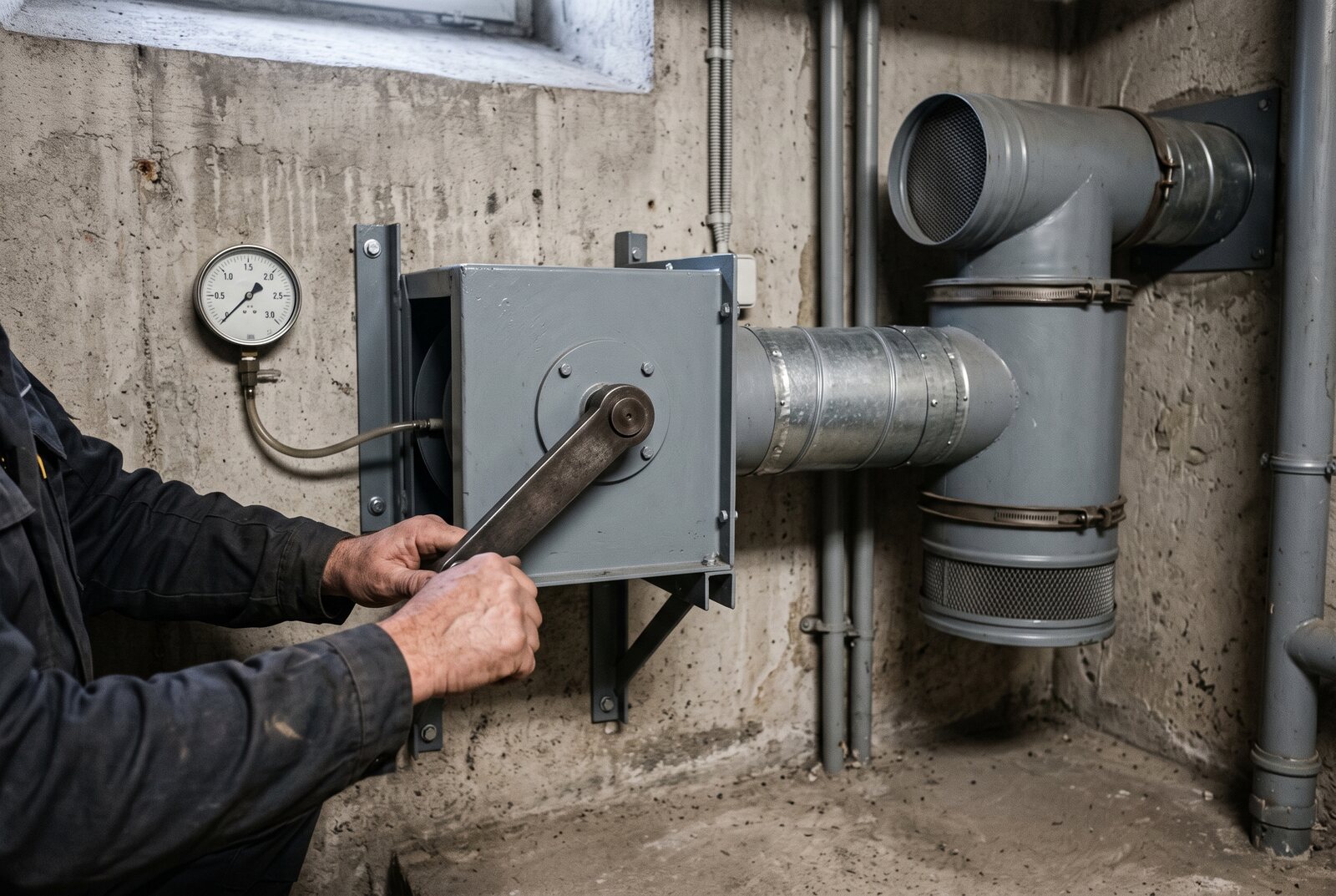
Filtered ventilation is needed precisely when there will most likely be no electricity. That’s why the Polish requirements provide for a manual drive for the fan, and only exempt units that have a backup power source.1 The Swiss Lunor has a crank and a generator alongside a 3 x 400 V motor rated at 180 W.11 The SAFE360 has a 12 V and 230 V motor and a hand pump.12 The British Castellex units have a crank too.13
When there is no power at all, the Swiss plan for turning the crank in shifts.2 So count how many adults will be in your shelter and who will take over from whom at three in the morning 😉 With only one adult, the crank is more theory than plan.
Battery or generator
If you plan to power the fan from a battery or a generator, you’ll find the article on how to get your home ready for a blackout useful. The Polish requirements also call for the system’s electronics to be shielded against an electromagnetic pulse.1 If that topic interests you, I write about what an electromagnetic pulse is in a separate article.
The generator and carbon monoxide. The filter doesn’t stop carbon monoxide, so exhaust fumes drawn in through the intake will go straight into the shelter, and you won’t smell the CO.2 A generator never stands in the shelter or by the air inlet, and keep its exhaust outlet at least as far from the intake as I gave above, under the system’s components. It’s the simplest way for an expensive installation to harm the very people it was meant to protect.
How to choose a unit: manufacturers and prices compared
Units a private buyer can get
Below are a few units you can buy from online shops or directly from the manufacturer. This isn’t a ranking or a recommendation. I read the prices on 2 October 2026, in the shop’s currency, without converting them to PLN.
The Swiss company Lunor makes three sizes. According to the data sheet, the VA-40 delivers 40 m3/h in filtration and 80 m3/h in clean-air ventilation, the VA-75 75 and 150 m3/h respectively, and the VA-150 150 and 300 m3/h.11 The fan and each filter have separate test numbers from the Swiss Federal Office for Civil Protection, for example BZS TE 98-005 for the fan and T 76-003 for the GF40 filter. A German shop sells the VA-40 for €5,900 including VAT, the VA-75 for €7,880 and the VA-150 for €9,750, plus shipping.14
A Swiss shop, on the other hand, says it can’t export these units because of restrictions imposed by the Swiss authority SECO. Its page doesn’t make clear whether this applies only to that shop.15
The Arconik SAFE360 costs from €2,060 including VAT in the same German shop. The seller says it is enough for up to 12 people, has a particle filter with an efficiency of at least 99.995% and comes with valves included.12
The British Castellex Air350 Mark II costs £5,520 plus VAT, with delivery in 4-6 weeks. The manufacturer quotes up to 150 m3/h, an H14 filter and an F7 pre-filter, a system efficiency of 99.99% and up to 24 people.13 The more expensive Air550HCC Ultimate costs £9,199 plus VAT, delivers up to 145 m3/h, has an efficiency of 99.995% and, according to the manufacturer, protects against “all known warfare gases”.16
On the manufacturer’s pages I looked at, though, there’s no name of a standard, no test number and no laboratory, so these are claims that can’t be checked. Also look at the sums. 150 m3/h divided by 24 people is 6.25 m3/h per person, but the page doesn’t say in which mode.
The Finnish Temet IVL-1 is a unit for larger shelters, with VTT certificate C 134/01, 144 m3/h in filtration and 612 m3/h with the filter bypassed.6 I couldn’t find a price in publicly available sources.
What to look for on the unit’s data sheet
Before you pay, ask the seller for a few things:
- the test or certificate number and the name of the laboratory, separately for the fan and for the filter, because Lunor has separate numbers for each part;11
- the HEPA filter class under EN 1822 (H13 or H14) and information on how tightly the filter is seated, because FEMA requires that no more than 0.1% of the air bypasses the adsorber;4
- the type of carbon and its effectiveness against methyl iodide;
- the output in filtration mode, not in clean-air ventilation, so you can divide it by 3;
- the manual drive, and what happens to the unit without electricity;
- the filter’s production date, tamper seal and sealed packaging;
- the cost and delivery time of a spare filter, and who in Poland will service it.
Watch out for mixed-up concepts. ISO 9001 is a certificate for a company’s management system, not a property of the filter. F7-F9 class filters are pre-filters, not HEPA. The words “meets the highest standards” without the name of a standard tell you nothing.
A box with a HEPA filter for PLN 1,400 is not filtered ventilation yet
In search results it’s easy to come across a “filtered ventilation unit for a shelter” for PLN 1,400. It’s a box with a pre-filter, an H13 filter and a carbon mat, with no fan. The seller himself describes the mat as a filter for catching unpleasant odours and says to replace it every 8-12 months.17 There’s no sealed housing, no tamper seal and no declared effectiveness against gases, which is what sets a filter-absorber apart from a kitchen filter. It might do for dust from building work, but not for a shelter.
Installing it in an existing basement, and common mistakes
What to leave to the professionals
Penetrations through the wall, blast valves, duct sizing and the load on the ceiling slab are a job for a designer and a contractor who has done this before. The Swiss manufacturer states plainly in its manual that installation may only be carried out by trained specialists.18 What you can do yourself is keep an eye on a few things that decide whether the installation will work at all.
Leaks
The most common mistake is a leaky room. If the gauge doesn’t show any overpressure in filtration mode, check the traps, floor drains, closures and doors, and then look around holes in the walls, service penetrations, hatches, the WC and septic tank covers.19 The Finns test airtightness by setting the airflow to 150 m3/h, and the shelter is tight enough if the gauge shows at least 100 Pa.3
A basement with a drain grate in the floor, an old door and an unsealed pipe penetration won’t get that result. So ask the contractor whether they will do an overpressure test after installation and show you the reading on the gauge.
Exhaust, intake and kitchen filters
The air the fan pushes in must have a way out, in a shelter through the airlocks and exhaust flaps.1 The opposite mistake is just as dangerous. An extract fan must never run on its own, without a supply, because the shelter will start running short of oxygen.2
An intake next to a septic tank, bins or a sewer vent will draw in exactly what the filter won’t stop. I gave the distances above, under the system’s components. And finally, buying just a fan with a kitchen filter, or a box with a HEPA filter. I explained why that doesn’t work in the previous section.
Storing, checking and replacing the filter
How long a filter lasts
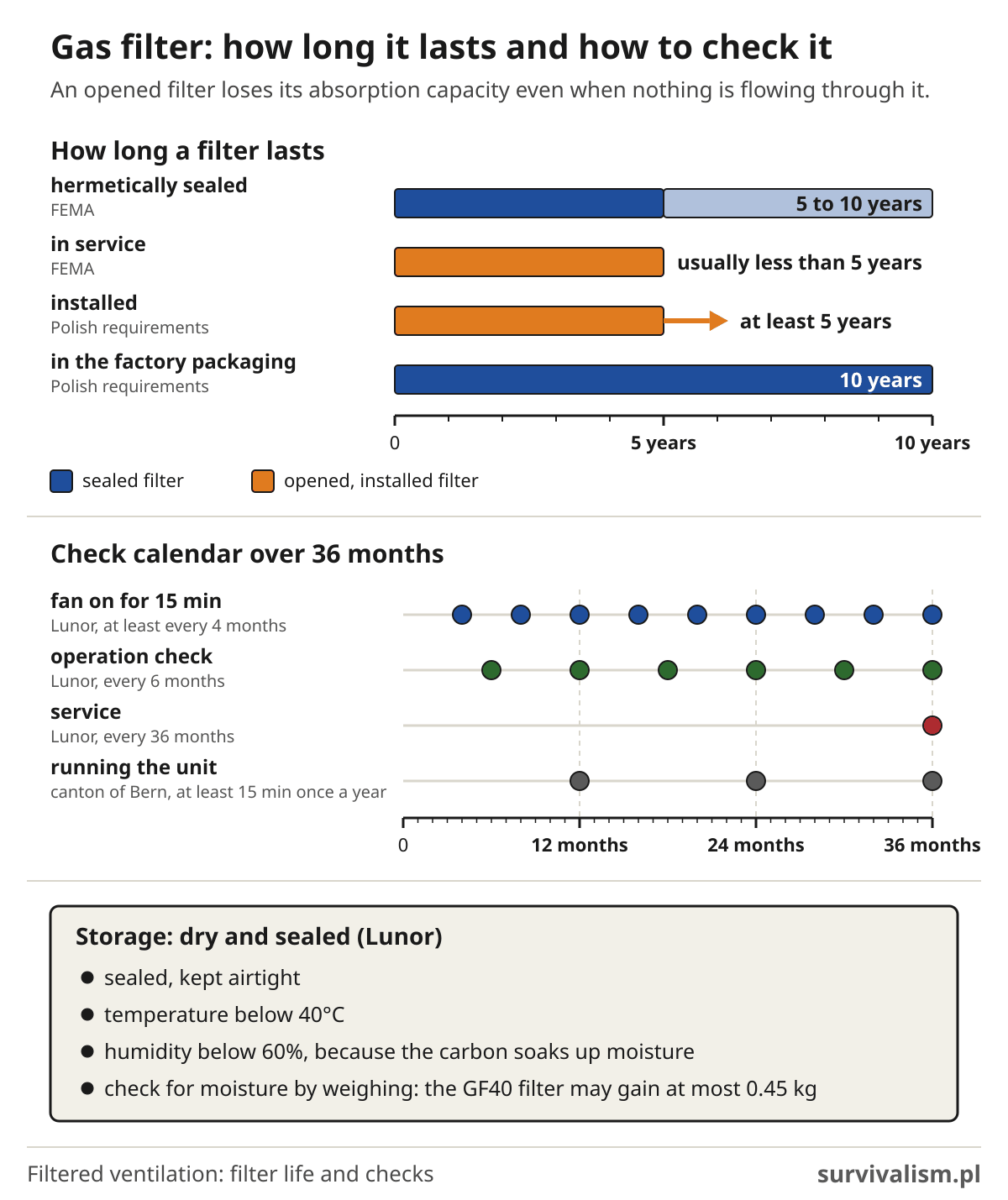
A gas filter in sealed packaging lasts a long time, but once opened it loses its absorption capacity even when nothing is flowing through it. FEMA gives a shelf life of 5 to 10 years for a hermetically sealed adsorber, and usually less than 5 years in service.4 The Polish requirements speak of at least 5 years for an installed filter-absorber and 10 years in the factory packaging.1 The Swiss plan to replace shelter components every 50 years on average, but a filter that has become saturated in use is replaced sooner.2
How to store and check it
The key is dry and sealed, so don’t break the filter’s seals.6 Lunor says to keep sealed filters airtight, at a temperature below 40°C and humidity below 60%, because the carbon soaks up moisture.18 It checks for moisture by weighing, since the GF40 filter may gain at most 0.45 kg. The fan is switched on for 15 minutes at least every 4 months, its operation is checked every 6 months, and it is serviced every 36 months.
In the Swiss canton of Bern the unit is run for at least 15 minutes once a year, electrically or by hand.19 Put that date in your calendar, because a fan nobody has switched on for years has every right not to start exactly when you need it.
Replacement after use
A used filter. A gas filter used during a disaster is replaced with a new one, and the used one is special waste.18 Everything the filter caught stays inside, so replace it following the manufacturer’s instructions and hand the old one in for disposal, not to the ordinary rubbish.
How much shelter air filtration costs
Let’s work out an example for a small family. The Lunor VA-40 costs €5,900, a spare GF40 gas filter €3,198 and a spare VF40 pre-filter €214.14 That’s 5,900 + 3,198 + 214 = €9,312 in total for the unit with a full set of replacement filters. The spare filter alone is 3,198 / 5,900, or more than half the price of the unit.
The cheapest of the sets compared, the SAFE360, starts at €2,060 including VAT and comes with valves.12 The British Castellex units cost from £5,520 to £9,199 plus VAT.1316 On top of prices from foreign shops, add shipping and the exchange rate on the day you buy.
I’m not giving prices for installation, wall penetrations, valves and sealing the basement. I didn’t come across any that could be checked, and the cost depends on the wall, the ceiling slab and how much work the sealing takes. Ask several contractors for quotes and compare what each one covers.
Regulations and funding
A shelter in the legal sense
Since 1 January 2025 the Act of 5 December 2024 on civil protection and civil defence (Polish Journal of Laws, Dz.U. 2024, item 1907) has been in force.20 Changes relevant to shelters were introduced by the Act of 17 April 2026 (Dz.U. 2026, item 646), in force since 29 May 2026.21 Under the Act, a shelter is a hermetic structure with filtered ventilation or regenerative absorbers, but only once the civil protection authority has recognised it as a protective structure. A non-hermetic structure is a hiding place. So your basement with a filtered ventilation unit is a shelter in the technical sense, and in the legal sense only once it has been recognised.
Who has to build, and who can build on a notification
New public buildings have to be provided with a protective structure, meaning a shelter or a hiding place. Underground storeys of public and multi-family buildings, and underground car parks with no protective structure planned, are designed so that temporary shelter places can be set up in them, with exceptions for small buildings. This applies to applications and notifications filed after 31 December 2025.2021 A single-family house is neither a public building nor a multi-family one.
Since 7 January 2026, a free-standing protective structure next to a house, with a usable floor area of up to 35 m2 and serving the residents of a single-family house, can be built on the basis of a notification rather than a building permit (Dz.U. 2025, item 1847).22 The stamp duty for the notification is PLN 155. Whether such a notification always has to include a full design, and whether the provision covers a shelter in the basement of an existing house, which is not free-standing, is not clear-cut. Ask at your county office (starostwo) before you start.
Do the technical requirements apply to your basement?
The ventilation requirements I quote throughout this text come from the Regulation of the Minister of the Interior and Administration of 4 November 2025 on the technical requirements for protective structures and the technical requirements for their use and siting (Dz.U. 2025, item 1548), in force since 28 November 2025.1 Whether they bind a private room that nobody has recognised as a protective structure isn’t clear. Building law includes them among the technical building regulations,22 while the civil protection Act defines a protective structure through recognition. That’s why I treat them as the only official model to follow, not as a definite obligation.
Funding
In the acts and programmes I read there is no grant, tax relief or loan for a private person building a shelter by their home. The Act provides for a targeted grant of up to 100% of the “increased costs” related to the protective function of a structure, but only for recognised structures.20 The municipality only recognises structures that matter for protecting its population, and leaves single-family houses out when it reviews buildings.
The draft Civil Protection and Civil Defence Programme for 2027-2031 ties funding to the structure first being recognised as a protective structure. The whole programme, not just shelters, has about PLN 102.4 billion over five years in the draft’s financial table, but it’s still a draft, not law in force.23 I didn’t search programmes run by BGK (the Polish state development bank), municipalities or regions, or tax rulings, so if you come across something like that, let me know in the comments.
Recognition has another side
A recognised shelter has to be made available for civil protection, and in a natural disaster, a state of emergency or war the authority can order it to be made available. In non-public buildings, however, the building’s users have priority.20
And for the record, the scale. According to an audit by NIK (the Supreme Audit Office), cited in the current programme for 2025-2026, places in protective structures could hold just under 4% of the population.24 On 2 March 2026 the government app “Gdzie się ukryć” (Where to take shelter) listed 81,823 shelter points.23
What if you can’t afford filtered ventilation
Radioactive fallout
Not everyone will spend several thousand, or well over ten thousand, euros on a unit. The good news is that with radioactive fallout, mass and time do most of the work. For the first 24 hours stay in the best-protected place, meaning a basement or the middle of a large building, ideally brick or concrete.25 During that time switch off fans, air conditioning and heating that draw in air from outside, and close the windows and doors. Radiation falls quickly, precisely during the first day.
A sealed room
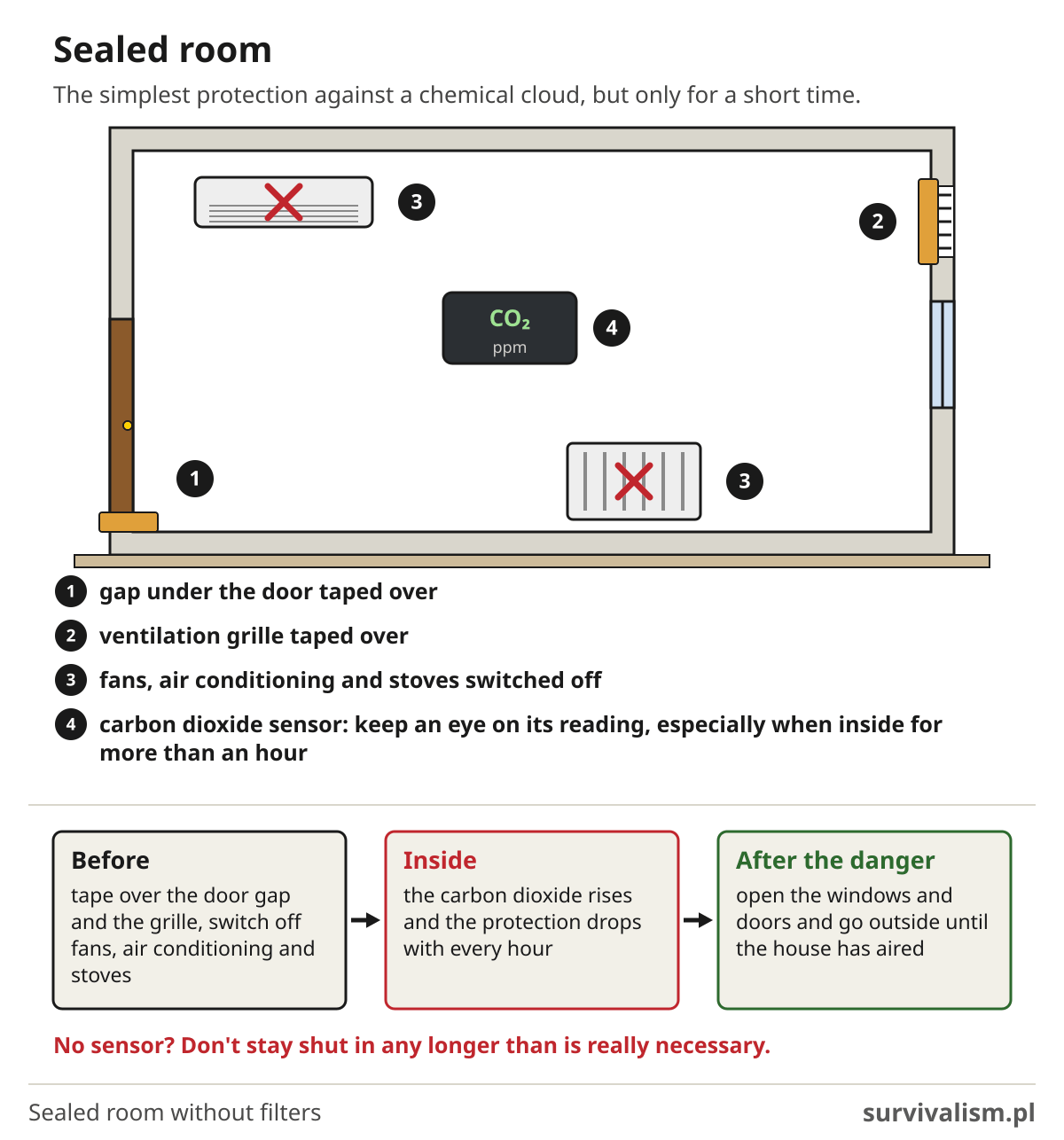
With a chemical cloud, the simplest form of protection is a sealed room without filters. You tape over the gap under the door and the ventilation grille, and switch off fans, air conditioning and stoves. When the danger has passed, you open the windows and doors and go outside until the house has aired.4
Watch out for carbon dioxide
A closed room without ventilation is only good for a short time, because with people inside the carbon dioxide concentration rises and the protection drops with every hour.4 A room like this should have a carbon dioxide sensor, and you need to keep an eye on its reading, especially when you’re inside for more than an hour. If you don’t have a sensor, don’t stay shut in any longer than is really necessary.
Frequently asked questions
How much does shelter air filtration cost?
On 2 October 2026 the unit alone for a few people cost from €2,060 (SAFE360) to €5,900 (Lunor VA-40) in a German shop, including VAT.1214 A spare filter for the Lunor is another €3,198. On top of that comes installation, whose price depends on the basement.
How many people will one unit serve?
Divide the output in filtration mode by 3 m3/h.1 A unit with an output of 40 m3/h in filtration will serve 13 people, and 12 m3/h is enough for four.
How often should you replace the filter?
A sealed, dry gas filter lasts 5 to 10 years unopened.4 After each use during an incident it is replaced with a new one.18
What’s the difference between a shelter and a hiding place?
A shelter is hermetic and has filtered ventilation or regenerative absorbers, while a hiding place is not hermetic.20 A hiding place in the lowest category protects against rubble and fragments, and in the higher ones it also attenuates gamma radiation and withstands a blast wave.1
What does NBC filter mean?
NBC is short for nuclear, biological and chemical threats. In practice an NBC filter is a set with a HEPA particle filter and a carbon absorber, which stops radioactive dust, biological aerosols and most chemical warfare agents.4 It does not stop carbon monoxide or smoke.2
Final thoughts
The aim of this text wasn’t to scare you or to talk you into buying anything. In my view filtered ventilation only makes sense once you have a sealed room, a power plan and a stock of food and water for a few days. Without that, even the best filter with a tamper seal and a test number won’t turn a basement into a shelter. Start with airtightness and the numbers, and only then with the catalogue.
If you have filtered ventilation at home, have converted your basement or have gone through the notification process at the county office, describe it in the comments. I read every comment, and experiences like that will be more useful to others than yet another seller’s offer.
Sources
- Minister of the Interior and Administration, Dz.U. 2025 poz. 1548, „w sprawie warunków technicznych dla budowli ochronnych oraz warunków technicznych ich użytkowania i usytuowania” (in Polish, accessed 2 October 2026): api.sejm.gov.pl/eli/acts/DU/2025/1548/text.pdf
- Bundesamt für Bevölkerungsschutz BABS, “Handbuch Logistik - Schutzbauten” (version 2025-03, accessed 2 October 2026): babs.admin.ch/dam/de/sd-web/jGqxEYOusXQO/03-HB-Logistik-Schutzbauten-de.pdf
- Pelastustoimi (Finland), “Väestönsuojaohje pelastuslaitoksen asiakkaille” (accessed 2 October 2026): pelastustoimi.fi/documents/25266713/168997673/V%C3%A4est%C3%B6nsuojaohje+pelastuslaitoksen+asiakkaille+.pdf
- FEMA (Ready.gov), “FEMA 453, Chapter 3: CBR Threat Protection” (accessed 2 October 2026): ready.gov/sites/default/files/2020-04/cbr-threat-protection_chapter-3.pdf
- Bundesamt für Bevölkerungsschutz BABS, “TWW 2012. Technische Weisungen für die Belüftung von Schutzräumen mit Wärmedämmungen” (accessed 2 October 2026): babs.admin.ch/dam/de/sd-web/zb8vg0Yc8BMb/tww2012-de.pdf
- Temet, “Ilmanvaihtolaite IVL-1” (unit data sheet, accessed 2 October 2026): 9349336.fs1.hubspotusercontent-eu1.net/hubfs/9349336/Ilmanvaihtolaite%20IVL-1.pdf
- Andair USA, “Pricing and Ordering” (accessed 2 October 2026): andairusa.com/pricing-and-ordering
- Schutzraum-Shop, “Belüftungsanlage VA40” (accessed 2 October 2026; price €5,900.00 including VAT, plus shipping): schutzraum-shop.de/produkt/belueftungsanlage-va40
- OSTI.GOV, A. Hill, “Noble gas control room accident filtration system for severe accident conditions N-CRAFT. System design (2014)” (accessed 2 October 2026): osti.gov/etdeweb/biblio/22500210
- Świętokrzyska Okręgowa Izba Architektów RP, M. Pietrzak, „Budowle ochronne cz. 1, podstawy” (in Polish; training session, Kielce 10.10.2025; accessed 2 October 2026): swietokrzyska.iarp.pl/wp-content/uploads/2025/11/SWOIA_-szkolenie_Szkolenie-Michal_Pietrzak_Budowle_ochronne_cz-1_Podstawy.pdf
- Lunor G. Kull AG, “Datenblatt VA40/75/150” (accessed 2 October 2026): lunor.ch/_Resources/Persistent/4/f/b/0/4fb0ed8cd5bf2e1adac50919b32c607005e39139/Datenblatt_Lunor_VA40_75_150.pdf
- Schutzraum-Shop, “Belüftungsanlage SAFE360” (accessed 2 October 2026; price from €2,060.00 including VAT, plus shipping): schutzraum-shop.de/produkt/belueftungsanlage-safe360
- Castellex, “Castellex Air350 Mark II” (accessed 2 October 2026; price £5,520 excluding VAT): castellex.com/product/castellex-air350-mark-ii
- Schutzraum-Shop, “Filter-Lüftungen” (accessed 2 October 2026; prices including VAT, plus shipping: VA40 €5,900.00, VA75 €7,880.00, VA150 €9,750.00, GF40 gas filter €3,198, VF40 pre-filter €214): schutzraum-shop.de/filter-lueftungen
- Foppa, “Schutzraum-Belüftungsanlage VA40 (13 Personen)” (accessed 2 October 2026): foppa.ch/produkt/schutzraum-belueftungsanlage-va40-13-personen
- Castellex, “Castellex Air550HCC Ultimate” (accessed 2 October 2026; price £9,199 excluding VAT): castellex.com/product/castellex-air550hcc-ultimate
- AKS Filter, „Urządzenie filtrowentylacyjne do schronu” (in Polish, accessed 2 October 2026; price PLN 1,400.00): aksfilter.pl/sklep/urzadzenie-filtrowentylacyjne-do-schronu
- Lunor G. Kull AG, “Operating Manual for the Shelter Ventilation Unit of Types VA-40/75/150” (version 1.0, 12.10.2022, accessed 2 October 2026): lunor.ch/_Resources/Persistent/e/e/a/c/eeac01d6f9622d3a349a6761766dde402fe0a5ca/Lunor_G_Kull_AG_Schutzraum-Bel%C3%BCftungsanlage_Betriebsanleitung_2022.10.12.pdf
- Amt für Bevölkerungsschutz, Sport und Militär des Kantons Bern, “Merkblatt Unterhalt Schutzraum” (accessed 2 October 2026): bsm.sid.be.ch/content/dam/bsm_sid/dokumente/de/schutzbauten/psk-infocockpit/Merkblatt_Unterhalt_Schutzraum_BSM.pdf
- Sejm RP, Dz.U. 2024 poz. 1907, „o ochronie ludności i obronie cywilnej” (in Polish, accessed 2 October 2026): api.sejm.gov.pl/eli/acts/DU/2024/1907/text.html
- Sejm RP, Dz.U. 2026 poz. 646, „o zmianie ustawy o ochronie ludności i obronie cywilnej oraz niektórych innych ustaw” (in Polish, accessed 2 October 2026): api.sejm.gov.pl/eli/acts/DU/2026/646/text.pdf
- Sejm RP, Dz.U. 2025 poz. 1847, „o zmianie ustawy - Prawo budowlane oraz niektórych innych ustaw” (in Polish, accessed 2 October 2026): api.sejm.gov.pl/eli/acts/DU/2025/1847/text.pdf
- MSWiA (gov.pl), „Projekt uchwały Rady Ministrów w sprawie zatwierdzenia Programu ochrony ludności i obrony cywilnej na lata 2027-2031” (in Polish, accessed 2 October 2026; version 3.0 of 2 October 2026; PLN 102.4 billion is the five-year sum from the “Total” row of table 1 in annex 2): gov.pl/web/mswia/projekt-uchwaly-rady-ministrow-w-sprawie-zatwierdzenia-programu-ochrony-ludnosci-i-obrony-cywilnej-na-lata-2027-2031
- Council of Ministers, M.P. 2025 poz. 541, „Program ochrony ludności i obrony cywilnej na lata 2025-2026” (in Polish, accessed 2 October 2026): api.sejm.gov.pl/eli/acts/MP/2025/541/text.pdf
- Ready.gov, “Radiation Emergencies” (accessed 3 October 2026): ready.gov/radiation
Leave a comment