
A November afternoon, drizzle and 4 degrees above zero. The trail has turned out longer than you expected, and for the last half hour your mate has been walking slower and slower, tripping over roots and answering in monosyllables. He says he’s fine, just a bit cold. Maybe it’s ordinary tiredness. Or maybe it’s the first stage of hypothermia, the one that is easiest to miss precisely because it doesn’t look dangerous.
You don’t need a bitter frost to get dangerously cold. Wind, wet clothes, cold ground under your back and a few hours in which something went wrong are enough. Below you’ll find the symptoms and stages of hypothermia, step-by-step first aid in conditions where an ambulance can’t drive right up to the tree, the things you must not do, ways to get through a cold night in the woods, frostbite and a few myths. I base every first aid recommendation on current rescue guidelines, and you’ll find the sources at the very bottom.
What is hypothermia and at what temperature does it start?
Hypothermia is a drop in core body temperature, meaning the temperature deep inside, around the heart and brain, below 35 °C.1 It isn’t about cold hands or a red nose, but about the body no longer keeping up with producing heat, so the organs start to cool down. Hypothermia from cold often affects people who are active outdoors and those who have got lost. In other words, all of us, whenever a trip doesn’t go to plan.
Core temperature is practically impossible to measure reliably in the field, which is why rescuers judge how cold someone is by their behaviour and level of consciousness, not by a thermometer. There’s also a simple rule for when you’re in doubt. Someone who is shivering but talks normally, changes their own clothes and eats a snack bar is simply cold. Someone who is shivering, getting weaker and struggling to look after themselves probably already has hypothermia. And if you’re not sure, treat them as hypothermic.2
Symptoms of hypothermia: from shivering to unconsciousness
The first symptoms are not very dramatic. Shivering sets in, the skin becomes pale, cold and dry, the lips turn blue, speech becomes slurred, breathing slows down, and the person is tired and slightly dazed.3 It’s very easy to mistake this for tiredness after a long day, especially as a chilled brain is itself worse at judging the situation.
And it’s the brain that is the most treacherous part here. At a core temperature of around 33-34 °C it already starts to slow down, which shows up as irritability, confusion, apathy and increasingly poor decisions, and eventually drowsiness.2 That’s why, in my opinion, a person who was joking an hour ago and now stubbornly insists that “it’ll be fine in a minute” and wants to sit down in the snow for a moment needs your attention more than the one who is loudly complaining about the cold.
Stages of hypothermia
Rescuers today use a scale based on consciousness, because that can be assessed without a thermometer.1 Treat the temperatures in the last column only as a rough guide, as you won’t be able to measure them in the woods.2
| Stage | What you see | Core temperature (approximate) |
|---|---|---|
| I, mild | conscious, usually shivering hard, clumsy, slurred speech | 35-32 °C |
| II, moderate | impaired consciousness, drowsy and confused, shivering weakens or stops | 32-28 °C |
| III, severe | unconscious, but breathing and with a pulse, often very weak | 28-24 °C |
| IV | no signs of life, that is apparent death | below 24 °C |
Shivering doesn’t define the stage, but it’s a good clue. If someone is shivering hard, their core temperature is usually above 30 °C, because shivering stops at roughly 30 °C.12 When the shivering stops but the person is still cold and increasingly dazed, that is not an improvement, it’s a bad sign.
Why you get cold: ground, wind, sweat and water
The body loses heat in several ways at once, and outdoors each of them has its own face. Once you know them, you know what to protect yourself from, and what to protect someone who is already cold from.
Ground, wind and a clear sky
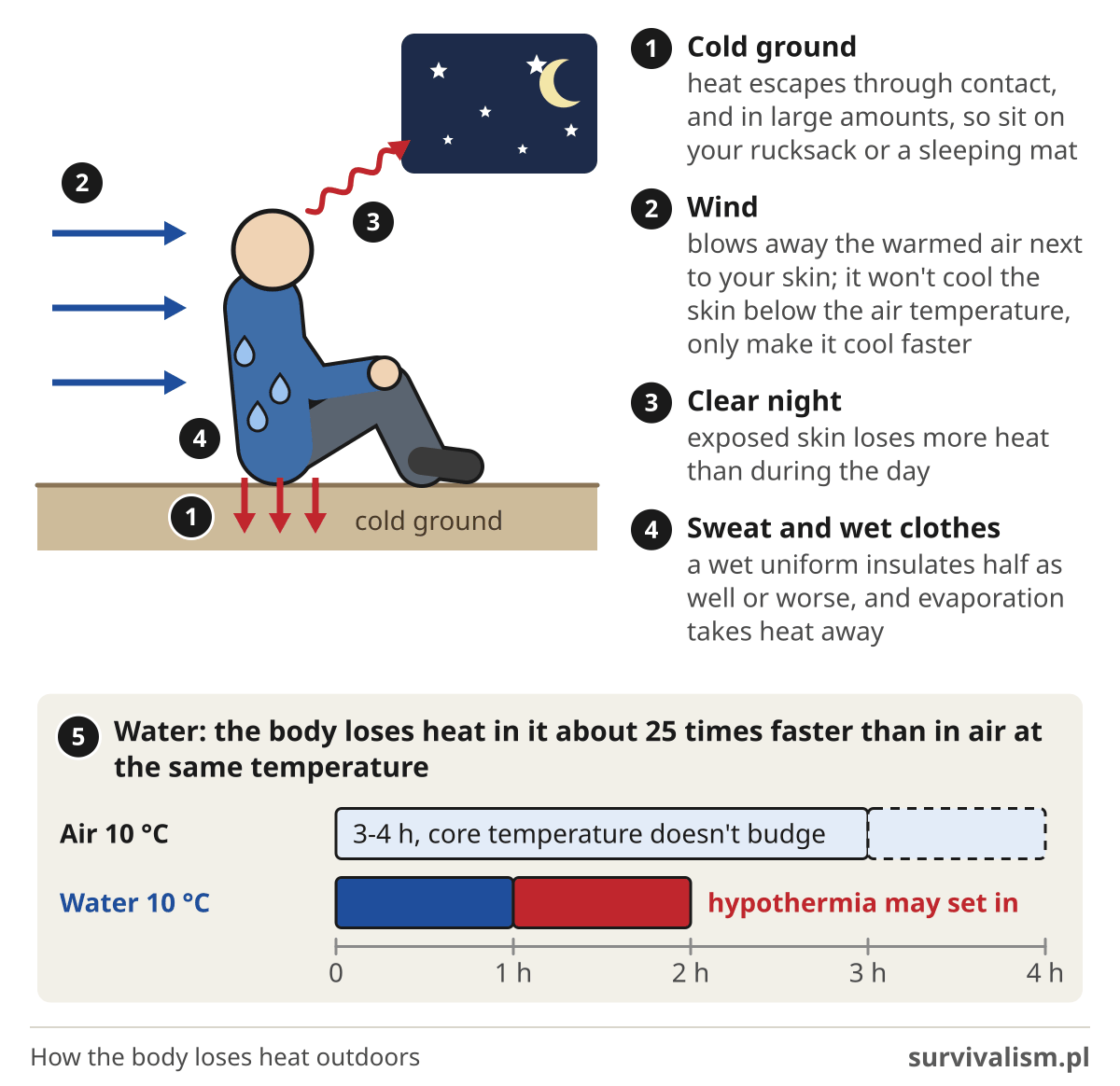
The most underrated route is the ground. When you sit or lie on cold ground, heat escapes from you through direct contact, and in large amounts.2 That’s why at a rest stop it’s better to sit on your rucksack or a piece of sleeping mat than on a tree stump or a rock, and someone who has fallen and is lying in the snow cools down faster than you’d think.
The second thief is the wind. It blows away the thin layer of warmed air next to your skin, so at the same temperature you lose heat faster. The wind won’t cool your skin below the air temperature, though, it will only make it cool faster.
At night there’s also radiation. Your body, your sleeping bag and the ground beneath you give off heat all the time as invisible infrared radiation. During the day the sun makes up for it, but at night nothing does, so under a clear sky exposed skin loses more heat than during the day, even when the air isn’t actually very cold.4
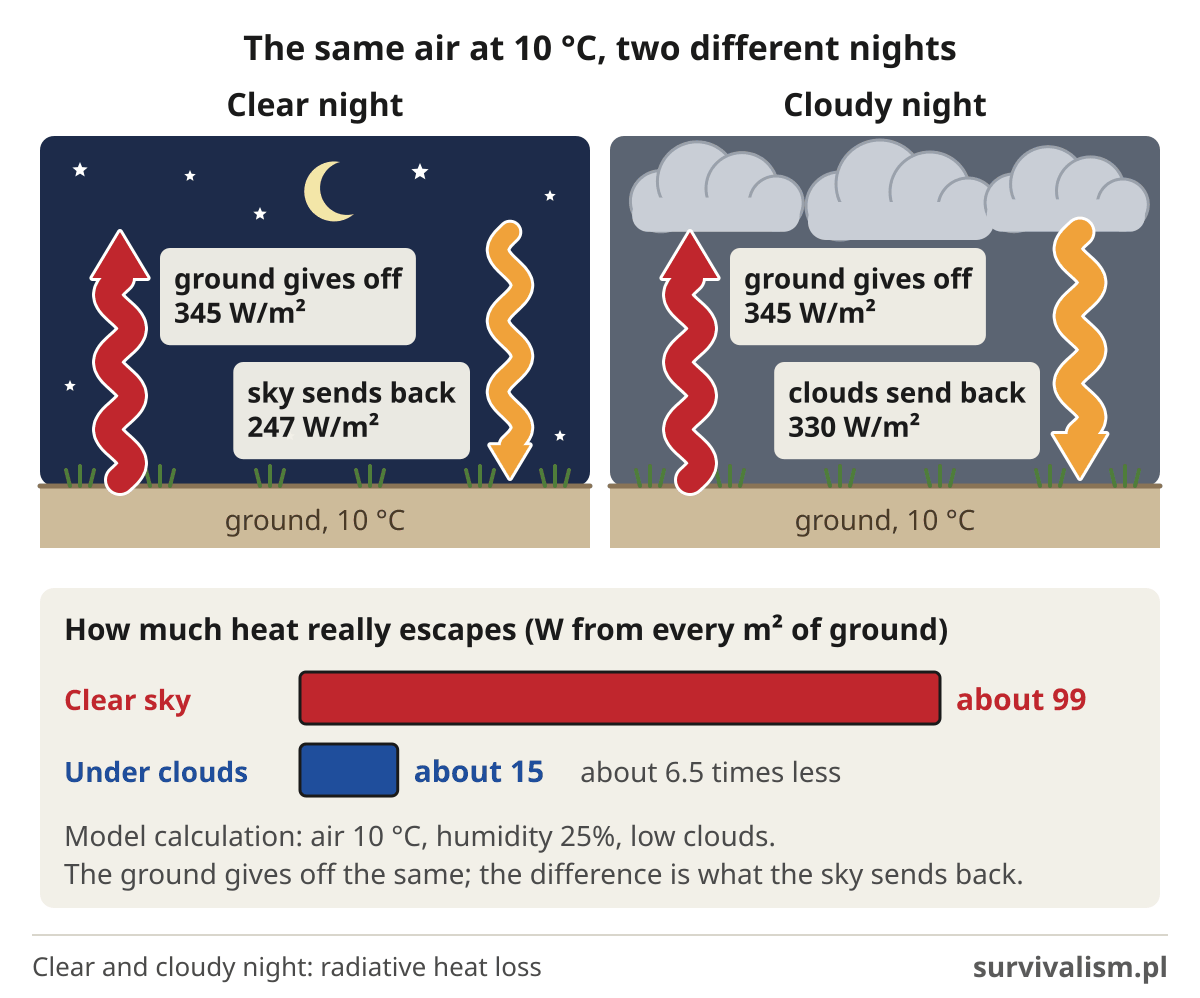
Few people realise that it’s not only the air temperature that counts here, but also what’s hanging above you. Clouds, especially low ones, give off heat themselves, downwards as well, back towards the ground. They work a bit like a heater hung above the forest. A clear sky sends back much less, so the heat escapes upwards and little of it comes back. That’s why, at the same air temperature, a starry night cools things down more than a cloudy one, and the coldest nights tend to be still, dry and clear.5
The difference is far from small. In a model calculation for air at 10 °C and 25% humidity, the ground under a clear sky loses about 99 W net this way from every square metre. Under low, solid cloud the same ground loses only about 15 W, or roughly six and a half times less.6 The ground itself gives off the same amount in both cases, and the whole difference comes from how much heat the sky sends back to it.
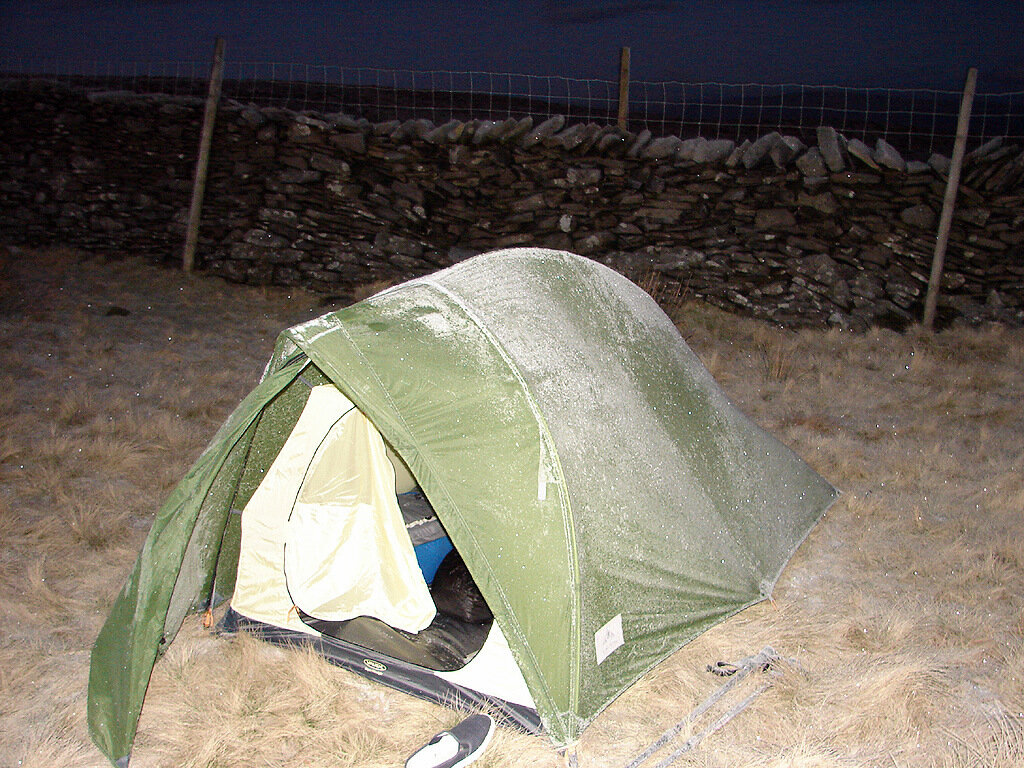
You can see this effect with your own eyes after a light frost. Meteorologists even have a separate name for the situation where there’s frost right above the ground while two metres up the temperature is still above zero: ground frost.7 The ground and the grass have radiated their heat into the sky and cooled down more than the air above them. For the same reason, in the morning dew or frost settles on whatever had the open sky above it all night: on the grass, on a car roof, on top of your sleeping bag.
Wind chill: wind and cold
The forecast gives you the air temperature, but your skin feels what the wind does on top of it. This calculator works out the wind chill with the formula used by the Canadian weather service and shows how quickly exposed skin can get frostbitten in that cold. It’s a warning, not a diagnosis: I cover the symptoms and first aid further down, in the section on frostbite.
Wind chill and frostbite time calculator
The calculator needs JavaScript turned on. The table it uses is below, and you can work out the wind chill by hand with W = 13.12 + 0.6215 × T - 11.37 × V^0.16 + 0.3965 × T × V^0.16, where T is the air temperature in °C, V is the wind in km/h and W is the result.
How it was calculated
Wind will not cool your skin below the air temperature, it only speeds up how fast it cools. The wind chill index is given without a degree sign, because it describes how cold the face feels and not a real temperature.
| Index | Risk | Exposed skin freezes in |
|---|---|---|
| 0 to -9 | low Your result | not given |
| -10 to -27 | moderate Your result | not given |
| -28 to -39 | high Your result | 10 to 30 minutes |
| -40 to -47 | very high Your result | 5 to 10 minutes |
| -48 to -54 | severe Your result | 2 to 5 minutes |
| -55 and colder | extreme Your result | less than 2 minutes |
This is an approximation for exposed, dry skin: wet skin cools faster, and the formula was tested on adults. If you feel numbness, your skin turns white or you shiver, see the sections of this article on hypothermia and on frostbite.
Sources: Environment Canada formula, Environment Canada risk bands and range of the formula according to the NWS. The formula holds for air up to 10 °C and wind from 5 km/h.
Sweat and wet clothes
The third route is water, and most often your own sweat. Wet clothing loses a large part of its insulation. A military uniform insulates half as well or even worse once it’s soaked, and sweat that hasn’t had time to evaporate also reduces the insulation of your clothes.4 On top of that, moisture evaporating from your clothes and skin takes heat away by itself.2
That’s why in winter it’s so important not to get sweaty. In the article on how not to freeze on the trail in winter, I wrote that I’ve sometimes walked with my clothes unzipped right down to my T-shirt with the temperature somewhere in the minus teens. The point is to let out the excess evaporating sweat before it soaks your base layer. In my opinion it’s better to be slightly cold for a while on the move than to shiver later at a rest stop in a wet T-shirt.
Water chills you fastest
The most dangerous thing is falling into water, because in water the body loses heat around 25 times faster than in air at the same temperature. The maths is merciless. In air at 10 °C you can sit for 3-4 hours and your core temperature won’t even budge. In water at the same 10 °C, hypothermia can set in after just 1-2 hours.4 Wading through an ankle-deep stream is not a disaster yet, but falling into water up to your waist on a November evening is a sign that you need to change into dry clothes or get to shelter immediately.
Hypothermia: first aid step by step
The order matters. First you stop any further heat loss, then you hand the casualty over to the rescuers, and warming comes last.1 Do everything calmly and gently, without jerking or rushing. If there are several of you, you can do the steps below at the same time.
1. Call for help
If you suspect hypothermia, call for help, and if there’s any impairment of consciousness, don’t hesitate for a second. Don’t leave the cold person alone if you don’t have to, and keep talking to them so they don’t fall asleep.3 The emergency number is 112, and in the Polish mountains you can call the mountain rescuers directly on 985 or 601 100 300.8
2. Shield from the wind and insulate from the ground
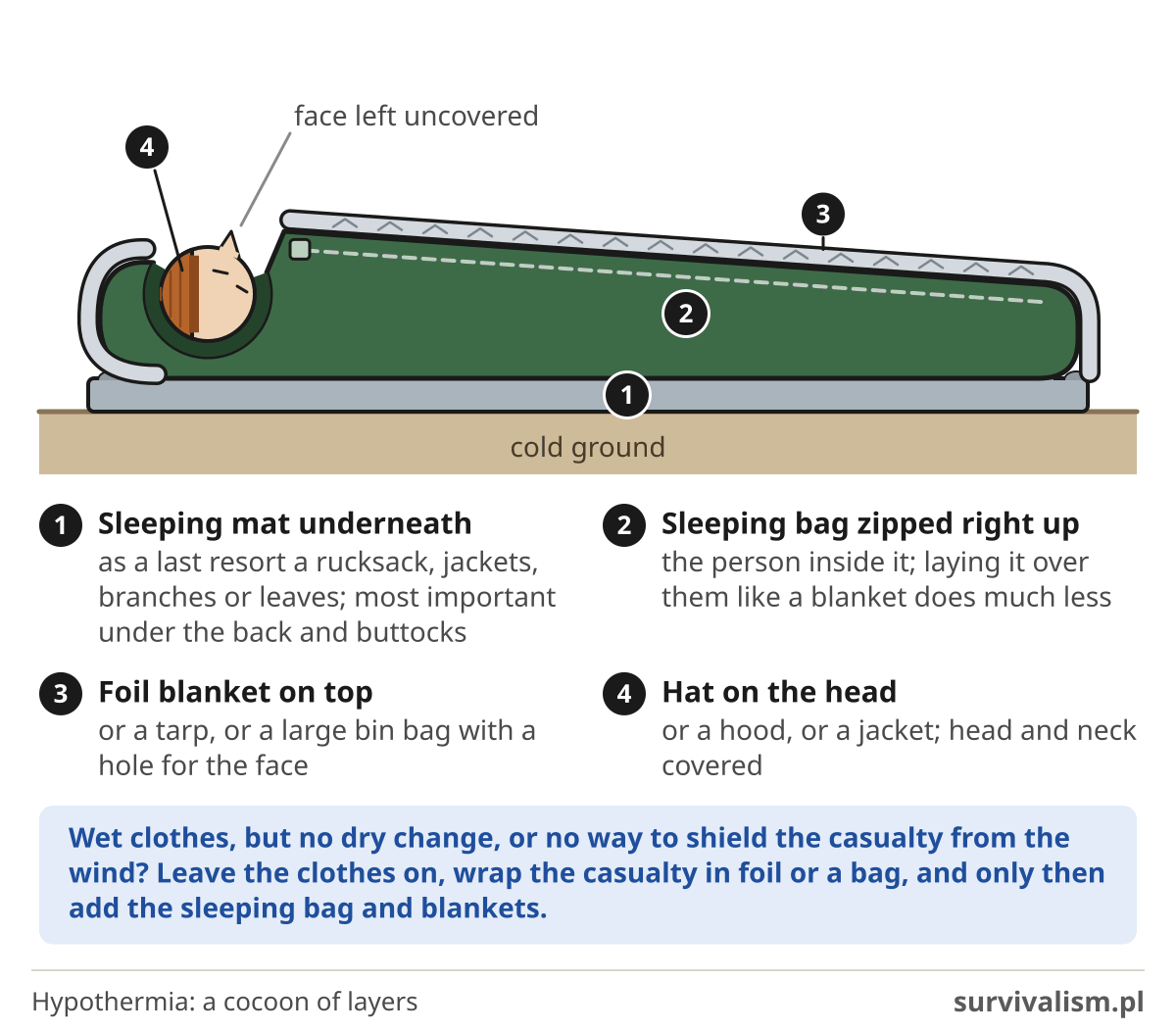
Move the casualty to a spot sheltered from the wind, or shield them from it with whatever you have to hand, for example rucksacks or a tarp.9 Don’t walk someone who is drowsy or confused along by the arm. Instead, carry them lying down or shield them where they are (I explain why below, under afterdrop). Put underneath them anything that will cut them off from the cold ground. A sleeping mat is best, and as a last resort a rucksack, jackets, branches or leaves.4 The back and buttocks lose the most heat, so that’s where insulation matters most.10
3. Wet clothes: take them off or leave them on?
Take wet clothes off once the casualty is sheltered from the wind and you have something to cover them with, and replace them with dry ones straight away.9 Ideally cut them off with a knife or scissors instead of pulling them over the head and bending the person’s arms. If you have no dry change of clothes or can’t shelter them from the wind, leave the wet things on and wrap them in a waterproof layer, for example foil or a bin bag. That way you limit evaporation, and the insulation you put on top won’t get soaked from the inside.2
4. Wrap them up like a cocoon
A sleeping bag works when the person is inside it and the zip is done up all the way. Laying a sleeping bag over them like a blanket gives much less. Over the sleeping bag or blankets goes a vapour-tight layer, that is a foil emergency blanket, a tarp or a large bin bag with a hole cut out for the face. Cover the head and neck with a hat, a hood or even a jacket, because the face stays uncovered for breathing anyway.2
A foil blanket Amazon store, affiliate link, opens in a new tab fits in a jacket pocket, which is why in my opinion it should be in every rucksack in winter. On top of the sleeping bag it protects the bag from wind and moisture, and underneath it protects it from the casualty’s wet clothes.
5. A warm, sweet drink and food
Shivering is a good sign. Strong shivering can increase heat production 5-6 times and raise core temperature by 3-4 °C per hour, provided the person is well covered and the body has the fuel to produce that heat.2 That’s why you should give someone who is conscious and can swallow on their own a warm (not hot) sweet drink and something to eat, ideally with plenty of carbohydrates. Don’t pour anything into the mouth of someone who is drowsy, confused or unconscious.3
Tea with plenty of sugar or honey works brilliantly.10 I often take a flask of Yerba Mate on winter outings, but for helping someone who is hypothermic, heavily sweetened tea is the better choice. A snack bar or a handful of sweets in your jacket pocket is also a good idea, because they’re right there when you need them.
6. External heat on the trunk only
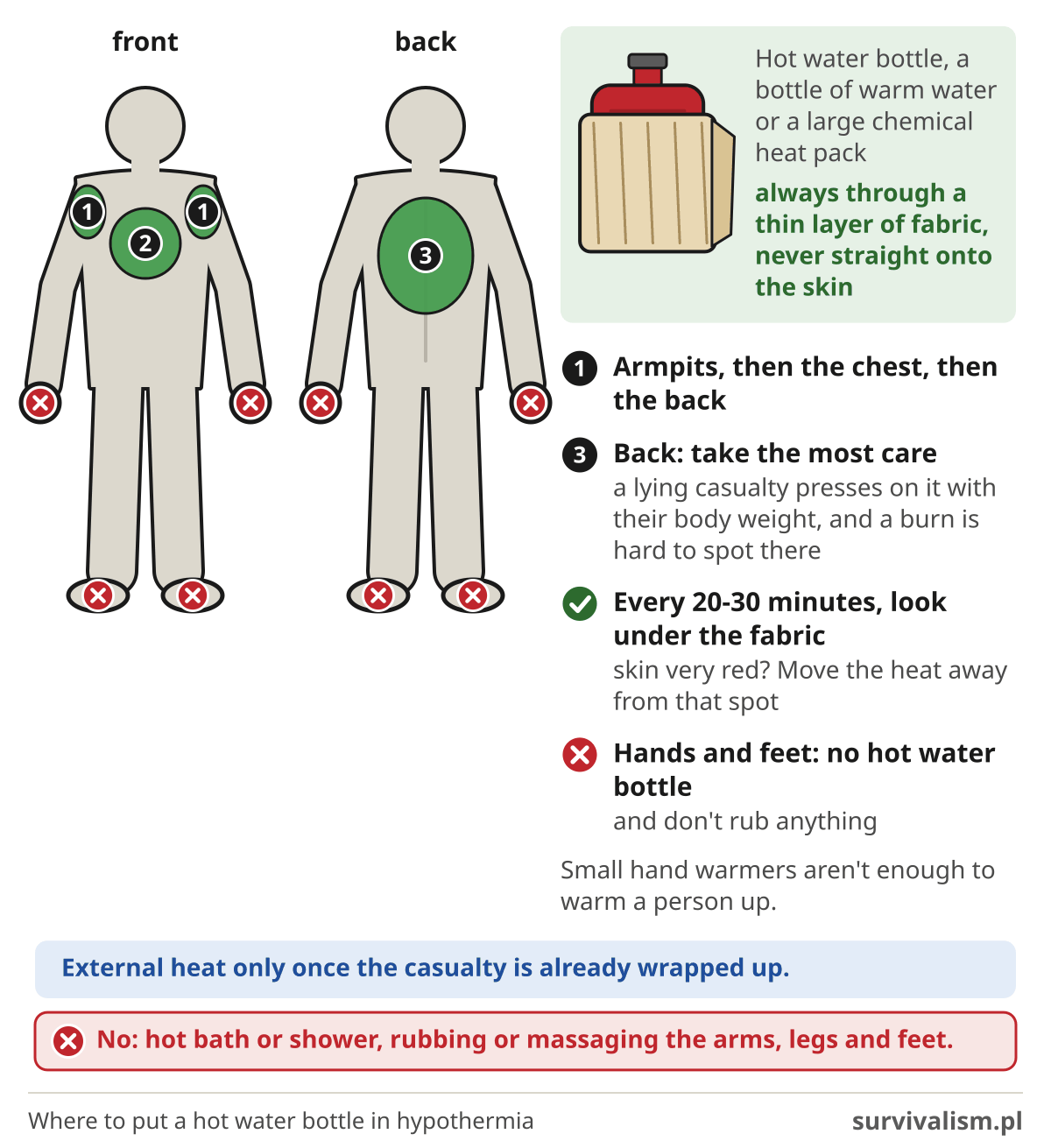
Once the casualty is wrapped up, you can help them with heat from outside. Place a hot water bottle, a bottle of warm water or a large chemical heat pack on the armpits, chest and back, in that order, always through a thin layer of fabric and never directly on the skin. Cold skin burns easily, and there have been burns even from a hot water bottle filled with lukewarm water placed straight against the body. So every 20-30 minutes look under the fabric and check whether the skin is very red, and if it is, move the heat source away from that spot. Be most careful with the back, because a person lying down presses on it with their body weight, and a burn is hard to spot there. Small hand warmers aren’t enough to warm a person up.2
Don’t warm the hands and feet first and don’t rub anything, more on that below. Warming with another person’s body in one sleeping bag doesn’t speed up rewarming any more than shivering alone, but in mild hypothermia it improves comfort, so you can use it as long as it doesn’t delay the descent or evacuation.2 And when the rescuers are close, wrapping the person up well and protecting them from further heat loss until they arrive matters more than fast rewarming.1
7. If they’re unconscious
Place an unconscious person who is breathing in the recovery position, but turn them slowly, without sudden movements.10 Check calmly for breathing and a pulse for a full minute, because in deep hypothermia they can be very weak and slow. If you can’t find them within that minute, start resuscitation and call 112 if you haven’t done so already. Don’t give up too early, because the lowest body temperature at which circulation has been successfully restored is 11.8 °C.1
8. After warming up, don’t set off straight away
If your cold mate has warmed up in the sleeping bag, eaten and is himself again, don’t jump straight up and start walking. Give him about half an hour in the warmth, with food and drink, and watch how he feels before you move on. Then let him get up calmly first, and start walking slowly, picking up the pace gradually.2 If you don’t see any improvement after that time, in my opinion there’s no point waiting and you need to call for help.
What not to do, and what afterdrop is
With hypothermia it’s easy to do harm in good faith. Don’t do any of these things:
- don’t put a hypothermic person into a hot bath or under the shower, even if the hypothermia looks mild;23
- don’t rub or massage their hands, arms, legs or feet;3
- don’t stand a more severely hypothermic person on their feet, don’t walk them along by the arm and don’t move their limbs;
- don’t put a hot water bottle, fire or radiator directly against the hands and feet.
Most of these don’ts share a common reason, which rescuers call afterdrop. Cold blood pools in the arms and legs of a hypothermic person. Movement, getting upright, massage or hot water suddenly open the way for it, and the cold blood flows back to the heart, which is extremely sensitive in deep hypothermia. In hypothermic people, a further drop in core temperature of as much as 5-6 °C has been described, and the heart can then go into dangerous rhythm disturbances.2
Keep a severely hypothermic person horizontal and handle them like a raw egg. Someone who is just cold, talks normally and changes their own clothes can be encouraged to move. No one with moderate or severe hypothermia should walk on their own.
How do you survive a cold night in the woods?
The best first aid is the kind you never have to give. If you’re sleeping out in the woods in late autumn or winter, a good bed and a few habits will do most of the work for you. You can read more about preparing for your first night out in the article on how to spend a night in the woods. During my first night in the woods I didn’t sleep a wink, but as it happens not because of the cold, only because of a dog barking somewhere in the distance and other forest noises 😉
First, what’s underneath you
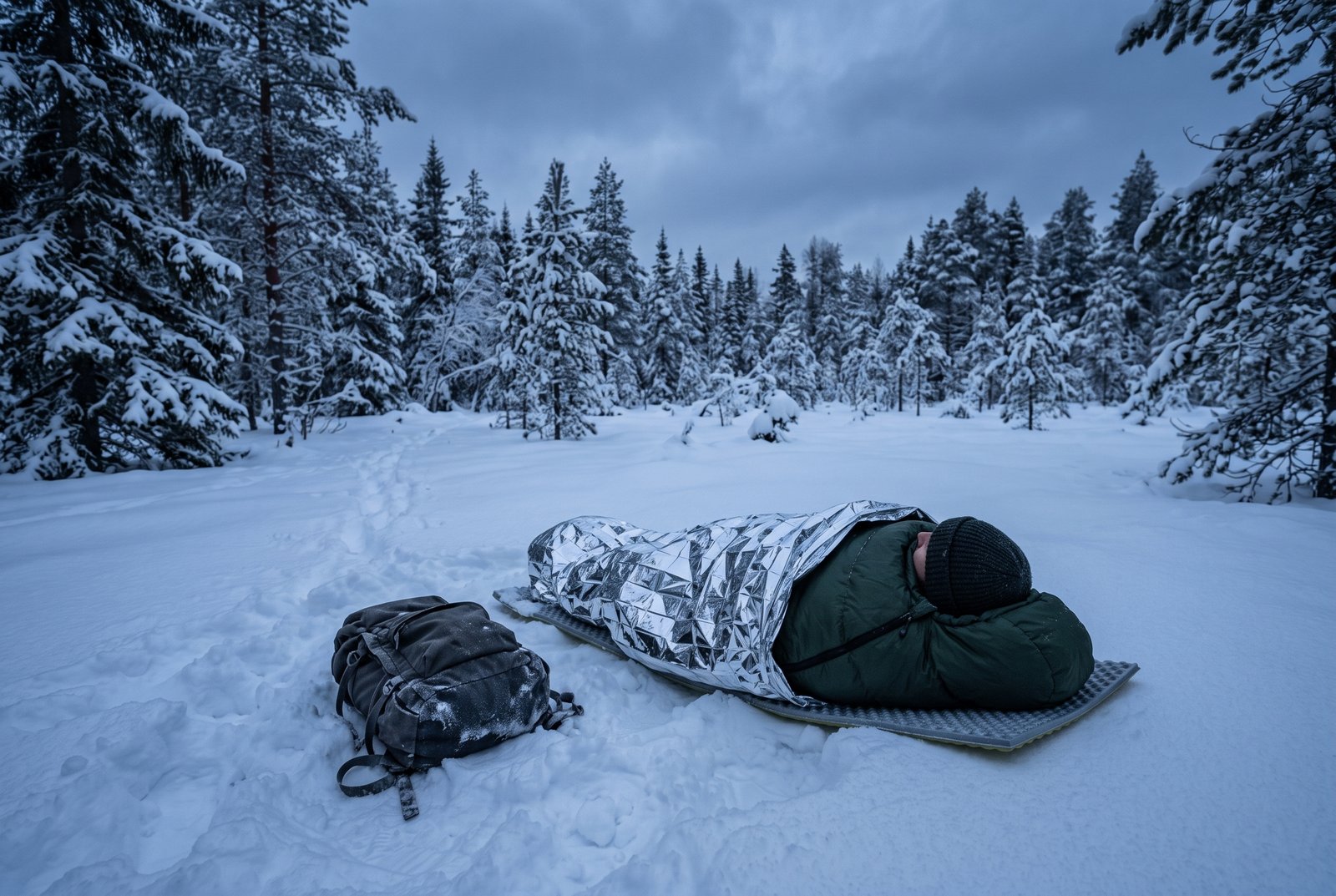
When you sleep on the ground, a large part of your heat escapes downwards, into the ground.2 A sleeping bag squashed flat under your body weight barely insulates underneath, so whether the night is bearable depends mainly on your sleeping mat. Without any kit, branches and leaves will save you.4 A layer of them under you will get compressed overnight, so in my opinion it’s not worth skimping on material.
Sleeping mats are now described by their R-value. The higher it is, the better the mat insulates, and the values of two mats placed one on top of the other add up. R 1-2 is generally considered enough for summer and 2-4 for three seasons. From around 4 you get into the year-round range, winter included, and above 6 you’re looking at mats for bitter frosts. For example, an inflatable mattress with R 4.2 placed on a foam mat with R 2.0 gives 6.2 in total, which is already in the bitter frost range.11
In winter two layers work well: a foam mat Amazon store, affiliate link, opens in a new tab at the bottom and an inflatable mattress on top. Foam doesn’t need inflating, so even if the mattress fails, you won’t end up on bare ground.
Shield yourself from the sky and stay out of valley bottoms
On a clear, still night, two simple things make a difference. The first is something over your head. A tarp, the dense crown of a spruce or even a little roof of branches shields you from the cold sky and sends some heat back to you itself, much like clouds do. That’s why in the morning there’s usually less frost under a dense tree than in an open clearing. If you have a tarp, put it up even when there’s no rain in the forecast.
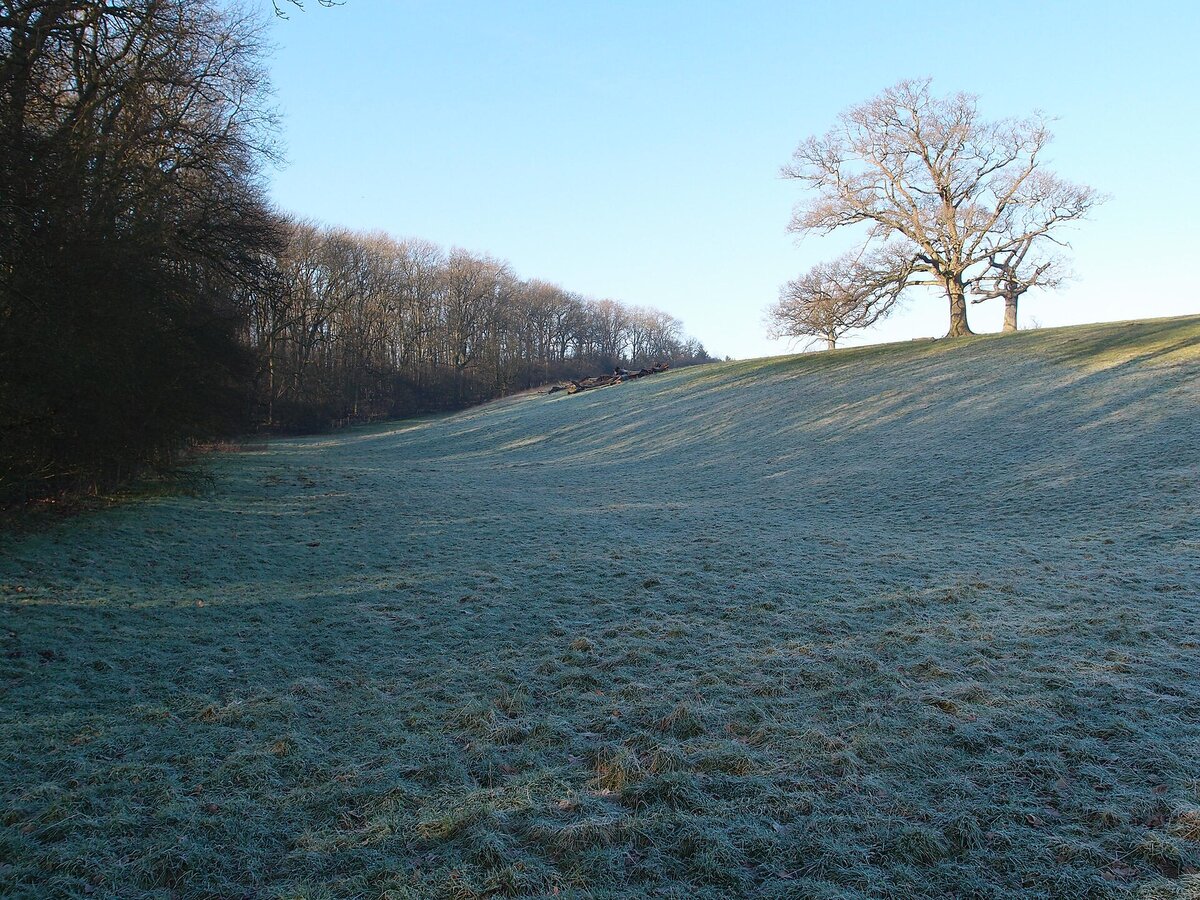
The second is choosing your spot. Air chilled near the ground is heavier, so it flows down the slopes and collects at the bottom of valleys and in hollows.12 Places like this are called frost hollows or frost pockets. A clearing in a dip, a meadow by a stream at the bottom of a valley or a hollow between hillocks can be colder on a clear night than a spot a little higher up the slope. It’s better to walk a few minutes uphill than to lie all night in a lake of cold air.
Dry clothes just for sleeping
Don’t get into your sleeping bag in sweaty base layers, because damp clothing loses a lot of its insulation.4 A spare T-shirt and socks that you put on only for sleeping weigh very little and make a big difference. Zip the sleeping bag up all the way and pull the hood on. The head doesn’t lose more heat than other parts of the body, but in a sleeping bag it’s usually the only uncovered part, so a hat for the night makes sense. On the trail in strong wind I wear a hat under my hood, and that double system has worked for me many times.
Eat something before bed
In winter the body usually needs 10-40% more calories than normal, and soldiers are taught to snack right before going to sleep as well.4 If you normally eat around 2,500 kcal a day, outdoors in winter you may need from 2,750 to 3,500 kcal. Shivering at night also needs fuel, and an empty stomach won’t supply it.2 In my opinion a hot meal before bed and a flask Amazon store, affiliate link, opens in a new tab of hot, sweet drink for the night are the simplest way not to wake up every hour from the cold.
 Amazon store, affiliate link, opens in a new tab
A bottle of warm water in your sleeping bag
Before going to sleep, you can slip a tightly closed bottle of warm water, wrapped in a sock or a T-shirt, into your sleeping bag. That’s a way to a warm bed for someone who is healthy. But if someone starts to shiver and become dazed during the night, the same bottle doesn’t go by their feet but under their armpit or on their chest, through fabric, exactly as in step 6 of the first aid.2
Frostbite: symptoms and first aid
How do you recognise frostbite?
Frostbite happens at temperatures of 0 °C and below, most often on the fingers and toes, nose and ears. It starts with cold, numb skin, red or pale. As the frostbite deepens, the skin becomes hard, white, blue or blotchy, swells and loses feeling, and then blisters filled with clear fluid or with blood may appear. In that situation, and also whenever you see symptoms of hypothermia alongside frostbite, call for help.13
The mildest form, known in English as frostnip, is not yet frostbite, just frost on the skin of the cheeks, ears or nose. It passes quickly once warmed and leaves no lasting marks. Remember that numbness is a warning, and losing feeling does not mean things are getting better.14
How do you warm frostbitten fingers?
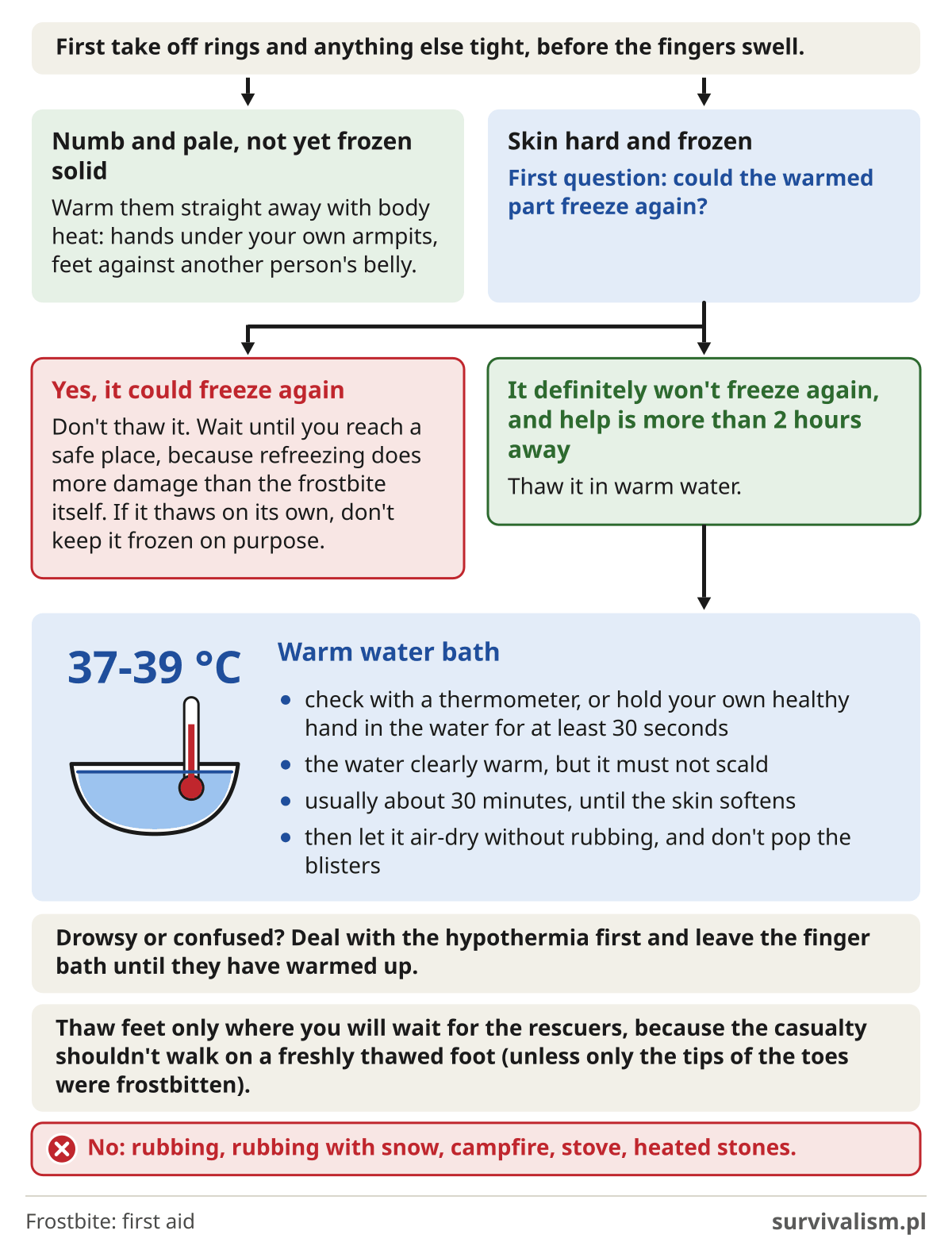
Take off rings and other tight items before the fingers swell. Warm numb and pale fingers that haven’t yet frozen solid straight away with body heat, which means putting your hands under your own armpits, while feet can be rested against another person’s belly. If the skin is already hard and frozen, the rule described below applies. Don’t rub the frostbitten area and don’t rub it with snow, although that method still lingers in a lot of people’s heads. Don’t warm it by a campfire, a stove or on heated stones either.14
When should you thaw in warm water?
The most important rule goes like this. If there’s a risk that the warmed part will freeze again, don’t thaw it, but wait until you reach a safe place, because refreezing does more damage than the frostbite itself. At the same time, don’t deliberately keep it frozen if it thaws on its own. If help is more than 2 hours away and the fingers definitely won’t freeze again, immerse them in water at 37-39 °C. But if the casualty is drowsy or confused, deal with the hypothermia first and leave the finger bath until they’ve warmed up. Check the temperature with a thermometer, and if you don’t have one, hold your own healthy hand in the water for at least 30 seconds. The water should be clearly warm, but it must not scald. Rewarming usually takes about 30 minutes, until the skin softens. Then let it dry in the air without rubbing, and don’t pop the blisters. The casualty shouldn’t walk on a freshly thawed foot any more (unless only the tips of the toes were frostbitten), so only thaw feet in water where you’ll be waiting for the rescuers.14
For the pain you can give paracetamol or ibuprofen, but don’t give aspirin to a child under 16.13
Myths about the cold that we still believe
“Half your body heat escapes through your head”
This myth came from a military study in which people sat out in the freezing cold in Arctic suits, but without hats. No wonder the heat escaped mainly through the only uncovered part of the body. If the same study had been done on people wearing nothing but swimming trunks, no more than 10% of the heat would have escaped through the head, because every uncovered part of the body cools you down in proportion to its surface area.15 In a study involving immersion in cold water, the head, which makes up about 7% of the body’s surface area, increased total heat loss by only 10%. What’s interesting is that the rate at which the core cooled rose by as much as 42% on average.16
So do put a hat on, but not because the head is some kind of magic chimney. An uncovered head is simply an uncovered part of the body, and in winter usually the only one.
“A shot of vodka will warm you up”
Alcohol widens the blood vessels in the skin, so it gives a brief feeling of warmth, but at the cost of losing heat from the core faster. It also suppresses shivering and the feeling of cold, which means it switches off the two most important alarms you have.4 Don’t give a hypothermic person alcohol in any form.3 Take a vacuum flask on a winter trip, not a hip flask.
“A foil blanket keeps you warm”
Neither a blanket nor foil produces heat, they only stop it escaping. A hypothermic person will warm up under them when they are producing heat themselves by shivering or getting it from outside, for example from a hot water bottle.9 In my opinion a foil blanket works best as a windproof and vapour-tight layer over a sleeping bag, jackets or a blanket, which is exactly where rescuers put it.2 Wrapping someone in wet clothes, lying on bare ground, in nothing but foil isn’t enough.
Final thoughts
To finish, if I had to sum everything up in one sentence, I’d put it like this: first stop the heat escaping, and only then warm the person up. Shelter from the wind, something under the back, dry clothes, a zipped sleeping bag, foil on top, sweet tea for someone who is conscious and heat at the trunk, not at the hands. And all of it calmly, without jerking.
I didn’t write this to scare you. Winter forests and mountains are beautiful, and in the vast majority of cases hypothermia can be avoided with dry base layers, a good sleeping mat and a bit of common sense. Still, it’s worth knowing what to do before you need to, because with a hypothermic mate on the trail there won’t be time to read guides.
And you, have you ever got really cold outdoors, or helped someone who had? What helped? Let me know in the comments, I read them all. See you on the trail!
Sources
- European Resuscitation Council, “European Resuscitation Council Guidelines 2025: Special Circumstances in Resuscitation”, Resuscitation 215 (2025) 110753: sofia.medicalistes.fr (PDF)
- Wilderness Medical Society, “Clinical Practice Guidelines for the Out-of-Hospital Evaluation and Treatment of Accidental Hypothermia: 2019 Update”, Wilderness & Environmental Medicine 30 (2019): sonar.rero.ch (PDF)
- NHS, “Hypothermia”: nhs.uk/conditions/hypothermia
- US Army, “TB MED 508: Prevention and Management of Cold-Weather Injuries”, 2005: usariem.health.mil (PDF)
- National Weather Service (Houston/Galveston), “Atmospheric Controllers Of Local Nighttime Temperature”: weather.gov (training material)
- M. Luciuk, “Night Radiative Cooling: The effect of clouds and relative humidity”: asterism.org (PDF)
- IMGW-PIB (Institute of Meteorology and Water Management, Poland), agrometeorological service, “Przymrozki” (in Polish): agrometeo.imgw.pl/przymrozki
- GOPR (Polish mountain rescue), “Co warto zabrać w góry?” (in Polish): gopr.pl/poradnik/co-warto-zabrac-w-gory
- European Resuscitation Council, “European Resuscitation Council Guidelines 2025: First Aid”, Resuscitation 215 (2025) 110752: sofia.medicalistes.fr (PDF)
- Serwis Zdrowie PAP, T. Sanak, “Hipotermia: jak skutecznie pomóc” (in Polish): zdrowie.pap.pl/pierwsza-pomoc/hipotermia-kiedy-bezpieczna-pozycja-boczna-nie-jest-bezpieczna
- Therm-a-Rest, “The Ultimate Guide to Therm-a-Rest Sleeping Pads”: cascadedesigns.com/blogs/thermarest-gear/ultimate-guide-sleeping-pads
- Met Office, “Why frost can still occur in late Spring”: metoffice.gov.uk/blog/2026/why-frost-can-still-occur-in-late-spring
- NHS, “Frostbite”: nhs.uk/conditions/frostbite
- Wilderness Medical Society, “Clinical Practice Guidelines for the Prevention and Treatment of Frostbite: 2019 Update”, Wilderness & Environmental Medicine 30 (2019): static1.squarespace.com (PDF)
- Indiana University School of Medicine, “Medical myths for the holiday season: true, false or unproven?” (on the article by R. Vreeman and A. Carroll in BMJ 2008;337:a2769): medicine.iu.edu/news/2008/12/medical-myths-for-the-holiday-season-true-false-or-unproven
- T. Pretorius et al., “Thermal effects of whole head submersion in cold water on nonshivering humans”, Journal of Applied Physiology 101 (2006): europepmc.org/article/MED/16614357
Leave a comment